
Let me say something that sounds obvious, but people still ignore it:
A crypto trading bot is not a money printer.
It’s a discipline printer.
If your rules are good, it executes them without emotion.
If your rules are bad, it executes them without mercy.
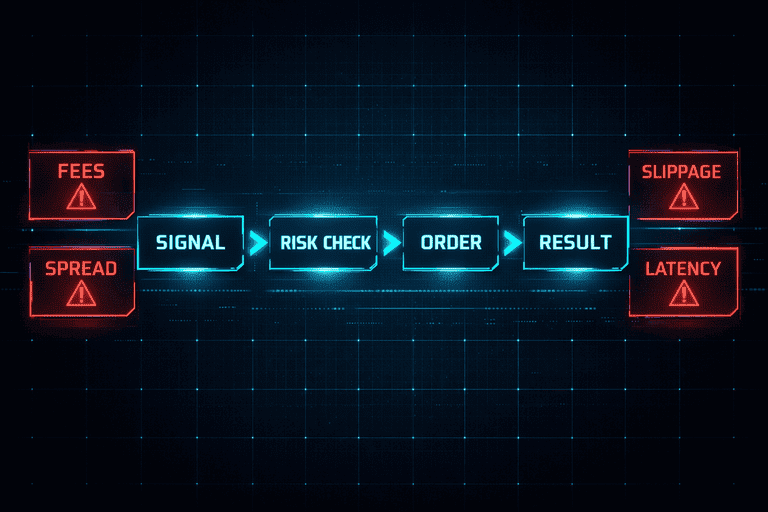
That’s why bots look “amazing” in screenshots and then quietly destroy accounts in real life. Not because bots are evil — because traders underestimate the boring stuff: fees, spread, slippage, volatility regimes, and execution quality.
In this guide, I’m going deep. Not “what is a bot” deep — trader deep.
What is a crypto trading bot (the real definition)
A crypto trading bot is simply a system that does three things automatically:
-
Reads market data (price, volume, indicators, order book, funding, etc.)
-
Makes a decision based on rules (if X then buy, if Y then exit)
-
Places orders through an exchange (usually via API)
That’s it. No magic.
Some bots are fully automatic. Some are “semi-auto” where the bot sends alerts and you confirm. For many traders — especially scalpers — that second option is actually the smarter first step.
If you want signals but still want control, this is the clean approach.
The 6 bot types you’ll see everywhere (and what they’re actually good for)
1) Grid bots (range farming)
These place a ladder of buy and sell orders inside a range.
When it works: market is choppy and returns to the middle.
When it fails: strong trend breaks the range and keeps going.
Grid bots are not “free money.” They’re basically a strategy: bet on mean reversion.
2) DCA bots (slow, steady exposure)
This is the “I want less stress” bot. It buys (or sells) on a schedule or on dips.
When it works: you’re not trying to time tops and bottoms.
When it fails: people mix it with leverage or panic-stop it at the worst time.
3) Trend bots (MA/EMA based, breakout style)
These follow momentum using moving averages, breakouts, volatility filters, etc.
When it works: clean trend.
When it fails: chop. Chop kills trend bots.
If you don’t understand EMA behavior, don’t automate it.
4) Mean reversion bots (fade extremes)
These buy oversold and sell overbought, sometimes using RSI, sometimes just range logic.
When it works: stable ranges.
When it fails: strong trending markets (it keeps fading and getting run over).
RSI can work — but only with rules that respect the market regime.
5) Arbitrage bots (advanced)
They try to capture price differences between exchanges.
When it works: you have infrastructure + capital + speed.
When it fails: fees + latency + withdrawals + “by the time you move funds, the gap is gone.”
Most people should not start here.
6) Signal bots (indicator-based / AI-based)
This is the popular category: “bot follows signals.”
It can be good — but only if you understand something critical:
A signal is not a trade.
Execution + costs decide whether it becomes profit or pain.
Even with signals, you still need a quick condition check.
Why most crypto trading bots fail (the honest list)
People blame bots. I blame assumptions.
1) Fees are ignored
Bots trade frequently. Even “small fees” compound fast.
If your bot trades 10–50 times a day, you’re basically running a fee machine unless your edge is real and your venue is good.
This is the cost scalpers underestimate the most.
2) Spread silently drains the edge
Spread is not just a concept — it’s the price of urgency.
If your bot enters with market orders and exits with market orders, spread gets paid twice.
Spread is a tax you pay on almost every bot trade.
3) Slippage turns “good backtests” into bad live results
Backtests usually assume perfect fills. Real markets don’t care.
This is why 1-minute bots break in real conditions.
4) Latency makes your bot late (and late is expensive)
If your data comes late or your order reaches the exchange late, you don’t get the trade you planned. You get a worse version of it.
Latency is the invisible reason ‘the bot is wrong’.
5) No regime filter (trend vs chop vs chaos)
A bot that trades the same way in every regime will eventually get smoked.
This is the part traders hate because it means you need rules for:
-
normal market
-
high volatility market
-
dead market
-
news spikes
-
liquidation cascades
Volatility changes the rules. Bots must adapt.
6) No kill switch
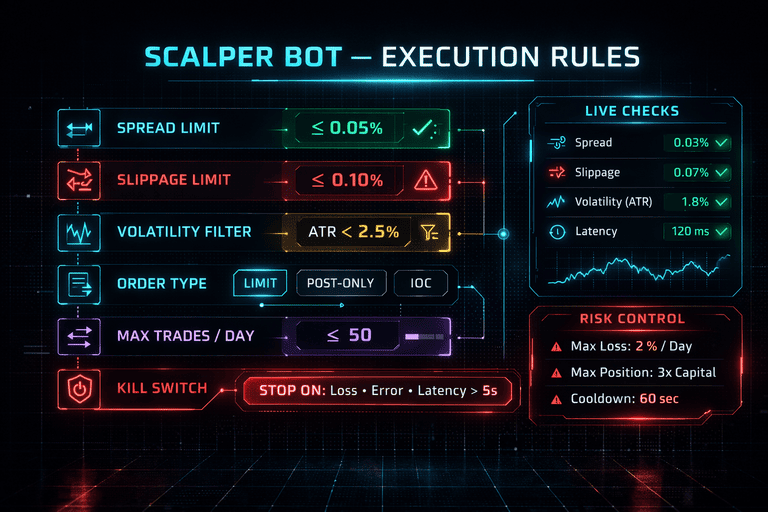
A proper bot setup has:
-
max loss per day
-
max trades per day
-
max position size
-
circuit breaker (pause if spread/slippage explodes)
-
sanity check (pause if data feed is broken)
Without these, you’re just letting a script swing a knife around your account.
If you automate anything, automate risk first.
The bot setup that actually makes sense for scalpers
If you’re a 1-minute scalper (or any fast trader), here’s the safest way to think about bots:
Step 1: Use the bot as a filter, not as a gambler
Let the bot answer questions like:
-
Is volatility too high right now?
-
Is spread too wide?
-
Is liquidity dead?
-
Is the session good?
-
Is funding skewed?
-
Is the trend clean or choppy?
Then you trade, or you let a semi-auto execution layer place the order.
This gives you the best of both worlds:
-
consistency from the bot
-
discretion from you
Your ‘when’ matters as much as your ‘how’.
Dead hours + bots = death by a thousand cuts.
Step 2: If you go full auto, automate execution rules properly
If you’re going full-auto, don’t just do “if RSI < 30 buy.”
A scalper bot needs execution rules like:
-
use limit orders when conditions are calm
-
use IOC orders when speed matters but price must be capped
-
use post-only when you want maker fills
-
never place market orders if spread exceeds a threshold
-
reduce size if depth is thin
Post-only is the ‘maker discipline’ switch.
IOC is for urgent fills without infinite slippage.
“Should I use a crypto trading bot?” — here’s my straight answer
Yes, if your goal is one of these:
-
reduce emotional mistakes
-
enforce risk rules
-
filter bad conditions
-
execute consistently
No, if your goal is:
-
“make money while I sleep” with no system
-
“beat the market” without understanding costs
-
“find a bot that always wins”
A bot is a multiplier:
-
good process → better consistency
-
bad process → faster losses
Choosing an exchange matters more than choosing a bot (for scalpers)
If your exchange has:
-
wide spreads
-
slow execution
-
unreliable cancels
-
unstable during volatility
…your bot will look “broken” even if the logic is decent.
If you scalp, exchange choice is part of the strategy.
Tight spreads are what make small targets possible.
My top exchanges for scalping (fees + spreads + execution).
Common bot myths (quick and painful)
“Bots always beat humans”
No. Bots just execute rules consistently. If the rules are average, the results are average.
“Backtests prove it works”
Backtests often ignore fees, spreads, and real fills. Live trading is where reality shows up.
“AI bots are smarter”
AI can help with signals, but execution costs still exist. AI doesn’t remove spread.
FAQ: Crypto Trading Bot (Big)
Are crypto trading bots legal?
Usually yes, but exchanges have API rules, rate limits, and terms. Some bot behaviors can get throttled or flagged. Always follow the exchange’s rules.
Can a crypto trading bot be profitable long-term?
It can be, but only if the strategy has an edge after costs. Many bots look good until you include fees, spread, slippage, and volatility spikes.
What’s the safest bot for beginners?
A DCA bot or an alert bot with manual confirmation. Full auto scalping bots are the riskiest starting point because execution costs are brutal.
Do bots work better in bull markets?
Many bots “look better” in trending markets because trends hide mistakes. The real test is sideways chop, where costs and fakeouts chew systems apart.
What’s the #1 reason scalping bots fail?
Execution costs. Tiny targets + frequent trades + spread/slippage/fees = edge gets eaten.
Is it better to use bots on spot or futures?
Spot is simpler. Futures adds funding, liquidation risk, and faster failure if risk controls are weak. If you go futures, you need strict risk rules.
How do I know if my bot is losing because of the strategy or execution?
If the entries are “right” but results are consistently worse than expected, check: spread, slippage, latency, and order types. Strategy and execution are separate problems.
Should I run multiple bots at once?
Only if you can measure them separately and they don’t fight each other. Most people run too many and can’t diagnose anything.
What’s a simple “kill switch” rule I should have?
A basic one: pause trading if daily loss hits a threshold, or if spread/slippage exceed your normal range, or if the exchange feels laggy during volatility.
Can I use your tools to support bot trading?
Yes — the cleanest approach is using tools as filters: check volatility, timing, sentiment, spreads, and only allow trades when conditions are good.