
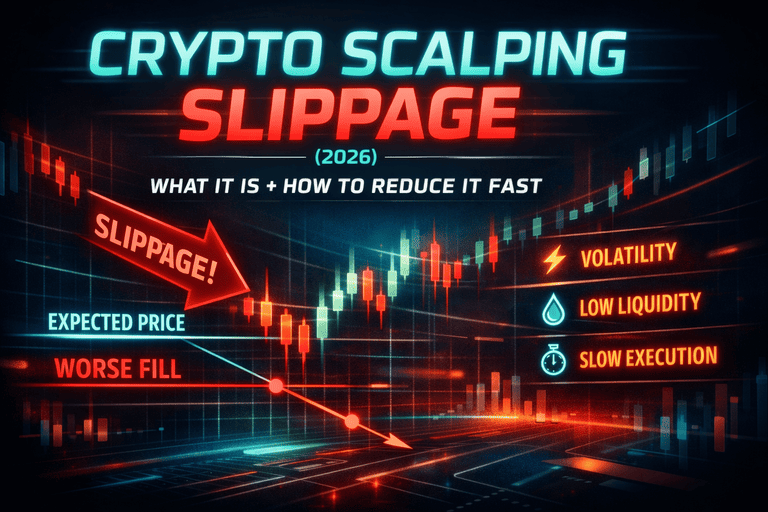
If you scalp crypto on low timeframes, slippage isn’t a “small detail.” It’s a silent performance tax that can turn a good setup into a meh trade — or a meh trade into a straight-up donation.
Slippage is basically the difference between the price you think you’ll get and the price you actually get. And on 1-minute scalps, that difference matters a lot more than most traders realize, because your targets are small and your trade count is high.
In this guide, you’ll learn:
-
what slippage is (with clear examples)
-
why it shows up more in crypto than people expect
-
how to measure it properly
-
the practical ways to reduce it without missing every trade
What is slippage in crypto scalping?
Slippage is the gap between:
-
the expected execution price (what you clicked / what your order was based on), and
-
the actual fill price (where you truly got executed).
It can happen on entries and exits.
Two types of slippage you’ll feel as a scalper
-
Negative slippage (the painful one): You buy higher than expected or sell lower than expected.
-
Positive slippage (the rare “nice surprise”): You get a better fill than expected.
In fast markets, negative slippage is way more common, especially when liquidity is thin or volatility spikes.
Why slippage is extra brutal for 1-minute scalpers
If you’re targeting small moves, slippage eats a huge percentage of your edge.
Example (simple and real):
-
Target per trade: 0.20%
-
Average slippage: 0.05% (entry + exit combined)
-
That’s 25% of your target gone… before fees.
Now multiply by 30–100 trades a week and you’re basically paying a subscription fee to the market.
Fees aren’t your only cost — slippage is the hidden one.
The 7 biggest causes of slippage in crypto
1) Low liquidity (thin order books)
If there aren’t enough limit orders sitting on the book, your market order (or aggressive limit) chews through levels and fills worse.
2) Wide bid–ask spread
Even with “no slippage,” the spread is already a built-in loss at entry/exit. When spreads widen, slippage often tags along.
3) Sudden volatility spikes
News, liquidations, breakout candles, funding flips — price moves faster than the book can refresh and Volatility changes the rules for scalpers.
4) Market orders (especially on perps)
Market orders are basically: “fill me now, whatever it costs.”
That’s convenient… and expensive.
5) Stop orders in fast moves
Stops can slip hard because when your stop triggers, it often becomes a market order (or behaves like one).
6) “Fake liquidity” and fast-moving books
Crypto order books can pull and re-post quickly. You see liquidity… then it vanishes the moment you hit the button.
7) Execution delay (latency + platform response)
Even a small delay matters when price is sprinting.
How to measure slippage properly (don’t guess)
Most traders “feel” slippage but never measure it. That’s like trying to lose weight without ever stepping on a scale.
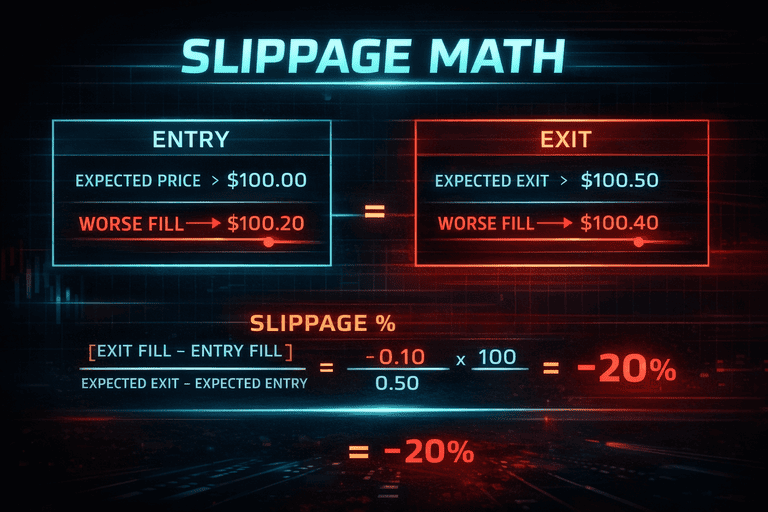
The simple scalper slippage formula
Slippage (%) = (Actual Fill Price − Expected Price) / Expected Price × 100
For a long entry:
-
Expected buy: 100.00
-
Actual fill: 100.06
-
Slippage = (100.06 − 100.00) / 100.00 = 0.06%
For a long exit:
-
Expected sell: 100.20
-
Actual fill: 100.16
-
Slippage = (100.16 − 100.20) / 100.20 = −0.04% (negative because you sold worse)
Total slippage is what you care about: entry + exit combined.
How to reduce slippage without missing every trade
Here’s the part that actually moves your PnL.
1) Prefer limit orders when possible (but be smart)
Limit orders can reduce slippage… but they can also reduce fills. The best approach is not “limit-only,” it’s situational execution.
Best practice for scalpers:
-
Use limit orders in stable conditions.
-
Use market orders only when conditions justify urgency (breakouts, invalidation risk).
2) Use “post-only” when you’re being paid to provide liquidity
Post-only is designed to avoid taking liquidity (and often helps you stay maker).
Scalper logic:
If you’re entering on a pullback or mean reversion, post-only can be a weapon.
(We can later build a dedicated “post-only scalping setup” article that links here.)
3) Trade pairs that behave, not just pairs that “move”
Scalpers love volatility, but clean liquidity beats chaos.
Look for:
-
tighter spreads
-
consistent volume
-
smoother order book depth
Execution quality varies by exchange — and it matters more than you think.
4) Avoid the worst liquidity hours
Some hours are basically “slippage season.”
If the market is quiet and thin, you’ll get:
-
wider spreads
-
weaker fills
-
more random wicks
Quiet hours can quietly destroy scalps.
If you want better fills, timing matters.
5) Don’t size like a maniac in thin books
If your order size is too big relative to liquidity at the top of book, you’ll slip. Simple.
A clean rule:
-
if your market order would “eat” multiple levels, expect slippage
-
reduce size or use staged entries
6) Add a “max slippage” discipline to your system
This is underrated: define the maximum slippage you’ll tolerate per trade.
Example:
-
if slippage > 0.08% combined, you reduce size, skip trade, or switch to limit setup
That’s how you prevent “death by a thousand bad fills.”
7) Use a quick pre-trade check (30 seconds) before you fire
Before you click buy/sell, check:
-
spread (is it wide?)
-
volume (is it dead?)
-
volatility (is it spiking?)
-
session (is liquidity good?)
-
structure (is price whipping?)
Run this 30-second pre-trade check before every scalp.
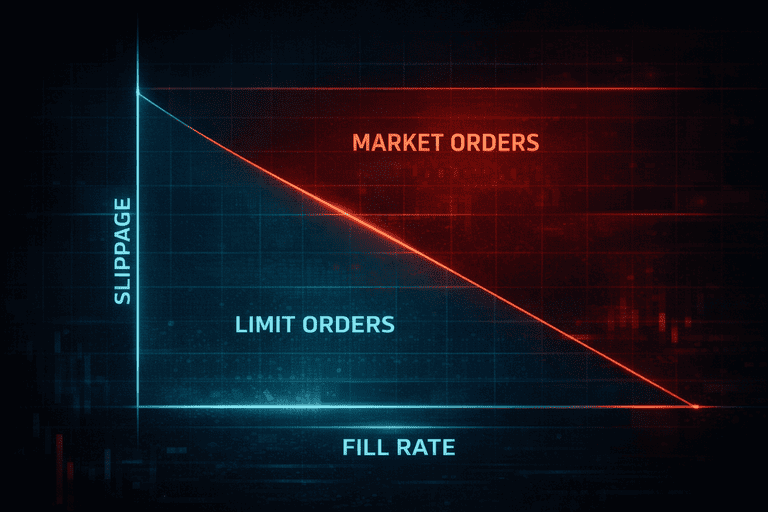
The slippage vs fill-rate tradeoff (the real scalper dilemma)
Every scalper faces this:
-
Market orders: high fill rate, higher slippage
-
Limit orders: lower slippage, lower fill rate
The goal isn’t to “avoid slippage completely.”
The goal is to optimize expected value:
Better to miss 3 trades than to take 10 trades with garbage fills.
That’s not motivational talk — that’s pure execution math.
The fastest way to improve scalping results (without changing strategy)
If you’re already trading a system, the quickest upgrades usually come from:
-
execution (slippage control)
-
fees/spreads (venue selection)
-
timing (liquidity windows)
Not from adding your 18th indicator.
So treat slippage like a KPI:
-
track it
-
set limits
-
adapt order type + size to conditions
Recommended next step
If you want slippage to stop leaking your edge, do this flow:
-
Read this guide (you’re doing it , NICE)
-
Tighten venue selection and execution standards
-
Use a consistent “pre-trade check” workflow
-
Funnel your trading into the best conditions, not “every candle”
See the top exchanges that make scalping cheaper and cleaner (fees + execution).
FAQ
Does slippage only happen with market orders?
No — but market orders are the most exposed. Aggressive limit orders can also slip if price moves away and you chase.
Is slippage the same as spread?
No. Spread is the gap between bid and ask. Slippage is execution moving away from expected. They often show up together, but they’re different problems.
How much slippage is “normal” for scalping?
It depends on pair, exchange, time, volatility, and size. The best approach is to measure your average and set a hard max threshold for your system.
2 thoughts on “Crypto Scalping Slippage (2026): What It Is + How to Reduce It Fast”