
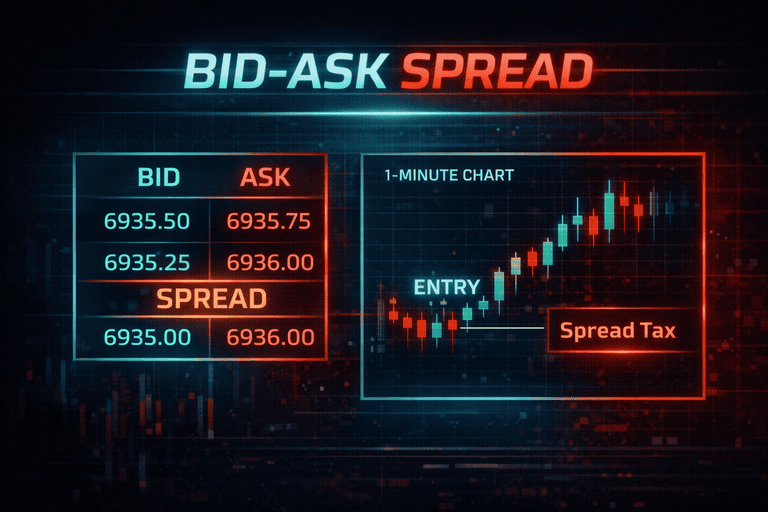
If you scalp crypto, you’re paying the spread on almost every trade. Even when you “get a perfect entry,” the spread can quietly drain your edge — especially on 1-minute charts where your targets are small and your trade count is high.
Spread is one of those things traders ignore until they realize:
“Wait… I’m right a lot, but the account still isn’t growing.”
That’s usually fees + spread + slippage teaming up like three villains in a trench coat.
This guide explains bid–ask spread in scalper terms: what it is, why it widens, how to measure it properly, and how to reduce its damage without killing your fill rate.
What is bid–ask spread (in scalper language)?
The bid is the best price buyers are currently offering.
The ask is the best price sellers are currently asking.
The spread is the difference between them:
Spread = Ask − Bid
When you buy at market, you usually pay the ask.
When you sell at market, you usually hit the bid.
So spread is like a built-in “entry fee” to every trade.
Spread example
-
Bid = 100.00
-
Ask = 100.05
-
Spread = 0.05 (which is 0.05% if price is ~100)
That sounds tiny… until you scalp 50 times a week.
Why spread matters more than almost anything on 1-minute scalps
Scalpers live on small targets, like:
-
0.10%
-
0.20%
-
0.30%
If spread is 0.05% and you pay it twice (enter + exit), you’re down 0.10% instantly — before fees and slippage.
That means on a 0.20% target, spread alone can consume 50% of your edge. Brutal.
Spread is not the same as slippage — but they often hit together.
Fees + spread + slippage is the real cost of scalping.
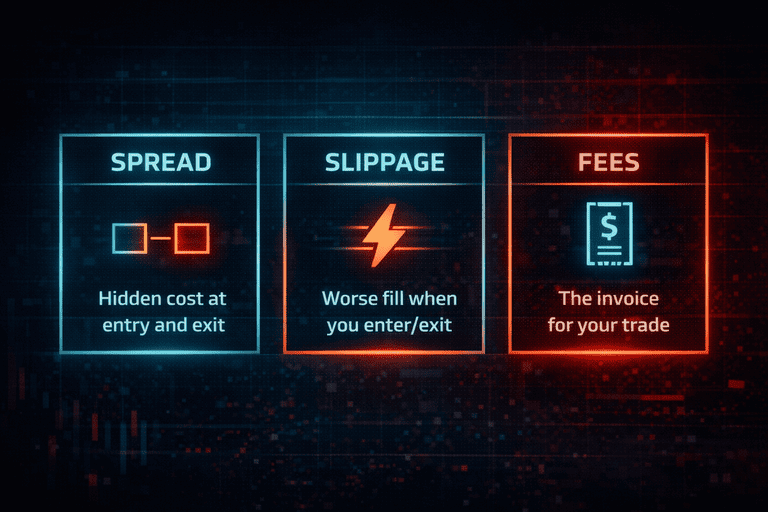
Spread vs slippage vs fees (quick clarification)
These get mixed up constantly:
-
Spread: the gap between bid and ask (always there, changes over time)
-
Slippage: you get filled worse than expected (execution issue)
-
Fees: what the exchange charges (maker/taker)
Spread is a market microstructure cost.
Slippage is an execution event.
Fees are your venue tax.
All three stack.
Why does spread widen in crypto?
Spread isn’t fixed. It expands when liquidity and stability drop.
1) Low liquidity (thin order book)
If there aren’t many limit orders close to price, the top of book is shallow → spread grows.
2) Off-peak hours / quiet market
During dead hours, market makers pull size or widen quotes because they don’t want to get clipped.
Quiet market hours often mean wider spreads.
3) Volatility spikes
When price moves fast, spreads widen because quoting tight is risky.
When volatility spikes, spreads usually widen.
4) Smaller altcoins / meme coins
Many meme coins have:
-
thinner books
-
fewer market makers
-
chaotic price behavior
So spread becomes a constant tax.
5) Exchange-specific market quality
Same coin can have totally different spreads on different exchanges due to:
-
liquidity pools
-
maker programs
-
user flow
-
matching engine behavior
How to measure spread properly (don’t eyeball it)
Spread as a percentage (best for scalpers)
Spread % = (Ask − Bid) / Midprice × 100
Where Midprice = (Ask + Bid)/2
Example:
-
Bid 100.00
-
Ask 100.06
-
Mid 100.03
Spread % = 0.06 / 100.03 = 0.0599%
As a scalper, this number matters because it’s comparable across coins.
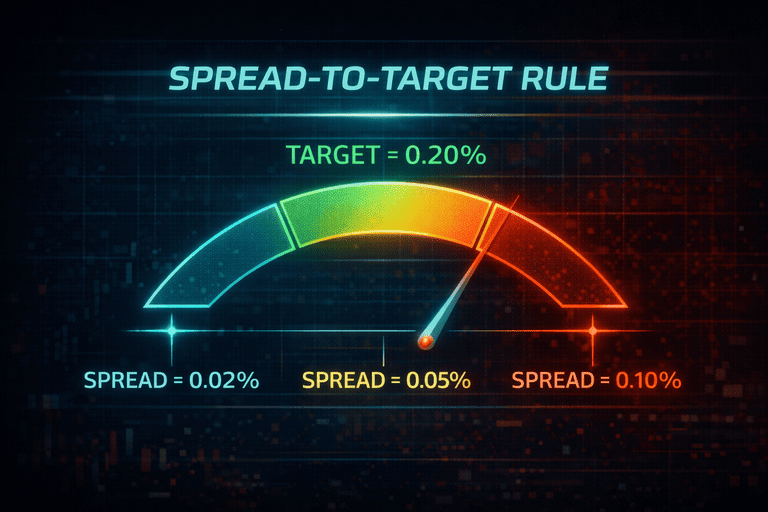
“Spread-to-target” rule (super practical)
If your typical target is 0.20%:
-
Spread 0.02% = ok
-
Spread 0.05% = danger
-
Spread 0.10% = you’re basically playing on hard mode
A clean rule many scalpers use:
If spread is more than 20–25% of your target, skip or change execution style.
The best ways to trade around spread (without losing fills)
This is where you stop bleeding.
1) Use limit orders when spread is wide
If spread is wide and you market in, you’re donating.
Instead:
-
place a limit near bid (for longs) or near ask (for shorts)
-
let price come to you
2) Trade liquid pairs when scalping
For most scalpers, the “boring” pairs win long-term:
-
BTC/USDT
-
ETH/USDT
-
top caps with consistent volume
3) Avoid scalping during low-liquidity sessions
If your goal is tight spreads and clean fills, timing matters.
Trade when liquidity is thick, not when candles are random. Here are best time of day for trading crypto.
4) Reduce size if you’re pushing the book
If your size is large compared to book depth, spread cost becomes worse in practice.
5) Use a quick “spread check” before every scalp
If you make this a habit, you instantly cut bad trades.
Use a pre-trade check to avoid wide spread traps.
Spread traps that look like “good setups”
This is a classic scalper trap:
You see a clean breakout candle.
You click market buy.
Price instantly goes against you.
You think: “Fakeout.”
But often it’s just the spread + your entry cost hitting you immediately.
Spread is why some setups only work on:
-
liquid pairs
-
tight spreads
-
active hours
What spread tells you about the market
Spread is also a signal:
-
Tight spread → healthy liquidity, stable conditions
-
Widening spread → risk rising, uncertainty increasing
-
Suddenly wide spread → news / volatility / thin book
So spread isn’t just a cost. It’s a real-time market quality indicator.
Best next step
If you’re serious about scalping, treat spread like a filter, not a footnote.
Do this:
-
track typical spread % for your pair
-
define a “no-trade spread limit”
-
choose exchanges where spreads + execution are consistently cleaner
See my top exchanges for scalping (fees + spreads + execution).
FAQ: Bid–Ask Spread in Crypto Scalping
What is bid–ask spread in crypto?
Bid–ask spread is the gap between the best bid (highest price buyers are offering) and the best ask (lowest price sellers are offering). It’s the “cost of immediacy” — if you want to get filled instantly, you usually pay it.
Is spread the same thing as slippage?
No.
-
Spread is the visible gap between bid and ask.
-
Slippage is when you get filled worse than expected because price moves or liquidity disappears during execution.
They often happen together, which is why scalpers sometimes blame “slippage” when the spread was the real tax.
Does spread matter if I only use limit orders?
Yes, but it hits differently. With limit orders, you can often avoid paying the full spread by placing your order near the bid/ask and letting price come to you.
The tradeoff is missed fills. Scalping is always a negotiation between price quality and fill rate.
Why does spread widen so much during certain hours?
Spread tends to widen when:
-
the order book is thin
-
volatility spikes
-
market makers reduce size
-
fewer traders are active (quiet sessions)
In dead hours, market makers quote wider to protect themselves from sudden moves and low-liquidity traps.
Why is the spread worse on meme coins and small caps?
Because the market is less efficient:
-
fewer market makers
-
thinner order book depth
-
more “pulling” liquidity
-
more violent wicks
Meme coins can move a lot, but spread often eats so much edge that scalping becomes a grind unless you have a very specific execution approach.
What is a “good” spread for 1-minute scalping?
Instead of a fixed number, use the spread-to-target rule:
If spread is more than 20–25% of your average profit target, it’s usually not worth it.
Example:
-
Target: 0.20%
-
Spread: 0.05%
Spread is 25% of your target → that’s already heavy, before fees/slippage.
How do I calculate spread percentage?
Use the percent version (best for comparing pairs):
Spread % = (Ask − Bid) / Midprice × 100
Where Midprice = (Ask + Bid)/2
This makes spread measurable across BTC, ETH, and low-priced coins.
Why do I instantly go negative right after entering a trade?
In many cases, that’s not “the market turning.”
That’s the spread doing its job.
If you buy at the ask, the mark price might immediately show you down because if you sold instantly you’d hit the bid. That’s normal, but it matters a lot more for scalpers because you’re aiming for small moves.
Is spread different in spot vs futures (perps)?
Yes, it can be. Perps may have:
-
different liquidity than spot
-
different market maker incentives
-
different volatility behavior
Also, funding and liquidation flows can affect microstructure. You should treat spread behavior as pair + venue specific, not universal.
What’s the difference between spread and “market depth”?
-
Spread = gap at the top of the book (best bid vs best ask).
-
Market depth = how much liquidity exists across multiple price levels.
You can have a tight spread but weak depth (still risky for size), or a wider spread but strong depth (less slippage once filled).
Can spread be manipulated?
It doesn’t need manipulation to hurt you — but in thin markets, it can widen quickly because liquidity providers pull orders. In smaller coins, it can feel “manipulated” because the book is shallow and reactive. The practical solution is the same: avoid thin conditions or adjust execution.
Does a tighter spread always mean a better exchange?
Usually it’s a positive sign, but not the only one. A venue can show tight spread and still have issues like:
-
unstable matching engine
-
partial fills
-
sudden liquidity gaps during spikes
So you want tight spread + consistent execution over time.
How can I reduce spread cost without missing trades?
Three practical approaches:
-
Use limits in normal conditions (don’t pay the spread).
-
Trade during high-liquidity hours (spread tightens naturally).
-
Avoid pairs where spread is consistently a large % of your target.
What’s the fastest “spread filter” I can use before scalping?
Use a simple rule you apply every time:
-
If spread looks wide for your target size, skip
-
If spread is tight and stable, you can trade normally
-
If spread is changing rapidly, treat it as a warning signal (market quality dropping)
Why does spread look small but I still lose on fills?
Because spread is only one cost. Your real scalper cost stack is:
-
spread
-
fees
-
slippage
-
partial fills / execution delay
If you want clean results, you need to control the whole stack, not just one piece.
Should I ever use market orders if spread is wide?
Sometimes — but only if your strategy requires urgency (like breakout confirmation where missing the move is worse than paying the spread).
If you’re doing mean reversion entries or pullbacks, wide spread + market orders is usually a bad combo.
1 thought on “Bid-Ask Spread in Crypto Scalping: The Hidden Cost Killing Your Edge”