
If you’re scalping crypto and feel like:
“I’m winning trades… but my balance still isn’t growing.”
You’re not crazy.
You’re not “bad at trading.”
You’re probably getting bled out by fees and execution costs.
Scalping is a high-frequency game.
Tiny edges. Fast decisions. Fast exits.
And the market doesn’t just punish bad entries — it punishes traders who don’t understand:
-
trading fees
-
spreads
-
slippage
-
funding fees
-
hidden execution penalties
-
exchange differences
In this guide, we’ll break everything down simply, with real examples — and show you how to reduce costs without changing your strategy.
Because most scalpers don’t lose because of analysis.
They lose because their cost structure is broken. If you want a deeper breakdown of which exchanges actually help reduce those hidden costs, read: Best Exchange for Scalping Crypto.
Let’s get tactical.
What “Scalping Fees” Really Mean (And Why They Matter More Than Strategy)
When you scalp, you’re often aiming for:
-
+0.20%
-
+0.35%
-
sometimes +0.50% if the move runs
Sounds great — until the invisible hand takes its cut:
-
ENTRY fee
-
EXIT fee
-
spread at entry
-
slippage on fast candles
-
funding (if using perpetuals)
-
sometimes maker/taker imbalance
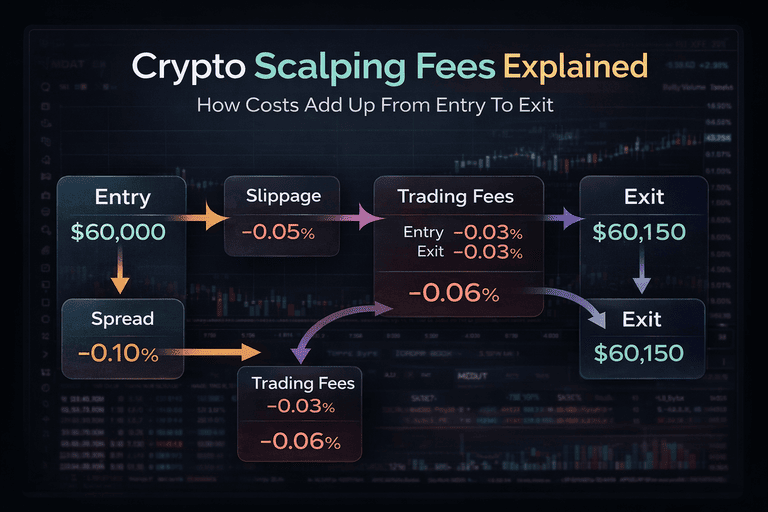
By the time you close the trade, your “+0.30%” might really be:
+0.30% – 0.18% fees = almost break-even
Do that 50 times per day?
You’re working hard… for nothing.
Before you change strategies, indicators, or AI tools, you need to optimize the boring part:
Cost → Execution → Only THEN strategy.
That’s the professional mindset.
The Core Fees Every Scalper Pays (Even If You Don’t Realize It)
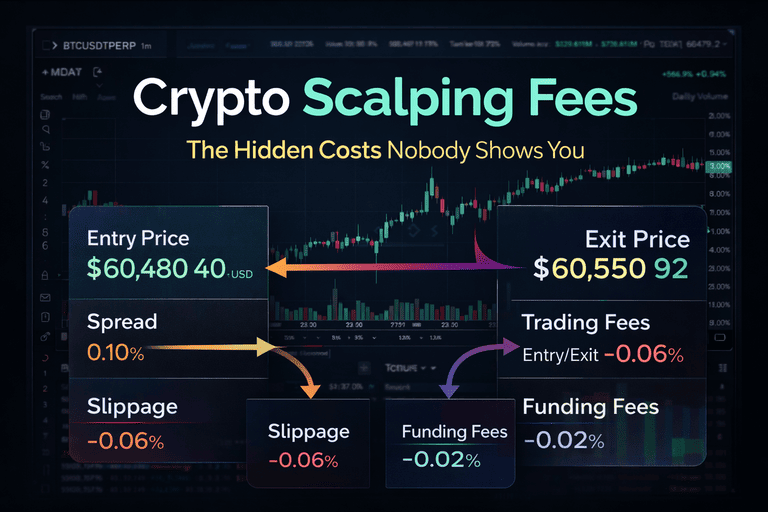
Let’s unpack each one.
1-Trading Fees (Maker vs Taker)
Most exchanges charge two fee types:
-
Maker – you add liquidity (limit orders)
-
Taker – you remove liquidity (market orders)
Scalpers love speed → so they usually pay taker.
And taker is always more expensive.
Example (typical):
-
Maker: 0.02%
-
Taker: 0.06%
Enter + exit = 0.12% gone instantly.
For a swing trader targeting 10% — no big deal.
For a scalper targeting 0.25% — that’s lethal.
When speed truly matters? Fine — pay taker.
When you can pre-place or use limits? Capture maker discounts.
This is where execution discipline pays off.
(And if you want to compare fee structures side by side, your starting point should always be this page:)
Top Exchanges to Start Trading Today
2-Spread — The Silent Killer
Spread is the difference between:
Bid (buyers)
Ask (sellers)
If spread is 0.08% and you market buy… you instantly start negative.
And small-cap altcoins?
Spreads explode during volatility.
Pro tip: before entering, quickly sanity-check behavior with structure tools:
-
Dojis forming?
-
Weak candles?
-
Choppy ranges?
Use your candlestick detectors:
Hammer & Shooting Star Detector
When patterns signal indecision + spread widens → don’t scalp there.
Execution beats excitement.
3-Slippage — When Price Moves While You Click
Slippage happens when:
-
You hit “market buy”
-
Price jumps before execution
-
You get filled higher than expected
On fast 1-minute candles, slippage can easily equal or exceed your entire profit target.
You can reduce slippage by:
avoiding extreme spikes
using limit orders near key structure
trading pairs with real liquidity
And yes — our AI Dashboards help filter noisy environments:
It won’t “predict” price.
But it helps you trade only when conditions justify risk.
4-Funding Fees — The Cost Nobody Talks About
Perpetual futures charge funding every few hours.
If you hold positions longer than expected (even scalps turned “oops I’ll wait”)…
Funding can eat profits silently.
And when markets get aggressive, funding flips insanely fast.
Use your tools to monitor behavior before committing capital. High imbalance = higher funding risk.
If longs pile in like crazy?
Expect funding to punish longs soon.
Scalpers don’t like taxes — especially invisible ones.
5-Latency & Execution Delays
This is subtle — but real.
-
slow internet
-
overloaded exchange matching engines
-
laggy browsers
-
heavy indicators on charts
Result?
Your button click becomes your slippage.
This is why professional scalpers obsess over:
-
lightweight dashboards
-
fewer indicators
-
fast UI
-
fast exchange execution
The more you “decorate” your screen, the more you tax execution.
Minimalist traders usually outperform.
Real Math: Why Small Fees Destroy Good Scalpers
Let’s simulate:
Target: +0.35% per trade
Loss: –0.35% per loss
Win-rate: 55%
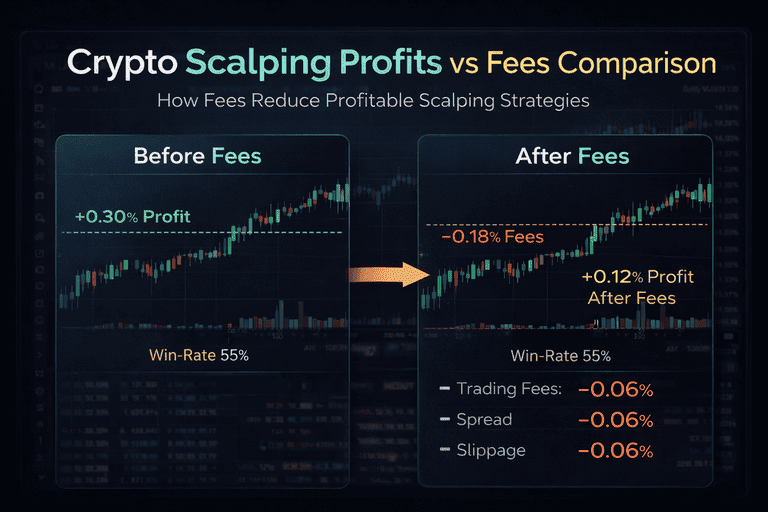
Looks profitable, right?
Now add realistic costs:
-
total fees + spread + slippage ≈ 0.18%
Your new math:
-
Wins = +0.35 – 0.18 = +0.17%
-
Losses = –0.35 – 0.18 = –0.53%
Same win-rate.
Completely different outcome.
This is why I keep repeating:
“Fees are part of your system. If you don’t model them, you don’t actually know your edge.”
And yes — before every session, you should sanity-check the environment using Pre-Trade style thinking:
-
Is the market clean?
-
Are conditions readable?
-
Are execution costs high?
Your tools help you avoid trading when the environment is the edge killer.
How to Reduce Scalping Fees Without Changing Strategy
Here’s the playbook.
1. Trade High-Liquidity Pairs
BTC, ETH, SOL, major USDT pairs.
Lower:
-
spread
-
slippage
-
execution weirdness
Small caps are exciting.
Small caps also bleed scalpers to death.
2. Avoid Over-Trading
Every trade is a fee payment.
Ask yourself:
“Is this setup worth paying fees twice?”
Most scalpers would immediately improve ROI simply by trading less garbage.
Use tools that help filter chop:
When the market is compressing and messy… sit back.
Discipline is alpha.
3. Try To Use Maker Orders When Possible
Not always realistic.
But when structure gives you time, place limits strategically and let price come to you.
Maker rebates reduce your structural cost base.
Small win → big lifetime impact.
4. Do Not Hold “Scalps” Into Funding Windows
Set a rule:
Scalps don’t pay funding. Period.
If you’re tempted to hold… it wasn’t a scalp anymore — it was coping.
5. Choose Exchanges Designed for Fast Execution
Lower fees are great.
But execution + spread + liquidity matter more than headline marketing.
Compare, test, and choose intentionally.
Start here:
Top Crypto Exchanges for Fast Scalping Execution
That’s where the rubber meets the road.
How Our Tools Help You Keep More of Your Profits
Your ecosystem is intentionally built around one idea:
“Trade only when conditions justify risk — and avoid hidden costs.”
Here’s how they connect:
-
Check market environment → AI Dashboard
-
Scan structure + signals → MA Cross / RSI / Candlesticks
-
Avoid noise → Volatility + Market Timing
-
Stay aware of sentiment → Long vs Short
-
Manage psychology → Pre-Trade thinking
Quick internal links to explore:
RSI Overbought/Oversold Scanner
Use these with 1 minute scalping strategy.
This turns you from “button clicker” into operator.
And operators survive.
Key Takeaways (Tattoo These on Your Brain)
-
Most scalpers don’t lose because of entries
-
They lose because costs silently eat them alive
-
Execution beats ego
-
Spreads + slippage matter more than indicators
-
Choosing the right exchange is part of your strategy
-
Tools help you filter bad conditions — not predict the future
Optimize costs → keep more profits → scale smarter.
That’s the professional stack.
6 thoughts on “Crypto Scalping Fees Explained: The Hidden Costs That Quietly Kill Winning Traders”