
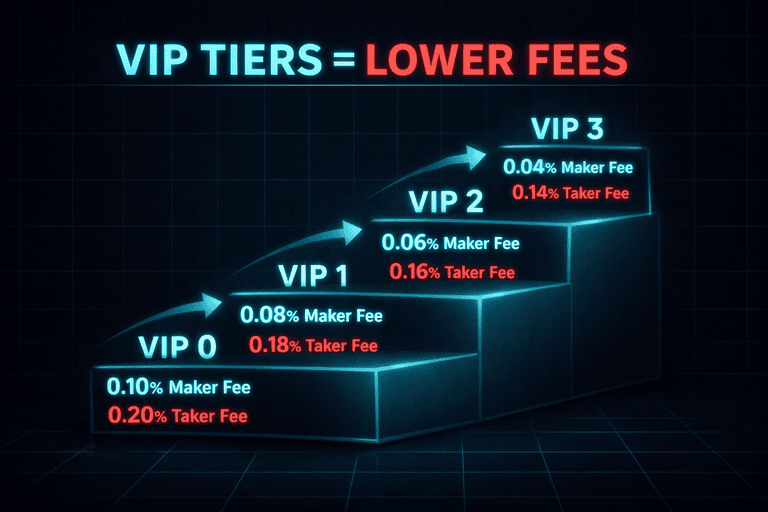
If you’re doing a few trades per week, VIP tiers don’t matter much.
If you’re scalping — especially on 1-minute charts — VIP fee tiers can quietly become the difference between “I’m doing fine” and “why does it feel like my edge is leaking?”
Because when you trade a lot, you don’t lose from one big mistake. You lose from small taxes repeated 200 times.
That’s what VIP discounts are: a way to reduce the tax.
But there’s a catch: every exchange explains fee tiers differently, and a lot of traders misunderstand the requirements. So this article is your practical, no-drama guide to:
-
what VIP tiers really are
-
what counts toward your tier (and what doesn’t)
-
how scalpers should think about maker vs taker discounts
-
how to avoid chasing volume for the wrong reason
What are VIP fee tiers on crypto exchanges?
VIP tiers are a volume-based discount system.
The basic idea:
-
trade more (usually measured over 30 days)
-
pay lower fees (maker and/or taker)
-
sometimes unlock better perks (withdrawal limits, API limits, rebates)
Every exchange has its own structure, but most VIP systems revolve around one or more of these:
-
30-day trading volume (spot and/or futures)
-
asset holdings (keep X amount of a token or balance)
-
maker volume ratio (some reward makers more)
The point is simple: exchanges want high-volume traders, and VIP tiers are how they keep them.
Why VIP tiers matter specifically for scalpers
Scalpers don’t usually win because of huge targets.
They win because:
-
lots of small edges
-
repeated many times
-
with costs kept under control
So if your fees drop even a little, the impact stacks fast.
Here’s the part most people miss:
VIP tiers don’t just reduce fees.
They can change what order types make sense.
Because when maker fees drop (or become rebates), using maker-style execution becomes more attractive.
And when taker fees are high, “click market and pray” becomes expensive.
If you trade frequently, fee structure matters more than strategy tweaks.
Maker vs taker discounts: where the real savings usually come from
VIP tiers often reduce both fees, but not equally.
Maker fees
-
Typically lower than taker fees
-
Sometimes reach near-zero on higher tiers
-
Sometimes even become rebates (rare, but exists on some venues)
Taker fees
-
Typically higher
-
Even with VIP, still a cost
-
And scalpers who use market orders pay it constantly
That’s why a lot of serious scalpers quietly evolve toward:
-
limit entries
-
maker-friendly execution
-
controlled exits
Post-only is one of the easiest ways to stay maker when conditions allow.
What counts toward VIP volume (and where people mess up)
This is where traders get confused, because exchanges count volume differently.
Common “gotchas”:
-
spot vs futures volume might be separated
-
only certain pairs might count
-
some exchanges count both sides of a trade (buy and sell volume each counted)
-
maker volume may be measured separately
-
API trading might have different rules in some cases
So the correct mindset is:
VIP tiers are an exchange-specific policy.
Don’t assume — verify the fee schedule.
This is also why “VIP tier” is a high-intent keyword: the person searching it is already comparing venues.
Fees matter, but execution quality matters too. Here’s the full scalper view.
VIP discounts vs spread vs slippage (don’t tunnel vision)
Lower fees help, but they don’t fix bad execution.
If an exchange has:
-
wide spreads
-
frequent slippage spikes
-
slow execution during volatility
Then a VIP discount can be like getting 10% off a product you shouldn’t buy.
Scalpers should treat “lowest fees” as the third filter, not the first:
-
execution reliability
-
spread tightness
-
fee structure (including VIP tiers)
Lowest spread matters because it’s a cost you pay constantly.
If execution is slow, fees are not your biggest problem.
The “don’t chase volume” warning (important)
VIP tiers can create a trap: you start trading extra just to “reach the next tier.”
That’s backwards.
You never want your strategy to become:
-
“trade more to pay less”
Because the extra trades often cost more than the discount saves.
A cleaner rule:
Only care about VIP tiers if you already trade that volume naturally.
If you have to force it, it’s not a discount — it’s a trap.
How to use VIP tiers as a scalper (a practical approach)
Here’s the way I’d structure it if I was optimizing a scalping setup:
Step 1: Identify your true trading style
Be honest:
-
Are you mostly taker (market entries/exits)?
-
Are you mostly maker (limit entries, post-only)?
-
Mixed?
This determines which fee tier matters more.
Step 2: Estimate your 30-day volume (roughly)
Not perfect. Just a realistic band:
-
low volume
-
mid volume
-
high volume scalper
Step 3: Compare fee tiers for your style
Don’t compare “VIP 9” if you’ll never reach it.
Compare the tier you are realistically in within 30 days.
Step 4: Choose the exchange where your realistic tier is strong
That’s where the discount is real.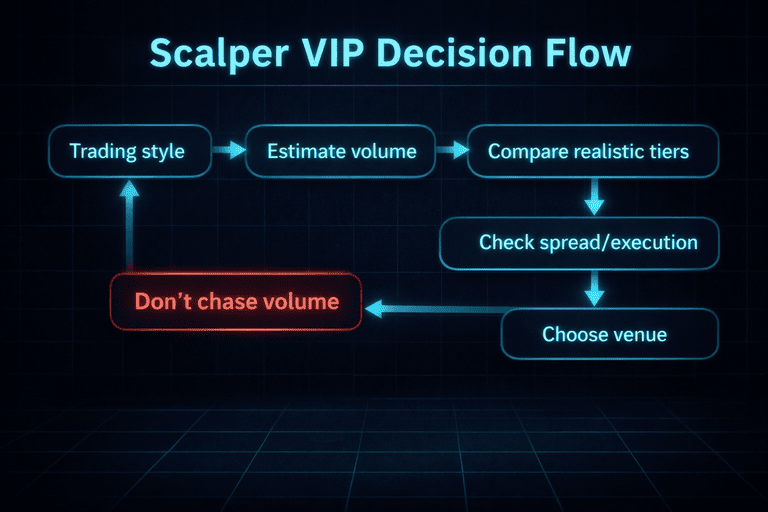
VIP fee tier “shortcuts” that are actually legit
Some exchanges let you qualify for better tiers via:
-
holding a specific token
-
keeping a balance
-
staking / membership programs
This can be useful if:
-
you’re comfortable holding that token
-
the token isn’t forcing you into extra risk
-
the discount genuinely beats alternatives
But don’t do token-holding just for a discount if you’re a scalper who wants flexibility and low risk.
Recommended next step
If you’re serious about VIP tiers, do the smart thing:
-
Pick your main market (spot or perps)
-
Pick your main pair (BTC/USDT if you’re a scalper)
-
Compare fee tiers you can actually hit
-
Confirm spreads + execution are clean
-
Then commit
See my top exchanges for scalping (fees + spreads + execution).
FAQ: Crypto Exchange VIP Fee Tiers & Discounts (Bigger)
What does VIP tier mean on a crypto exchange?
VIP tier usually means a fee discount level based on your recent trading volume (often 30 days). Higher tiers generally reduce maker and taker fees.
Does higher VIP tier always mean cheaper trading?
Cheaper fees, yes — but overall cheaper trading depends on spreads and execution too. A slightly higher fee on a cleaner exchange can beat a low-fee exchange with bad fills.
Is VIP based on spot volume or futures volume?
Depends on the exchange. Some have separate VIP programs for spot and futures. Always check the fee schedule for the specific market you trade.
Do maker and taker fees both drop with VIP tiers?
Usually yes, but maker discounts are often stronger. Some exchanges prioritize maker activity because it improves liquidity.
Should a scalper focus more on maker or taker discounts?
If you enter/exit with market orders often, taker fees matter a lot. If you use limit/post-only setups, maker fees matter more. The best setup is execution rules that naturally reduce taker usage when conditions allow.
Is it smart to trade more just to reach a higher VIP tier?
Usually no. Trading extra to reach a discount often costs more in mistakes, slippage, and bad setups than you save on fees.
What is a fee tier “token discount” and is it worth it?
Some exchanges let you qualify for discounts by holding their token. It can be worth it if you understand the risk and the discount is meaningful — but don’t hold extra risk just for a small fee cut.
Can VIP tiers reduce slippage?
Not directly. VIP tiers reduce fees. Slippage depends on liquidity, spreads, volatility, and execution quality. But a venue that supports high-volume traders well often has better liquidity, which can indirectly help.
Why do VIP systems feel confusing?
Because exchanges define “volume” differently and separate markets/pairs differently. That’s why you should compare the tier you can realistically hit and verify what counts.
What’s the simplest way to choose using VIP tiers?
Choose the exchange where:
-
spreads are consistently tight for your pair
-
execution is reliable during volatility
-
and the VIP tier you can actually reach improves your fee structure
1 thought on “Crypto Exchange VIP Fee Tiers & Discounts: How Scalpers Pay Less (Legitimately)”