
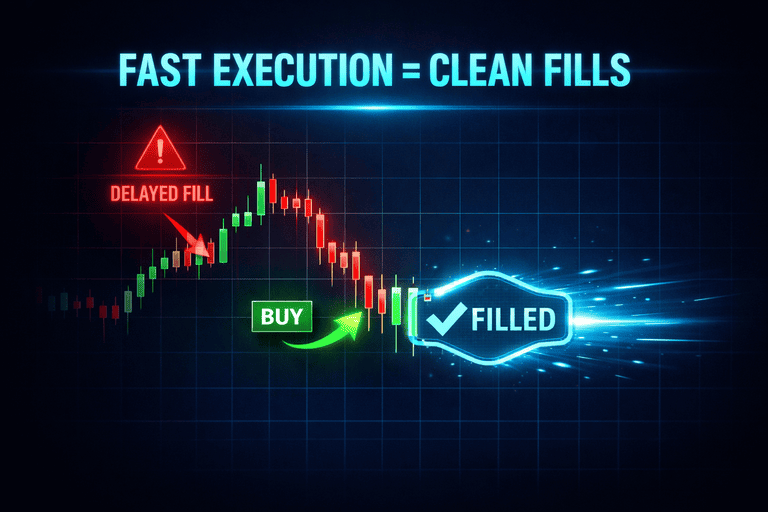
When scalpers talk about “the best exchange,” they usually mean one thing:
clean fills.
Not pretty UI. Not influencer hype. Not “0% fees” marketing.
In scalping, execution is your infrastructure. If execution is slow or inconsistent, your strategy gets sabotaged before it even has a chance.
This article shows you how to pick a fast execution crypto exchange for scalping using measurable signals — without relying on random Reddit opinions.
What “fast execution” actually means (it’s not just ping)
Most people think fast execution = low ping. Nope.
Fast execution is a pipeline:
-
your platform sends the order
-
your network delivers it
-
the exchange processes it (matching engine)
-
you receive confirmation
-
your fill is accurate and consistent
So a “fast execution exchange” is one that performs well in the real world, especially during volatility.
Latency is the hidden reason your fills look worse than your chart.
Why execution speed matters more for scalping than any other style
A swing trader can tolerate slow execution.
A 1-minute scalper can’t.
Slow or unstable execution causes:
-
entries after the move already started
-
exits that slip past your level
-
stops that fill worse than planned
-
canceled orders that don’t cancel
-
partial fills in the worst moments
If you’ve ever said:
“Bro, I clicked exactly there!”
…you’ve felt execution problems.
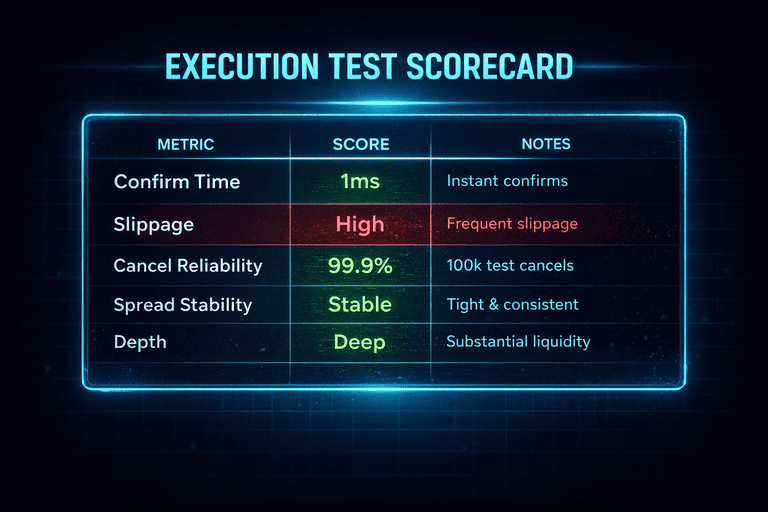
The 5 execution metrics that actually matter for scalpers
Forget marketing. Measure these.
1) Click-to-confirm time
How long from clicking the order to receiving a confirmation?
If this spikes during big candles, that exchange is risky for scalping.
2) Slippage consistency
Not “one bad fill.”
Consistent worse fills = execution quality issue.
Slippage is often a symptom of weak execution.
3) Cancel/replace reliability
Scalpers cancel and reposition orders constantly.
If cancels lag, you get ghost orders and unexpected fills.
4) Spread stability under pressure
Tight spreads in calm times are easy.
The best venues keep spreads reasonable when it matters.
Spread is a cost — but also a real-time market quality signal.
5) Order book depth on your pair
Execution isn’t just speed. It’s also liquidity.
A fast engine on a thin book still produces ugly fills.
What makes an exchange “fast” for scalping?
Here are the real drivers:
1) Strong matching engine performance
This is the exchange’s internal ability to process a flood of orders.
2) High liquidity concentration
More traders + market makers on your pair = better fills.
3) Stable market data feeds
If your feed lags, you’re trading the past.
4) Professional order types + behavior
Good venues support clean execution features and handle them reliably.
Fast execution vs low fees: what matters more?
For scalpers, the right answer is:
Execution first, fees second.
Because bad execution can cost more than fees ever will.
But the best outcome is both:
-
low fees
-
tight spreads
-
reliable execution
Here’s my full scalper-focused exchange comparison.
If you trade a lot, fee structure still matters.
How scalpers test execution speed (simple method)
You don’t need a lab. You need a routine.
Step 1: Pick one pair
Use the pair you actually scalp (example: BTC/USDT).
Step 2: Test during your real trading hours
Execution quality changes across sessions.
Test during liquidity windows — that’s when scalpers live.
Step 3: Use the same order types
If you normally use:
-
market entries
-
limit exits
Test that exact style across venues.
Step 4: Track these outcomes
-
average click-to-confirm time
-
average slippage per entry/exit
-
number of partial fills
-
any cancel failures
Execution mistakes that make a “fast exchange” feel slow
Sometimes it’s not the exchange — it’s your setup.
1) Heavy browser + 20 tabs
Your click delay becomes your enemy.
2) VPN routes that add jitter
Some routes add random latency spikes.
3) Trading during dead hours
Thin books make fills feel worse even on good exchanges.
Dead hours often create bad execution conditions.
4) Oversized orders
If you’re eating multiple levels, no engine can save you.
Practical execution tools: when to use what
Post-only (maker discipline)
Great for pullbacks and calm conditions.
Post-only helps scalpers avoid taker fills in stable markets.
IOC (urgent execution with a price boundary)
Useful when you need speed but don’t want unlimited slippage.
IOC orders are a scalper tool for instant execution without leaving leftovers.
So… which exchange is best for fast execution?
I’m not going to claim one exchange is “always fastest” because:
-
it changes by region routing
-
it changes by pair
-
it changes by market regime
Instead, the real answer is:
The best fast-execution exchange is the one that has deep liquidity + stable matching performance for your pair during your trading hours.
And that’s exactly why your site’s exchange content wins: it teaches selection by execution reality, not hype.
Recommended next step (affiliate-friendly but clean)
If you want fast execution for scalping, your priority stack should be:
-
execution stability under volatility
-
spread tightness
-
fee structure (maker/taker + tiers)
-
platform reliability
See my top exchanges for scalping (fast execution + tight spreads + low fees).
FAQ: Fast Execution Crypto Exchanges (Bigger)
What does “fast execution” mean for crypto scalping?
It means your orders are confirmed and filled quickly and consistently — especially during volatile moments — with fewer bad fills, fewer cancel issues, and less slippage.
Is low ping the same as fast execution?
No. Ping is only network delay. Execution also depends on the exchange’s matching engine performance, platform responsiveness, and data feed stability.
Why do exchanges feel slow during big moves?
Because order flow surges. Some exchanges handle high load better than others. When the engine is stressed, confirmations lag and slippage increases.
Can fast execution reduce slippage?
It can reduce slippage frequency and severity, but it can’t eliminate it. Slippage also depends on liquidity depth and volatility.
Is a fast exchange more important than low fees?
For scalpers, yes — because bad execution can cost more than fees. Ideally you want both, but execution stability is the foundation.
How can I test execution speed without coding?
Track click-to-confirm time, slippage on similar setups, cancel reliability, and spread stability across exchanges during the same trading hours.
Does execution speed differ by pair?
Yes. BTC/USDT may be excellent, while a smaller coin on the same exchange may execute poorly due to low liquidity and thin books.
Does region matter for execution?
Yes. Routing and distance to exchange servers can affect latency. That’s why the “best exchange” can vary by trader location.
Which order types help scalpers control execution?
Post-only helps maker entries in stable conditions. IOC helps urgent execution with a price boundary. Both help scalpers control fill behavior compared to pure market orders.
What’s a warning sign execution is bad today?
If confirmations lag, cancels fail, spreads widen suddenly, and your fills consistently slip more than normal — it’s often smarter to reduce size, trade fewer setups, or stop for that session.