
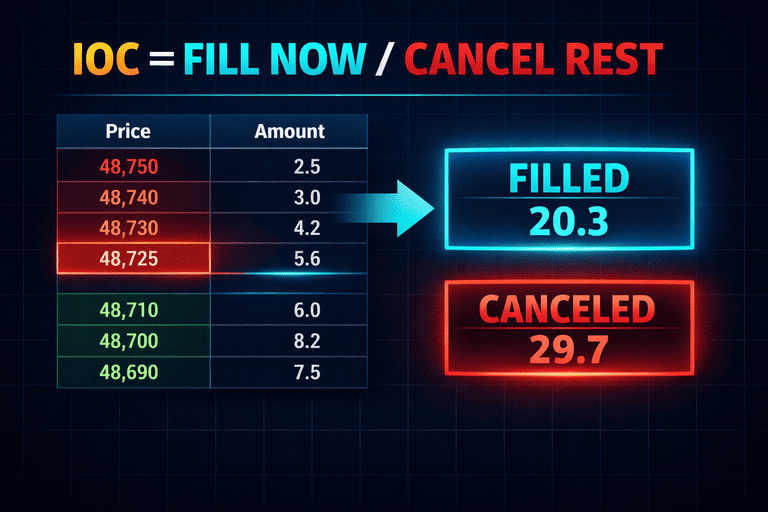
IOC sounds fancy, but it’s basically a scalper’s “no time-wasting” button.
An IOC (Immediate-or-Cancel) order tells the exchange:
“Fill what you can immediately at my price (or better).
If anything can’t fill instantly, cancel the remaining amount.”
That’s it.
It’s not a strategy. It’s an execution tool — and if you scalp, execution tools matter as much as indicators.
What does IOC mean in crypto?
IOC = Immediate-Or-Cancel.
It’s an order instruction that forces your order to:
-
execute immediately for whatever volume is available at your price, then
-
cancel any unfilled portion instantly
IOC works on limit orders (most common)
Typically you choose:
-
Limit price
-
Time-in-force = IOC
So you control the worst acceptable price (unlike a market order), but you still demand immediate execution.
IOC vs Market vs Limit (fast comparison)
Market order
-
✅ fills immediately
-
❌ price is uncontrolled
-
❌ slippage risk is higher
Normal limit order
-
✅ controlled price
-
❌ might sit on the book
-
❌ can miss the move
IOC limit order
-
✅ controlled worst price
-
✅ immediate attempt to fill
-
✅ cancels leftovers (no sitting)
-
❌ can partially fill (size issues)
In scalper terms:
IOC = “Act now, but don’t chase beyond my limit.”
Why scalpers use IOC
IOC is useful when you want:
-
speed (like a market order)
-
but with a price boundary (like a limit order)
-
and you don’t want leftovers sitting and getting filled later in a different context
This matters a lot in 1-minute trading because conditions change quickly.
IOC is the opposite cousin of post-only
This is a clean internal-linking opportunity for your site:
-
Post-only: maker-only, rests on the book, cancels if it would fill instantly
-
IOC: taker-style urgency, fills instantly, cancels what can’t fill
Post-only is the opposite: it refuses immediate fills to stay maker.
When IOC is useful (real scalper scenarios)
Scenario 1: You want the fill, but not at any price
Example:
-
breakout is happening
-
you want in now
-
but you don’t want to eat 3 levels of the order book
IOC lets you say:
“Fill me up to THIS price. If you can’t, cancel.”
Scenario 2: You don’t want stale orders sitting around
A normal limit order can sit and fill later when the chart context is different.
IOC prevents that by canceling leftovers immediately.
Scenario 3: Fast exits with price protection
If you need out but don’t want a pure market order, IOC can be a compromise:
-
exit now
-
but don’t accept a horrible price
(Still, in emergency exits, market orders may be safer. Risk control > fee optimization.)
The hidden issue: partial fills (and why they happen)
IOC orders often result in partial fills because you’re demanding immediate execution.
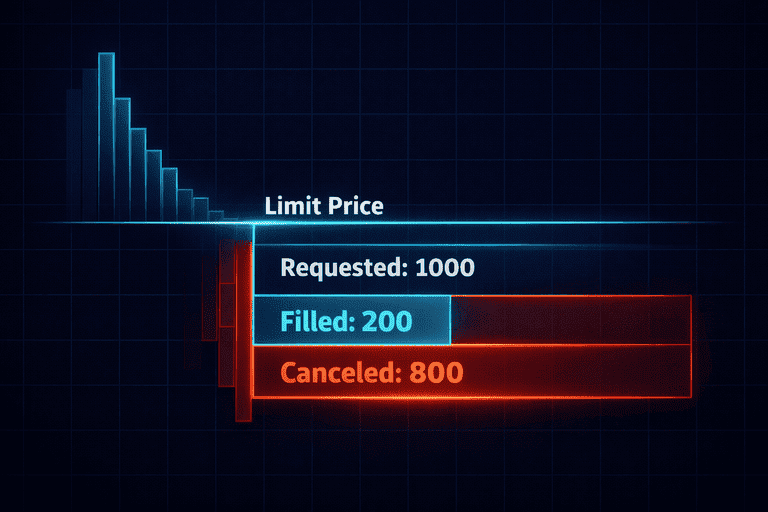
If the book has:
-
200 units available at your limit
-
and you send 1,000 units IOC
You might fill 200 and cancel 800.
That’s not a bug — that’s literally how IOC works.
IOC and spread/slippage (how it connects)
IOC doesn’t magically remove slippage. But it can reduce “runaway” slippage compared to market orders because your limit price is a boundary.
Still, two key costs remain:
1) Spread cost
If you’re using IOC to enter immediately, you’re often crossing the spread.
Spread is still a tax on urgent execution.
2) Slippage during volatility
If price moves fast, your IOC may:
-
fill less than expected
-
miss entirely
-
or fill at the worst acceptable boundary (your limit)
IOC controls max price, but volatility can still create slippage pain.
IOC vs FOK vs GTC (quick glossary)
Exchanges usually offer other “time-in-force” settings:
-
GTC (Good-Til-Canceled): stays on the book until filled or canceled
-
IOC (Immediate-Or-Cancel): fill now, cancel remainder
-
FOK (Fill-Or-Kill): must fill completely immediately or cancel entirely
Scalper interpretation:
-
IOC = “give me what you can now”
-
FOK = “either all now or nothing”
(FOK is rarer on some exchanges, but when available it’s useful for strict sizing.)
Best practices for using IOC in scalping
-
Use IOC when urgency matters, not for every entry.
-
Keep your size realistic relative to liquidity, or expect partial fills.
-
Set the limit price intentionally (don’t set it so tight you never fill).
-
If you get repeated partial fills, consider:
-
smaller size
-
more liquid pair
-
better session timing
-
Liquidity windows make IOC fills cleaner.
If your fills feel late or inconsistent, check latency.
Latency can turn an IOC order into a worse fill or a missed fill.
Quick pre-trade checks reduce execution disasters.
Recommended next step
IOC is a tool. The real improvement comes from pairing it with:
-
liquid pairs
-
tight spreads
-
clean execution venues
-
good timing
Choose exchanges that execute fast when it matters.
See my top exchanges for scalping (fees + spreads + execution).
FAQ: IOC Orders in Crypto (Bigger)
What does IOC mean on crypto exchanges?
IOC means Immediate-Or-Cancel. The exchange tries to fill your order immediately at your limit price (or better) and cancels whatever can’t be filled instantly.
Is IOC the same as a market order?
No. A market order prioritizes execution with no strict price cap.
An IOC order typically uses a limit price, so it prioritizes immediate execution within your price boundary.
Why did my IOC order only partially fill?
Because only part of your order size was available immediately at your limit price (or better). The exchange filled what it could and canceled the rest as instructed.
Can IOC reduce slippage?
It can reduce “unbounded” slippage compared to market orders because you define the worst acceptable price. But you can still get slippage up to that boundary in fast markets.
When is IOC better than post-only?
When you need speed.
-
Post-only is for controlled maker entries.
-
IOC is for urgent execution without leaving stale orders behind.
Does IOC make me a maker or taker?
Usually IOC behaves more like a taker-style action because it tries to execute immediately against existing liquidity. Fee classification depends on the exchange, but IOC is typically used for immediate fills, not providing liquidity.
Is IOC good for breakout entries?
Often yes, because breakouts are time-sensitive. IOC can help you enter quickly while preventing the “I ate the whole book” problem of a market order.
Is IOC good for stop-loss exits?
It can be used if your exchange allows it and you want a price boundary, but stops are primarily about risk control. If you need out urgently, market exits are often safer than any order type that risks not filling.
Can latency affect IOC execution?
Yes. If your order arrives late, price may move away and you may get a worse fill (at your limit) or no fill at all. That’s why execution quality and latency matter for scalpers.
What’s the difference between IOC and FOK?
-
IOC: fill what you can now, cancel the rest
-
FOK: fill the entire order now or cancel everything
FOK is stricter and is useful if partial fills break your strategy.