
Cryptocurrency markets move extremely fast. Prices can shift dramatically within minutes, creating both opportunities and risks for traders. Because of this volatility, many traders rely on crypto signals to help identify potential trading opportunities.
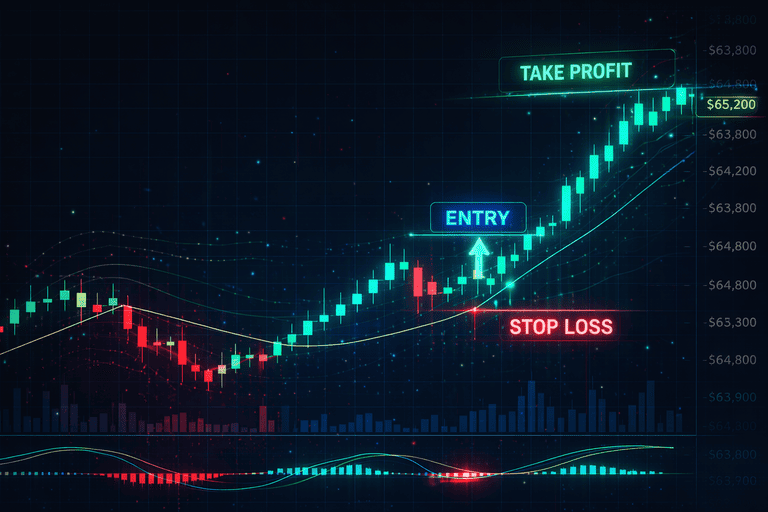
Crypto signals are structured trade alerts that indicate when to buy or sell a cryptocurrency. These alerts often include entry price, stop loss levels, and profit targets. Signals can be generated by experienced traders, automated systems, or artificial intelligence models analyzing market data.
For traders who want structured trade ideas or additional confirmation for their strategies, crypto signals have become an increasingly popular tool.
In this guide, we will explain what crypto signals are, how they work, the different types of signals traders use, and how to apply them responsibly within a trading strategy.
What Are Crypto Signals?
Crypto signals are trading suggestions that indicate a potential opportunity in the cryptocurrency market. These signals usually include several important elements that help traders understand how to execute the trade.
A typical crypto signal contains the following information:
• The cryptocurrency pair (for example BTC/USDT)
• Entry price
• Stop loss level
• Take profit targets
• Timeframe or trade duration
A simplified example of a crypto signal could look like this:
BTC/USDT
Entry: 63,850
Stop Loss: 63,200
Take Profit: 64,900
Timeframe: 5 minutes
This type of signal gives traders a clear framework for a potential trade.
Signals are often used by traders who want additional confirmation before entering the market or those who prefer structured trade ideas instead of constantly analyzing charts themselves.
Crypto signals are particularly common in short-term trading styles, where opportunities may appear and disappear quickly.
Many scalpers, for example, rely on signal alerts to capture small but frequent market movements. Traders interested in this style often combine signals with strategies like the one explained in the 1-minute scalping strategy guide .
Why Crypto Signals Have Become Popular
The popularity of crypto signals has grown alongside the expansion of the cryptocurrency market.
Unlike traditional financial markets, crypto markets operate 24 hours a day, which means trading opportunities can occur at any time.
Because monitoring charts continuously is difficult, signals provide traders with a structured way to identify opportunities.
Signals help traders:
• Discover trade setups faster
• Reduce time spent analyzing charts
• Learn how market conditions affect trading decisions
• Improve discipline when executing trades
Another reason for their popularity is the rise of data-driven trading tools.
Modern trading platforms can scan market conditions using technical indicators such as RSI or moving averages. These tools detect specific conditions and generate alerts when potential trade setups appear.
For example, traders may use indicator tools that detect RSI overbought or oversold conditions or identify moving average crossover signals.
These types of signals allow traders to respond quickly to market conditions.
How Crypto Signals Are Generated
Crypto signals can be generated using several different approaches. Understanding how signals are produced helps traders evaluate their reliability.
Manual trading signals
Manual signals are generated by experienced traders who analyze charts and market conditions.
These traders often use methods such as:
• support and resistance analysis
• price action patterns
• trend analysis
• indicator combinations
Manual signals rely heavily on the skill and experience of the trader producing them.
Algorithmic signals
Algorithmic trading systems automatically analyze market data and generate signals when predefined conditions are met.
These systems can monitor multiple indicators simultaneously and identify patterns across large amounts of data.
Algorithmic signals often detect setups such as:
• moving average crossovers
• volatility breakouts
• trend continuation signals
• momentum shifts
Because algorithms process data quickly, they are commonly used for short-term trading strategies.
AI-driven crypto signals
More advanced signal systems now incorporate artificial intelligence models.
AI-based signals analyze historical price data and market conditions to identify patterns that may indicate potential opportunities.
These models often evaluate:
• market momentum
• volatility cycles
• price behavior across timeframes
• indicator combinations
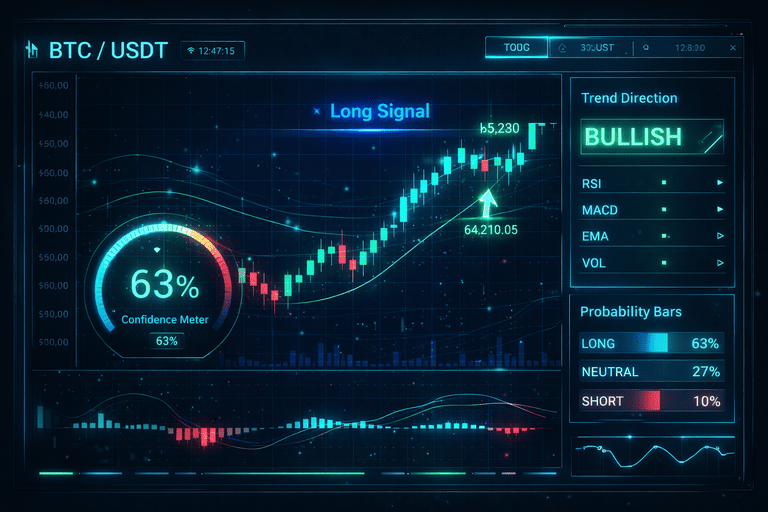
Many traders now use AI signal dashboards to monitor market conditions in real time, such as the BTC signal dashboard.
These platforms combine technical indicators, price data, and probability models to produce structured trading insights.
Types of Crypto Signals
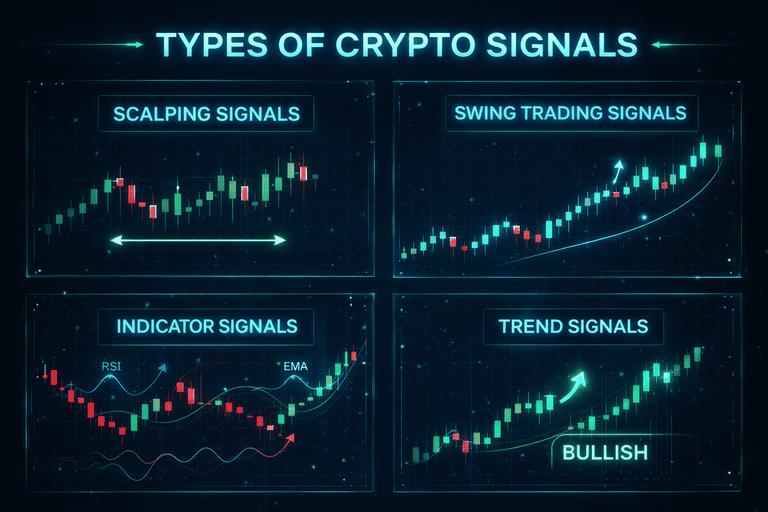
Not all signals are designed for the same trading style. Different signals serve different purposes depending on the strategy used.
Scalping signals
Scalping signals focus on capturing small price movements over short timeframes.
These signals are typically used on charts such as the 1-minute or 5-minute timeframe.
Scalping signals rely heavily on quick market reactions and are often combined with tools that detect rapid indicator changes.
Many traders combine scalping signals with technical tools that detect price patterns such as doji candles or hammer patterns.
Swing trading signals
Swing signals target larger price movements that may occur over several hours or days.
Instead of capturing very small price fluctuations, swing signals aim to identify medium-term trends.
These signals often rely on trend analysis and support-resistance zones.
Indicator-based signals
Indicator signals are generated when specific technical indicators trigger a trading condition.
Examples include:
• RSI oversold signals
• moving average crossovers
• MACD momentum signals
• Bollinger Band breakouts
Indicator-based signals are commonly used in automated trading tools.
Trend signals
Trend signals indicate the overall direction of the market rather than a precise entry point.
For example, a trend signal might indicate that the market bias is bullish or bearish.
Traders often use trend signals to confirm whether a trade idea aligns with the broader market direction.
Do Crypto Signals Actually Work?
A common question among traders is whether crypto signals actually work.
The reality is that signals are tools rather than guarantees.
Markets are influenced by many factors including economic news, liquidity changes, and sudden shifts in market sentiment.
Because of this, even well-structured signals can sometimes fail.
Successful traders understand that signals operate based on probability rather than certainty.
For example, a strategy that wins 60% of the time can still be profitable if losses are controlled properly.
Risk management plays a crucial role in using signals effectively.
Many traders limit risk by:
• setting clear stop losses
• using small position sizes
• avoiding excessive leverage
When signals are combined with responsible risk management, they can help traders make more structured decisions.
How to Use Crypto Signals Correctly
Using crypto signals effectively requires discipline and a clear process.
Many beginners make the mistake of blindly following signals without understanding how to manage risk.
A structured approach can significantly improve trading results.
Step 1: Choose a reliable exchange
Trading signals are most effective when executed on exchanges that offer strong liquidity and fast order execution.
Low fees and tight spreads are also important considerations.
Traders comparing exchanges often analyze factors such as spreads, slippage, and execution speed using comparison guides like the best exchanges for crypto scalping comparison.
Step 2: Understand the signal details
Before entering a trade, carefully review the signal parameters.
Make sure you understand:
• the entry price
• the stop loss level
• the take profit target
• the timeframe
Entering a trade without understanding these elements increases risk.
Step 3: Execute the trade
Once the signal conditions are met, traders place the order according to the signal.
Some traders prefer limit orders because they reduce slippage compared to market orders.
Step 4: Manage risk
Risk management is essential when using signals.
Professional traders rarely risk more than 1–2% of their trading capital on a single trade.
This prevents a few losing trades from significantly damaging the account.
Step 5: Track trading performance
Tracking results helps traders evaluate whether a signal system performs well over time.
Many traders keep a trading journal that records:
• entry price
• exit price
• profit or loss
• notes about the trade
This information helps identify patterns and improve strategy decisions.
Free vs Paid Crypto Signals
Crypto signals can be found in many places, including Telegram groups, trading communities, and specialized trading platforms.
Signals are typically offered in two main formats.
Free crypto signals
Free signals are widely available online.
These signals can be useful for beginners who want to observe how signals work and learn basic trading concepts.
However, free signals may have limitations.
Large public audiences can reduce the effectiveness of signals because many traders attempt to enter the same trade at once.
Paid crypto signals
Paid signal services typically provide more structured trading systems and smaller communities.
These services may include:
• detailed trade analysis
• risk management guidance
• advanced market insights
Some platforms also combine signals with data-driven analysis tools that monitor market conditions continuously.
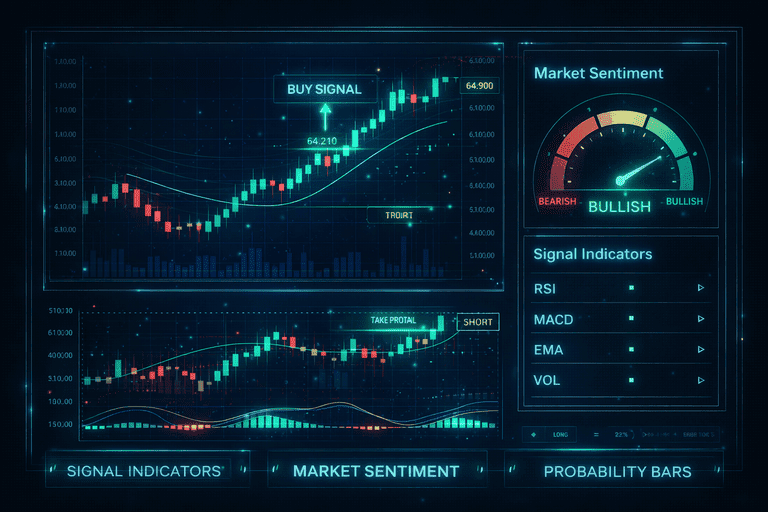
For example, traders can monitor real-time signal analysis and market indicators through tools like the AI crypto trading dashboard.
Common Crypto Signal Mistakes
Even when signals are accurate, traders can still lose money due to common mistakes.
Understanding these errors can help traders avoid unnecessary losses.
Entering trades too late
If a signal has already moved significantly from the entry price, entering late increases risk.
Always compare the current market price with the signal entry level.
Ignoring stop losses
Stop losses protect traders from large losses.
Ignoring them can quickly damage a trading account.
Overtrading
Taking too many signals without proper analysis can lead to emotional trading decisions.
Quality signals should always be prioritized over quantity.
Lack of strategy
Signals should be used as part of a broader trading strategy rather than the sole decision-making tool.
Combining signals with technical analysis tools and market research helps improve consistency.
Final Thoughts on Crypto Signals
Crypto signals have become an important tool for many traders navigating the fast-moving cryptocurrency market.
When used correctly, signals can help traders identify opportunities faster and apply structured trading decisions.
However, signals should always be combined with proper risk management and personal trading judgment.
As trading technology evolves, the integration of real-time data analysis and AI-driven signals is likely to become even more important.
Traders who combine signal insights with strong trading discipline and reliable tools will be better positioned to navigate the volatile cryptocurrency market.
Frequently Asked Questions About Crypto Signals
What are crypto signals?
Crypto signals are trading alerts that suggest when to buy or sell a cryptocurrency. A typical signal includes an entry price, stop loss level, take profit target, and the trading pair. These signals are generated using market analysis, technical indicators, or automated trading systems.
Many traders use crypto signals to help identify opportunities faster without constantly analyzing charts themselves.
How do crypto signals work?
Crypto signals work by analyzing market data to identify potential trading opportunities. The signal provider analyzes indicators, price patterns, or algorithmic models and sends a structured alert to traders.
A typical signal includes:
• the cryptocurrency pair
• entry price
• stop loss
• take profit levels
• timeframe
Traders then decide whether to execute the trade based on their strategy and risk tolerance.
Are crypto signals accurate?
Crypto signals are not guaranteed to be accurate. Like any trading strategy, signals operate based on probability rather than certainty. Even professional trading strategies experience losing trades.
Successful traders focus on risk management and consistency rather than expecting every signal to succeed.
Using stop losses and proper position sizing is essential when trading signals.
Are crypto signals good for beginners?
Crypto signals can be helpful for beginners because they provide structured trade ideas and show how experienced traders analyze the market.
However, beginners should still learn the basics of trading and risk management before relying heavily on signals.
Signals work best when used alongside educational resources and technical analysis tools.
What information does a crypto signal include?
Most crypto signals include the following elements:
• trading pair (for example BTC/USDT)
• entry price
• stop loss level
• take profit targets
• timeframe
Some advanced signals may also include confidence levels, trend analysis, or indicator confirmations.
What is the difference between free and paid crypto signals?
Free crypto signals are typically available through public trading communities or Telegram groups. They can be useful for learning but may have inconsistent quality.
Paid crypto signals often provide more structured analysis and smaller communities. Some services also combine signals with data-driven tools or real-time analysis dashboards.
How can traders verify crypto signals?
Traders should evaluate signals carefully before using them. Important factors include:
• historical win rate
• transparency of past results
• risk management approach
• clear trade structure
Reliable signal systems usually provide structured entries and defined stop loss levels rather than vague suggestions.
Do professional traders use crypto signals?
Many professional traders use signals as part of their trading process. However, they usually combine signals with their own market analysis rather than blindly following them.
Signals can act as trade alerts or confirmation tools rather than complete trading strategies.
What are the risks of using crypto signals?
The main risks include:
• market volatility
• entering trades too late
• poor risk management
• overtrading
Even high-quality signals can fail during unpredictable market conditions.
Traders should always manage risk and avoid using excessive leverage.
What are AI crypto signals?
AI crypto signals are trading alerts generated by algorithmic systems that analyze market data using machine learning models.
These systems evaluate large amounts of historical data, technical indicators, and market conditions to identify potential trading opportunities.
AI-based signals aim to improve consistency by removing emotional decision-making from the trading process.