
If you scalp the 1-minute chart, you’ve probably experienced this more times than you can count.
You sit down at your screen.
Bitcoin is moving. Candles are printing. Wicks are forming. Indicators are active.
Everything looks tradable.
You take a trade. It hesitates.
You take another. It scratches or stops out.
You keep trading because the market is “alive”.
By the end of the session, nothing dramatic happened — yet your PnL is negative.
This pattern is not random.
It happens overwhelmingly during quiet market hours, and it’s one of the biggest hidden reasons 1-minute scalpers lose money consistently.
Most traders blame their strategy.
In reality, they are trading the wrong market conditions.
What Are “Quiet Market Hours” in Crypto Scalping?
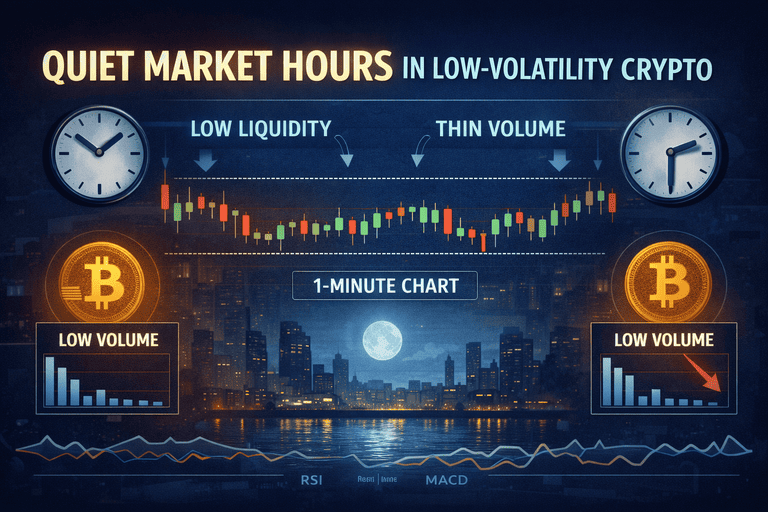
Quiet market hours are periods where price continues to move, but real participation and conviction are missing.
In crypto, this typically occurs:
-
Between major session overlaps
-
During regional off-hours
-
After a strong volatility expansion has already finished
-
During extended consolidation phases
The important detail is this:
Quiet does not mean flat.
Price still fluctuates. Candles still print.
This is exactly why these periods are so dangerous for 1-minute traders.
The market produces just enough movement to trigger entries, but not enough follow-through to sustain trades.
Experienced scalpers are aware of this and monitor session timing closely using a market opening timer rather than relying on charts alone. Knowing when liquidity enters the market is often more important than spotting another candle pattern. Also consider reading free Crypto Pattern Detector Tool (2026).
Why the 1-Minute Chart Becomes Especially Dangerous in Low Volatility
The 1-minute chart amplifies everything.
That includes:
-
Noise
-
Random order flow
-
Small liquidity pockets
-
Short-lived reactions
During quiet hours:
-
Small market orders push price more than usual
-
Micro pullbacks look like reversals
-
Breakouts lack continuation
-
Mean reversion dominates
This creates an environment where technical signals fire frequently but fail quietly.
Nothing explodes against you.
Instead, trades stall, drift, and reverse just enough to stop you out.
Indicators don’t break here — they over-signal.
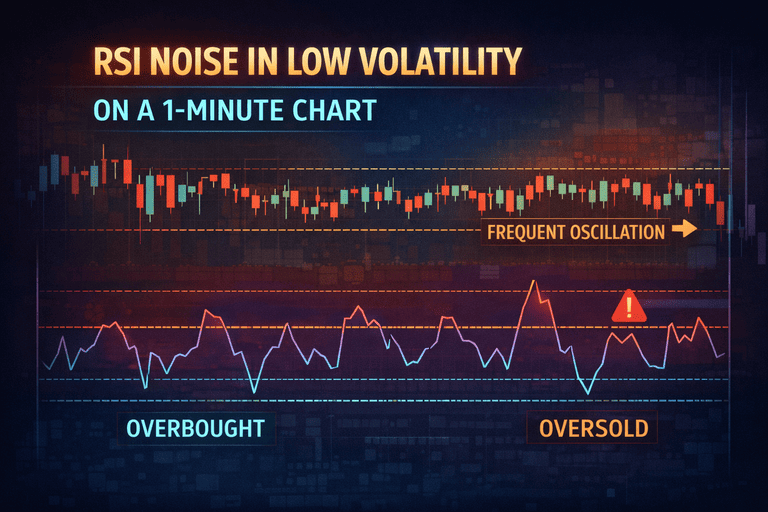
RSI is a classic example.
On the 1-minute chart during low volatility, RSI can oscillate between overbought and oversold repeatedly while price remains range-bound.
This is why disciplined traders don’t treat RSI as a standalone entry trigger in these conditions. Instead, they use an RSI overbought/oversold detector to determine when RSI readings are meaningful versus when they are simply reflecting market noise.
Why Quiet Markets Feel Tradable (The Illusion)
Quiet markets create a powerful illusion.
From the trader’s perspective:
-
The chart is active
-
Indicators are responsive
-
Price is not frozen
This tricks the brain into believing opportunity exists.
But without participation, price has no reason to continue.
Moves start, hesitate, and fade — over and over again.
The 1-minute chart makes this illusion worse because it compresses time.
What looks like “action” is often just random oscillation inside a narrow liquidity range.
This is why traders feel busy but unproductive during these periods.
Common Mistakes 1-Minute Scalpers Make During Slow Sessions
Quiet hours don’t usually cause one big mistake.
They cause many small ones.
The most common errors include:
-
Overtrading because “the market is moving”
-
Forcing setups that only work in volatility
-
Ignoring session context entirely
-
Trading out of boredom
-
Accumulating fees in chop
Each individual trade looks reasonable.
Collectively, they destroy performance.
This is where many scalpers slowly bleed capital while believing they are “doing everything right”.
The market isn’t punishing lack of intelligence.
It’s punishing unfiltered activity.
Why Quiet Market Losses Are So Hard to Diagnose
Quiet-market losses feel confusing.
There is no obvious failure point:
-
No news spike
-
No major mistake
-
No emotional blow-up
Just a slow erosion of capital and confidence.
This causes traders to misdiagnose the problem.
They start tweaking indicators, changing parameters, or jumping strategies — when the real issue is market selection, not execution.
What Professional 1-Minute Scalpers Trade Instead
Professional scalpers do not trade continuously.
They trade specific market states.
High-quality trading conditions usually include:
-
Session opens
-
Volatility expansions
-
Liquidity grabs
-
Clear directional pressure
Instead of asking:
“Is there a setup right now?”
They ask:
“Is the market in a state where my setup has edge?”
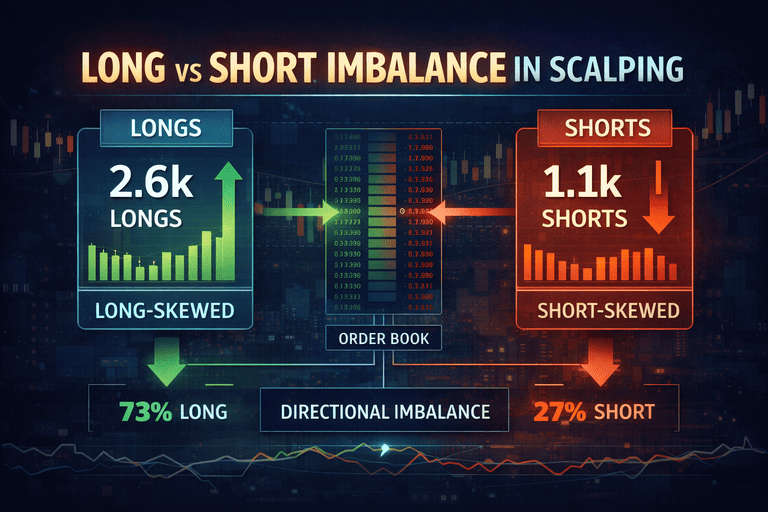
One way traders evaluate this is by monitoring directional imbalance. A long vs short ratio dashboard helps reveal whether the market is leaning decisively — or simply oscillating with no real intent.
Session Context: Why Timing Matters More Than Patterns
Many strategies work — but only during the right sessions.
A setup that performs well during:
-
London open
-
New York open
May completely fail during:
-
Late Asian hours
-
Mid-session lulls
This is not because the setup is bad.
It’s because participation changes.
Quiet hours strip strategies of the fuel they rely on: follow-through.
A Smarter Way to Filter Trades on the 1-Minute Chart
Winning on the 1-minute chart is not about adding complexity.
It’s about removing bad conditions.
A simple filtering framework:
-
Avoid low-participation hours
-
Trade when volatility is expanding, not compressing
-
Use indicators as confirmation, not triggers
-
Align entries with session timing and pressure
This turns indicators into decision filters, not signal machines.
This approach sits at the core of structured scalping systems and is explained in detail inside the ultimate 1-minute scalping strategy framework, where context matters more than individual signals.
The Psychology Trap: Why Scalpers Keep Trading Quiet Hours
Quiet markets don’t feel dangerous.
They feel boring.
And boredom is one of the most expensive emotions in trading.
Scalpers trade because:
-
They are already at the screen
-
Doing nothing feels wrong
-
The chart looks “alive enough”
This leads to activity without edge.
The hardest skill in 1-minute scalping isn’t execution speed — it’s restraint.
How 1-Minute Scalpers Can Avoid These Traps Daily
Before placing a trade, ask:
-
Is this an active session?
-
Is volatility expanding or contracting?
-
Is there directional pressure?
-
Am I trading opportunity — or boredom?
Many disciplined scalpers keep a small set of tools open daily to answer these questions before entering the market.
Checkout 1Minute Scalper Toolkit: Quick Guide to Every Tool
Used correctly, they don’t increase trading frequency.
They protect capital and mental clarity.
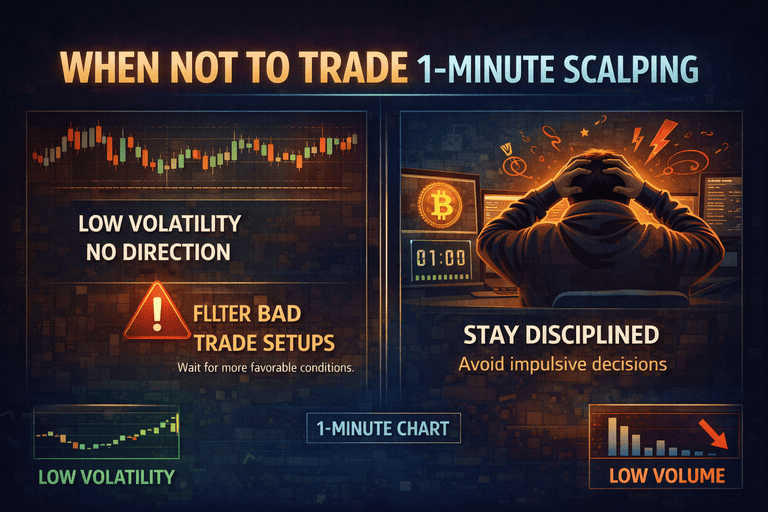
Final Thought
The 1-minute chart rewards precision, not persistence.
Quiet market hours are not an opportunity to trade more — they are a signal to trade less.
Read more on Why Most 1-Minute Scalpers Lose During Quiet Market Hours.
Most 1-minute scalpers lose because they never learned when not to trade.
Fix that, and your strategy finally starts working the way it was meant to.