
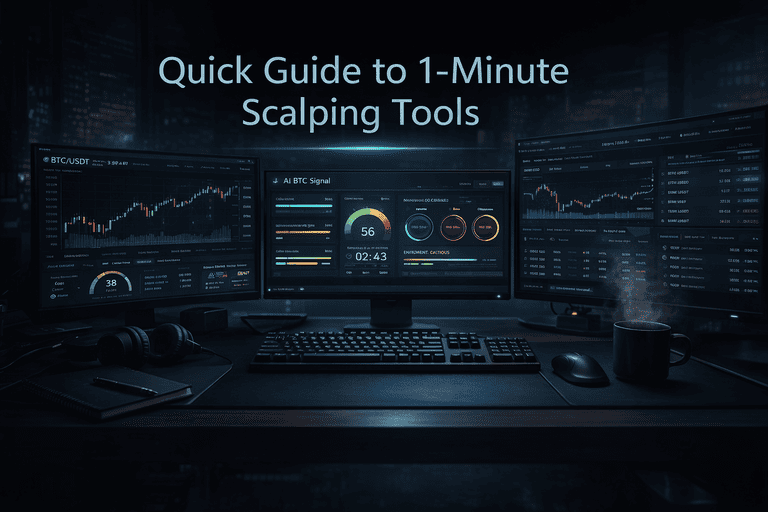
Before placing a trade, most scalpers focus on entries.
But the biggest losses rarely come from bad entries.
They come from trading when market conditions are not suitable.
This guide explains every tool in the 1MinScalper ecosystem — what it does, when to use it, and how it fits into your pre-trade decision process.
If you want to open the tools dashboard, you can do that here:
AI BTC/USDT Signal Dashboard
What it does
Aggregates structure, volatility, momentum, and bias into one dashboard.
Why it matters
It gives you a fast judgment call about whether conditions are supportive or hostile.
How to use it
Check it first. If conditions look unfavorable, stand aside.
RSI Extreme Scanner
What it does
Highlights pairs that are overbought or oversold.
Why it matters
Extremes often snap, and entering right into extreme momentum is where traders typically lose.
How to use it
Use as confirmation, not as an entry signal on its own.
MA Cross Detector
What it does
Identifies pairs where moving averages are converging or crossing.
Why it matters
Crosses can reveal trend transitions, clearer direction, or potential breakout conditions.
How to use it
Use when the market structure looks messy and you need direction clarity.
Doji Candle Detector
What it does
Scans for indecision candles across markets.
Why it matters
Doji candles often mean momentum is pausing. That usually signals patience.
How to use it
Great for avoiding trades when the market is undecided.
Hammer & Shooting Star Detector
What it does
Detects common reversal-style candle structures.
Why it matters
These patterns can highlight reaction areas after strong impulses.
How to use it
Combine with bias and momentum tools instead of trading every pattern.
Long vs Short Ratio
What it does
Shows positioning across the market.
Why it matters
When traders are heavily positioned one way, risk increases.
How to use it
Avoid blindly following crowded positioning.
Funding Rate Monitor
What it does
Tracks funding imbalances.
Why it matters
Extreme positive funding means traders are willing to pay to stay long, which often precedes corrections.
How to use it
Be cautious when funding becomes extreme.
Outperform / Underperform Tool
What it does
Shows pairs that lead or lag the market.
Why it matters
Scalping clean movers is usually better than fighting choppy pairs.
How to use it
Focus on pairs with relative strength or weakness.
Market Opening Timer
What it does
Shows when major trading sessions open.
Why it matters
Session opens bring volatility spikes, slippage, and unpredictable movement.
How to use it
Be cautious 5–10 minutes before and after session opens.
Fear & Greed Index
What it does
Shows overall crypto market sentiment.
Why it matters
Extreme fear or greed often leads to irrational price behavior.
How to use it
Adjust expectations and risk when sentiment is at extremes.
Execution & Exchanges
What it does
Compares trading environments optimized for short-term execution.
Why it matters
Fees, spreads, latency, and order behavior can completely destroy edge.
How to use it
Choose the exchange that reduces friction — not just the biggest brand.
How to combine the tools (simple workflow)
Use this order:
Step 1: Check environment
AI BTC Dashboard
Fear & Greed
Funding Rates
Step 2: Check structure
MA Cross
Outperform / Underperform
Step 3: Check timing
RSI
Candle patterns
Market opening timing
If tools align, conditions are acceptable.
If tools disagree, skip the trade.
Also Read Our top Pillars:
Ultimate 1-Minute Scalping Strategy
Beginner’s Guide to Crypto Scalping
Best Exchange for Scalping Crypto
Crypto Risk Management Strategies
5-Minute Scalping Strategy for Crypto
Final takeaway
These tools are not meant to predict the market.
They exist to help you avoid trading when:
-
structure is unclear
-
liquidity is poor
-
sentiment is extreme
-
execution cost is high
Better trades happen when conditions are right.
You can open the full tools dashboard here