
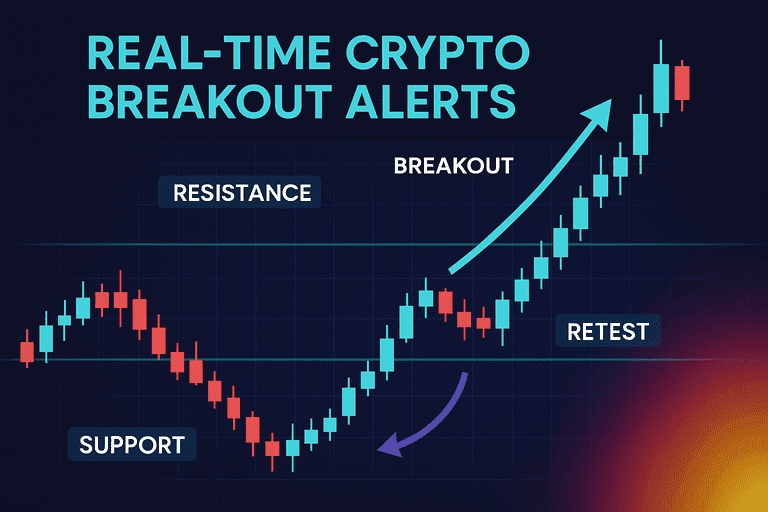
Breakouts are where crypto traders make their fastest profits — and where most traders also get trapped the hardest. In fast markets like Bitcoin, Ethereum, and high-volatility altcoins, being even 30 seconds late can turn a winning breakout into a fakeout or a liquidation.
That’s why real-time crypto breakout alerts have become one of the most valuable tools for scalpers, day traders, and algorithmic traders in 2026. They turn chaotic markets into predictable opportunities by notifying you the moment price, volume, or volatility reaches a critical threshold.
In this complete guide, you’ll learn:
-
What breakout alerts really are
-
How to read high-probability breakout conditions
-
How institutions predict breakouts
-
Why breakout alerts outperform normal indicators
-
How to combine alerts with EMA, RSI, sentiment, and volatility
-
The exact tools you can use to detect breakouts instantly
-
Real trading examples
-
Step-by-step strategies for using alerts efficiently
Let’s dive deep and build your breakout detection system from the ground up.
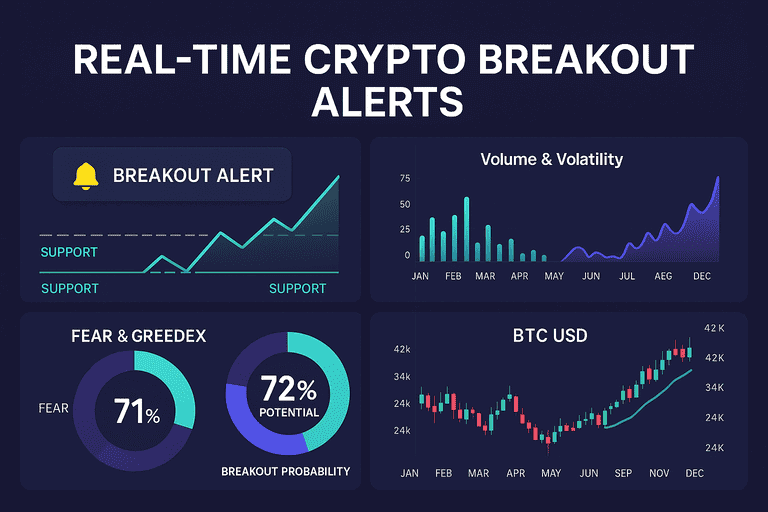
What Are Real-Time Crypto Breakout Alerts?
A real-time breakout alert is an automated signal that notifies you when price breaks through a major level with strong confirmation, such as:
-
Support
-
Resistance
-
Trendlines
-
EMA dynamic levels
-
Volume expansion zones
-
Volatility surges
Breakout alerts analyze live price behavior and alert you instantly when:
-
Volume spikes
-
Candle structure changes
-
Momentum expands
-
Whale orders enter
-
Volatility compressions release energy
They remove guessing from your trading and give you the reaction speed needed for 1-minute charts.
If 1 minute is so fast for you, read 5 Minute Scalping Strategy for Crypto.
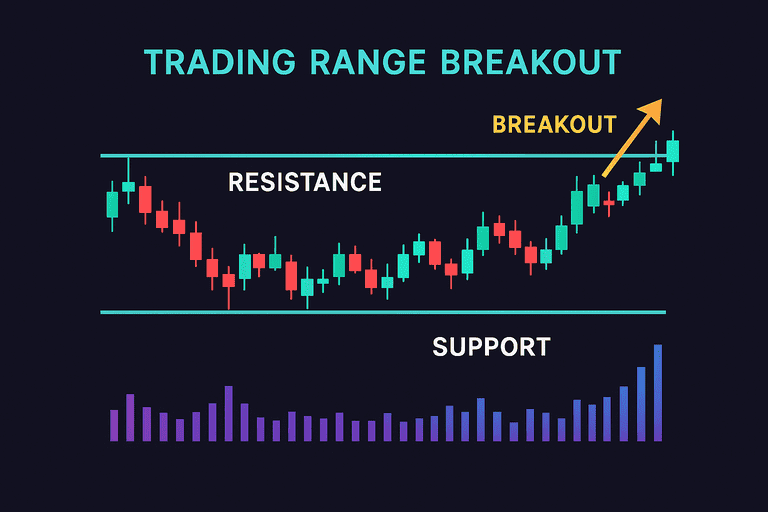
Why Breakouts Matter for Crypto Traders
Crypto is naturally a high-volatility market where price often moves in strong, sudden bursts. These bursts typically begin when price breaks through a key level.
Understanding breakouts helps you:
-
Catch early trends
-
Avoid fakeouts
-
Identify whale positions
-
Predict price acceleration
-
Time entries with precision
Breakouts form more than 70% of crypto’s major moves, especially during:
-
News releases
-
Funding rate shifts
-
High volatility cycles
-
Market session openings
-
Liquidation cascades
-
Altcoin rotations
This is why traders who master breakouts consistently outperform those who rely only on static indicators.
Breakout alerts automate this mastery.
How Breakout Alerts Work Behind the Scenes
Different alert systems use different logic, but most rely on a combination of:
1. Price Levels
When price crosses:
-
Recent highs
-
Recent lows
-
Trendlines
-
Key psychological levels (like $30k, $50k, $100k)
2. Volume Expansion
Breakouts require volume.
An alert triggers when volume spikes above baseline.
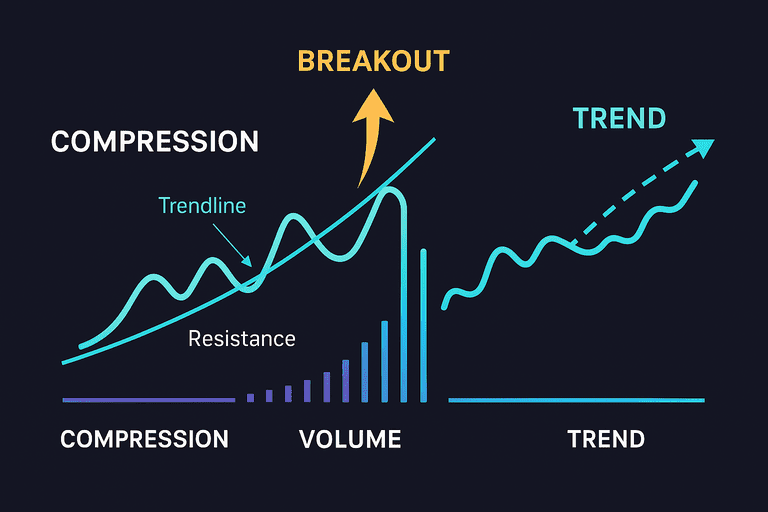
3. Volatility Compression → Expansion
Before a breakout, price forms tight ranges (squeezes).
Alerts detect the release of this compressed energy.
4. Candle Structure
Such as:
-
Large bullish/bearish bodies
-
Expansion candles
-
Momentum candles
-
No upper/lower wicks
5. Market Sentiment Shifts
Long vs short imbalance is often the early signal.
6. EMA or MA Breaks
Dynamic breakouts happen when price slices through:
-
EMA20
-
EMA50
-
EMA200
Your EMA Cross Detector fits perfectly here.
This combination is what separates a real breakout from a weak push.
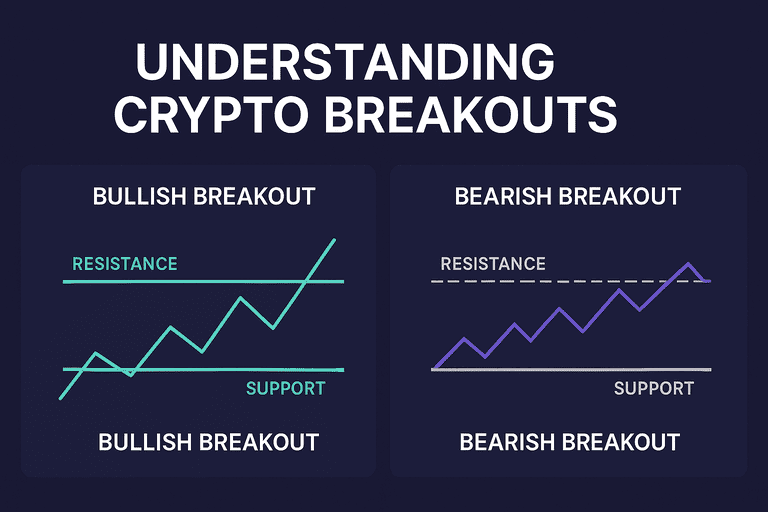
Types of Breakouts You Can Track in Real Time
Breakouts aren’t all the same. Understanding the type helps you time entries and manage your risk.
1. Horizontal Breakouts
These are classic support/resistance breakouts.
Easy to spot and act upon.
Best indicators to use with these:
-
Volume Analyzer
-
EMA trend
-
Long/Short Ratio
-
RSI shifts
2. Trendline Breakouts
These occur when price breaks:
-
descending resistance
-
ascending support
-
wedge formations
-
channels
Trendline breakouts are often explosive because they trigger stop hunts.
3. Volatility Breakouts
When price escapes a low-volatility cluster.
These are ideal for scalpers.
Your volatility-based tools will shine when combined with this.
4. Candle-Pattern Breakouts
These occur when you see:
-
Dojis
-
Hammers
-
Shooting stars
-
Engulfing
-
Breakout-body candles
https://1minscalper.com/how-to-trade-doji-candles-in-crypto-using-a-doji-candle-detector-tool/
5. News-Driven Breakouts
These are triggered by:
-
CPI
-
FOMC
-
ETF news
-
Exchange outages
-
Whale transactions
Fast and often violent.
How to Identify a High-Probability Breakout (Checklist)
Here’s a clean checklist used by professional traders:
Tight consolidation
Volume rising before breakout
Long/short ratio imbalance
Low wick candles
Higher timeframe alignment
EMA direction matches breakout
Volatility expanding
This checklist improves accuracy 10x.
To implement this efficiently, you can use your own ecosystem of tools.
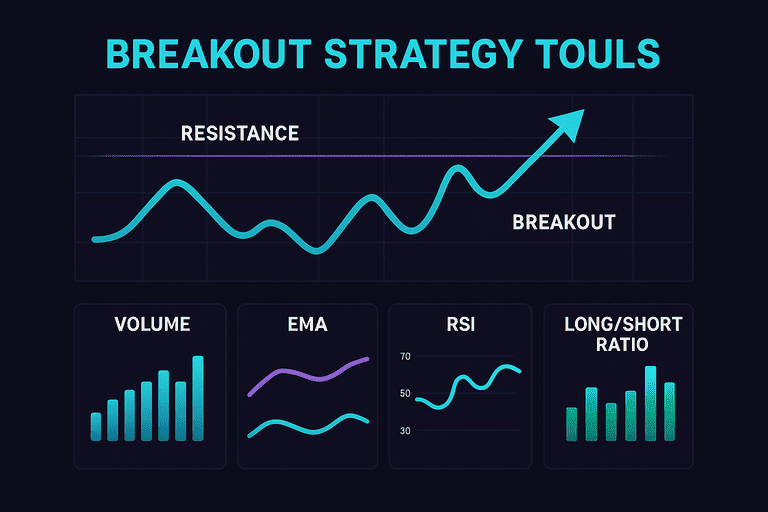
Using Real-Time Alerts With Your Tools (Perfect Combination)
Your website tools give you a massive advantage in real-time breakout detection.
Here’s the ideal combo:
1. EMA Crossover Detector → Trend Direction
EMA cross gives early trend direction confirmation.
2. RSI Overbought/Oversold Scanner → Momentum Clarity
Detects overextended moves before breakout or reversal.
3. Long/Short Ratio Dashboard → Sentiment Exposure
Shows when traders are trapped before a breakout.
4. Crypto Performance Analyzer → Choose the Strongest Coin
Breakouts work best on strong performers.
5. Doji & Candlestick Pattern Detector → Micro Structure
Your doji detector helps identify reversal breakouts.
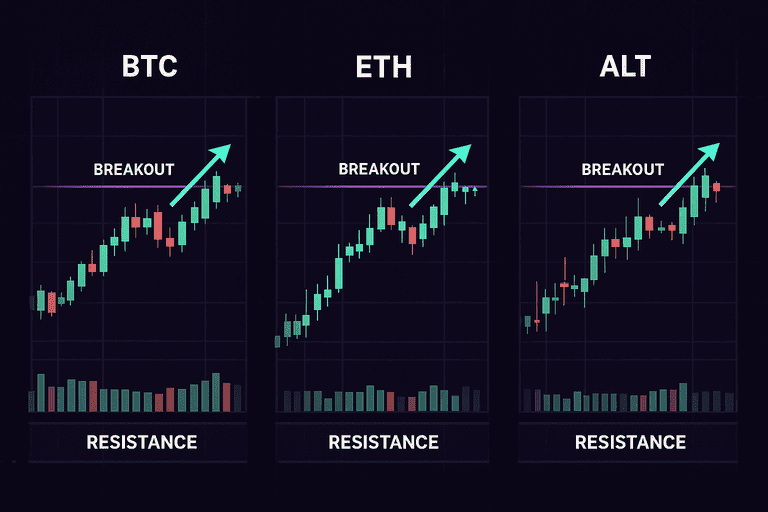
Real Examples of Breakouts (BTC, ETH, ALT)
Example 1: BTC Resistance Breakout (Classic)
-
Consolidation below resistance
-
Volume spike
-
EMA cross
-
Breakout candle with no wick
-
2% move in minutes
Example 2: ETH Volatility Expansion
-
Squeeze on the 1-minute
-
Low-wick candles
-
Sudden breakout
-
Trend lasts 5–10 minutes
Example 3: Altcoin Rotation Breakout (SOL/AVAX/DOGE)
-
Whales rotate liquidity
-
Fast breakout
-
Overshoot beyond resistance
Perfect for scalpers.
Breakout Trading Strategy (Step-by-Step)
Here is a fully optimized strategy for using real-time alerts:
Step 1: Identify the setup
Wait for consolidation.
Step 2: Check indicators
EMA + RSI + Long/Short Ratio.
Step 3: Confirm volume
At least 20–30% higher than baseline.
Step 4: Wait for breakout candle
Full body, low wick.
Step 5: Enter on confirmation
Not on the initial wick.
Step 6: Exit on structure break
Don’t overstay trends.
Common Breakout Mistakes (Avoid These)
-
Entering too early
-
Trading inside the range
-
Ignoring volume
-
Not watching sentiment
-
Using breakout alerts alone
Combine alerts with context.
Conclusion: Real-Time Breakout Alerts Are Your Edge in Fast Markets
Real-time breakout alerts allow you to trade confidently without guessing.
When combined with EMA, RSI, volume, sentiment, and volatility tools, they produce one of the most reliable short-term trading frameworks in fast markets.
If you want to become consistent, mastering breakout alerts is not optional — it’s necessary.
1 thought on “Real-Time Crypto Breakout Alerts (2026 Guide): How to Catch Moves Before They Happen”