
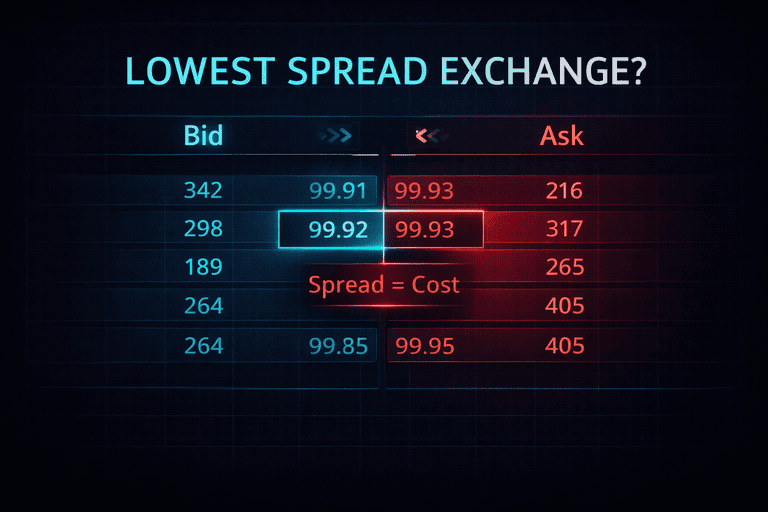
“Lowest spread crypto exchange” is one of the most profitable searches in crypto — not because of hype, but because it signals a trader is already in decision mode.
They’re not asking “what is scalping?”
They’re asking: “Where do I get the cleanest fills?”
But here’s the problem: the lowest spread exchange is not a permanent crown. Spreads change by:
-
pair (BTC/USDT vs random alt)
-
market type (spot vs perps)
-
time of day (liquidity windows)
-
volatility regime
-
exchange incentives & market makers
So the real goal is this:
Find the exchanges and conditions where spreads are consistently tight for the pairs you actually trade.
This guide shows you how to do that — and how to avoid the “marketing spreads” trap.
What “lowest spread” actually means (and why most comparisons are fake)
A lot of articles claim “Exchange X has the lowest spread” like it’s a static feature.
That’s not how spreads work.
A spread is created by:
-
market makers quoting both sides
-
liquidity depth
-
risk/volatility
-
how active traders are
So you should treat “lowest spread” as:
-
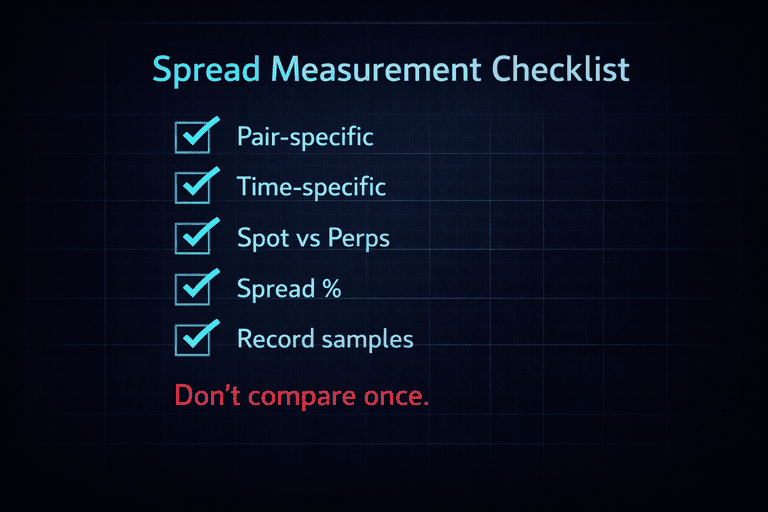
pair-specific
-
time-specific
-
volatility-specific
-
venue-specific
Translation: you’re not hunting a mythical “best exchange.”
You’re building a repeatable process for choosing tight markets.
If you want a real edge, understand spread first.
Spread vs fees vs slippage (why spread can matter more)
Scalpers often obsess over fees — and yes, fees matter.
But spread can be bigger than fees because you pay it constantly:
-
on entry
-
on exit
-
on every trade
Plus, wide spread often comes with:
-
worse slippage
-
more partial fills
-
more fakeouts
Fees are visible. Spread is the hidden cost.
Wide spreads and slippage usually show up together.
What affects spreads on crypto exchanges?
1) Pair liquidity (BTC/USDT vs low-cap alts)
Top pairs are usually tighter. Random coins often have ugly spreads.
2) Spot vs perpetual futures
Perps can be tighter or wider depending on:
-
market maker incentives
-
liquidation flows
-
volatility
3) Time of day (liquidity windows)
There are hours when spreads tighten naturally because more volume is flowing.
Best time for scalping:
Trade during liquidity windows if you want tighter spreads.
4) Market regime
-
quiet markets = sometimes thin books → wider spread
-
volatile markets = market makers widen quotes for protection
Quiet market hours:
Quiet sessions can quietly widen spreads.
Volatility guide:
When volatility spikes, spreads often widen.
5) Execution quality and latency
If your order arrives late, you’ll feel spreads and slippage harder — even when the spread itself isn’t huge.
Latency can turn tight spreads into bad fills.
How to measure spread correctly (the scalper method)
If you want to find the “lowest spread exchange,” don’t measure once. Measure consistency.
Step 1: Use spread % not raw spread
Raw spread (0.50) is meaningless across coins.
Use:
Spread % = (Ask − Bid) / Midprice × 100
Step 2: Measure spreads at the times you trade
Example:
-
take snapshots during your normal trading hours
-
compare across 2–3 exchanges
Step 3: Focus on your actual scalping pair
If you trade BTC/USDT:
-
only compare BTC/USDT
-
don’t let an “altcoin example” mislead you
Which exchanges usually have the tightest spreads?
I’m going to be careful here: I’m not going to claim a single exchange is “always the lowest spread,” because that can be untrue depending on pair/time/regime.
But in general, the exchanges that tend to show tighter spreads are the ones with:
-
high volume on the pair
-
strong market maker programs
-
deep order books
-
stable matching engine performance
So instead of “pick a name,” here’s the smart way:
The scalper’s “tight spread shortlist” process
-
Pick your main pair (example BTC/USDT)
-
Compare 2–4 top venues on that pair
-
Sample spread % during your trading hours
-
Verify execution quality (fills/cancels/latency feel)
-
Pick the best for you and your hours
This keeps the article honest and evergreen.
How to trade to avoid paying spread as much
Even on a good exchange, you can reduce spread cost with execution choices:
1) Use limit orders more often
Limit orders help you enter closer to the bid (for longs) or ask (for shorts).
2) Use post-only when conditions are stable
Post-only can help you avoid taker execution (and often reduces fees too).
[LINK: Internal — Post-only meaning]
Anchor text: “Post-only is a scalper tool for cleaner entries.”
URL: https://1minscalper.com/post-only-order-crypto-meaning/
3) Avoid scalping pairs with consistently wide spread
If spread is always a large % of your target, it’s not a “setup problem.” It’s a market-quality problem.
Spread + execution quality is why exchange choice matters.
Simple rule for scalpers: spread-to-target
This one rule alone filters out a lot of bad trades:
If the spread is more than 20–25% of your typical target, the trade must be A+ or you skip.
Example:
-
Your target = 0.20%
-
Spread = 0.06%
That’s 30% of your target → very expensive.
Recommended next step
If you want tight spreads consistently, don’t chase headlines — build a routine:
-
Trade during high-liquidity windows
-
Use a pre-trade check (spread + volume + volatility)
-
Choose exchanges that perform well for your pair
-
Use maker-style execution when possible
See my top exchanges for scalping (fees + spreads + execution).
FAQ: Lowest Spread Crypto Exchange (Bigger)
Is there one crypto exchange that always has the lowest spread?
No. Spreads vary by pair, market type (spot/perps), time of day, and volatility. The “best” exchange is the one that has consistently tight spreads for the pair you trade during the hours you trade.
Are spreads tighter on spot or futures?
It depends. Some venues have tighter perps spreads because liquidity is concentrated there. Others have tighter spot spreads for certain pairs. Always compare the specific market you trade.
Why do spreads widen suddenly during news or big moves?
Market makers widen spreads to protect themselves when price moves quickly. Liquidity can also get pulled from the book, making the gap bigger.
Does a low spread guarantee better profits?
No. Low spread helps, but you still need:
-
reliable execution
-
low fees
-
low slippage
-
stable platform performance
How many spread samples do I need to compare exchanges?
More than one. A good rule is to take multiple snapshots across your normal trading window (example: 10–30 samples) and compare the average spread % and how often it spikes.
What’s the difference between spread and slippage?
Spread is the visible bid–ask gap. Slippage is getting filled worse than expected. A wide spread often increases the chance of slippage, but they are not the same.
Can I reduce spread cost without changing exchanges?
Yes. Using limit/post-only entries, trading during high-liquidity hours, and avoiding thin pairs can reduce spread cost even on the same venue.
Why does spread matter so much for 1-minute scalping?
Because your targets are small. If the spread is a big percentage of your target, your edge gets crushed quickly.
Are meme coins bad for spread scalping?
Often yes. They can have wide spreads, thin books, and unstable liquidity. You can still trade them, but you need stricter rules and should expect worse execution costs.
What’s a practical spread limit for scalping BTC/USDT?
It depends on your target size. Many scalpers treat spread as “acceptable” only if it stays below ~20–25% of their target move during normal conditions.