
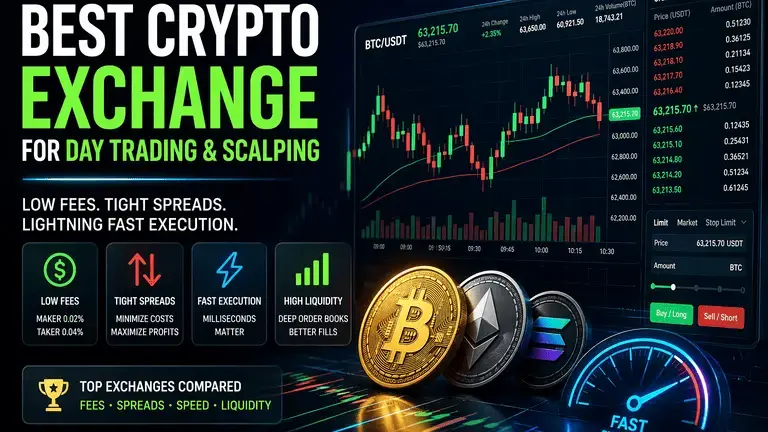
Choosing a crypto exchange for day trading is not just about finding the platform with the lowest advertised fee. That is where many traders get cooked.
A platform can look cheap on the surface, then quietly destroy your edge through wider spreads, slow order execution, bad fills, or poor liquidity when the market starts moving fast. For day traders and scalpers, that matters more than fancy design, influencer hype, or a giant bonus banner on the homepage.
The truth is simple: the best crypto exchange for day trading is the one that lets you enter and exit quickly, keep trading costs under control, and stay consistent when volatility expands. That means you need to look at the full picture, not just one line on a fee page.
If you are trading frequently, small weaknesses compound brutally. A tiny spread disadvantage repeated over dozens of trades can quietly do more damage than a slightly higher maker or taker fee. Slow execution can turn a good setup into a mediocre one. Weak order book depth can increase slippage exactly when you want precision most.
That is why experienced traders judge exchanges through a different lens. They ask better questions:
- How tight is the spread during active hours?
- How fast are fills when momentum hits?
- Does the exchange support proper order control?
- Are fee discounts realistic, or mostly marketing?
- Is the platform strong enough for short-term, repeatable trading?
If you want the short version, the best crypto exchanges for day trading usually combine five things: competitive fees, strong liquidity, fast execution, stable infrastructure, and flexible order types. Miss one of those, and your trading costs can rise fast without you even noticing.
What Actually Makes an Exchange Good for Day Trading?
Most beginners compare exchanges the wrong way. They compare headlines. Serious traders compare friction.
Friction is everything that stands between your trading idea and the actual result you get in the market. That includes fees, spread, slippage, latency, rejected orders, poor fills, and sometimes even platform lag during high-volume periods.
A strong day trading exchange reduces friction. A weak one adds hidden drag to every trade.
For example, imagine two platforms:
- Exchange A charges slightly lower fees but has weaker execution and wider spread.
- Exchange B charges a little more, but fills cleanly and consistently with deeper liquidity.
For a casual investor, Exchange A might look attractive. For a short-term trader, Exchange B can easily be the better business decision.
This is why understanding the real cost structure matters so much. If you have not already dug into the full cost side of scalping and active trading, start with this guide on crypto trading fees explained for active traders. It breaks down why the cheapest-looking option is not always the most profitable one.
The 5 Things You Must Check Before Choosing an Exchange
1. Trading Fees
Yes, fees matter. But not in the simplistic way most review sites present them.
If you are day trading, you need to know:
- maker fee
- taker fee
- futures fee
- withdrawal costs
- any discount system tied to token holdings or volume tiers
The more frequently you trade, the more important this becomes. A trader doing many short-duration trades can bleed a surprising amount of capital from fees alone. This is especially true if most entries and exits are taker orders.
That said, fee tables should never be viewed in isolation. A low-fee exchange with poor fills can still cost you more overall. Still, fee structure is the first filter, and if you want a broader comparison point, this page on the lowest-fee crypto exchanges for active traders is worth reviewing alongside this article.
2. Spread
Spread is one of the most underrated killers in day trading.
You can be “right” on direction and still get a trash result if the bid-ask spread is too wide. On paper, that may seem like a small issue. In real trading, especially on lower timeframes, it directly affects break-even distance and how efficiently you can enter and exit.
This becomes even more important when you trade volatile moments, breakout setups, or fast mean-reversion moves. Wider spreads force you to work harder just to cover transaction cost before your trade even starts making money.
If you want a deeper breakdown, I strongly recommend reading this explanation of how spread impacts crypto scalping performance. It helps traders understand why some markets feel clean while others feel sticky and expensive.
You can also pair that with this dedicated guide to finding a crypto exchange with tighter spreads if spread quality is one of your top priorities.
3. Execution Speed
This one separates real day trading exchanges from pretty websites.
Fast execution is not optional when you are trading short-term. If the market moves quickly and your platform hesitates, requotes, freezes, or fills badly, your setup quality drops immediately.
Execution matters most in these situations:
- market opens and high-activity sessions
- breakout trades
- momentum entries
- short-term reversals
- stop-loss protection in fast conditions
An exchange that executes smoothly under pressure gives you a much more stable operating environment. That is why you should not just look for low fees. You should look for low friction under real market conditions.
If this is your focus, read this piece on fast execution for crypto scalpers and also this more technical guide on exchange latency in crypto trading. Those two topics matter more than most traders realize.
4. Liquidity and Order Book Depth
Many exchanges look fine until the market starts moving.
A thin order book can create ugly fills, especially if you are trading size, using market orders, or entering during strong volatility. Good liquidity helps keep spread tighter and reduces slippage. It also makes your trade management more predictable.
For day traders, liquidity is not just about convenience. It is risk control.
A liquid market makes it easier to scale in, exit fast, and trust that your stop or target has a better chance of executing closer to expectations. A weak market makes everything less precise.
That is why traders who want long-term consistency tend to prefer major, highly liquid pairs and exchanges with deeper books rather than chasing random coins with exciting price action but poor execution quality.
5. Order Types and Trading Controls
A good exchange should not force you into sloppy execution.
At minimum, short-term traders should care about:
- limit orders
- market orders
- stop orders
- post-only orders
- IOC orders
- reduce-only controls for derivatives
These tools matter because they help you control cost and execution quality.
For example, post-only can help you avoid accidentally taking liquidity and paying taker fees when your goal is to sit as maker. If you have not used it properly, this guide on what post-only means in crypto trading is a good refresher.
Likewise, IOC orders can be useful in certain fast-entry situations, and this page on IOC orders in crypto explains where they fit.
Good order controls do not magically make you profitable, but they absolutely make your execution cleaner.
Why “Lowest Fees” Alone Is a Trap
A lot of traders search for something like “best crypto exchange lowest fees” and assume that solves the whole problem.
It does not.
Here is the trap: an exchange can advertise ultra-low fees, then quietly hit you with wider spreads, thinner liquidity, or more slippage during active periods. In that case, you are not actually saving money. You are just paying through a different channel.
The market does not care whether your cost comes from fee, spread, or slippage. Your account feels the same result either way.
That is why the best exchange for day trading is rarely the one with the flashiest “zero fee” headline. In some cases, that can still be useful, but only if the rest of the trading environment is strong.
If that topic interests you, compare this article with your existing piece on trading crypto with ultra-low fees. Used together, the two articles can capture both curiosity traffic and serious comparison traffic.
VIP Tiers, Discounts, and the Real Cost of Volume
Some exchanges become much more competitive once your trading volume increases.
That is where VIP programs, token-based discounts, or futures fee reductions start to matter. If you are serious about active trading, this can improve your operating cost over time. But again, you should treat these as part of the full package, not the whole package.
A trader should ask:
- Are the volume thresholds realistic?
- Is the discount structure transparent?
- Do the benefits apply to spot, futures, or both?
- Are the better tiers worth chasing?
For traders trying to optimize cost over time, this resource on crypto exchange VIP fee tiers and discount structures is a strong supporting read.
Best Exchange Type for Different Day Traders
Not every trader needs the exact same exchange profile.
Beginner day traders
Beginners usually benefit most from a platform with simple layout, strong liquidity on major pairs, clean order entry, and predictable execution. Fancy features matter less than stability and clarity.
Scalpers
Scalpers need the most precision. They should care deeply about spread, latency, order speed, and fee structure. Even a tiny edge in execution can make a huge difference when trades are short and frequent. Your main pillar on the best exchange for crypto scalping is the strongest internal destination for these readers.
Small-account traders
Smaller traders often think they only need low fees, but they also need reasonable order handling and accessible markets. This guide to crypto trading strategies for small accounts can help bridge that audience into your broader funnel.
Signal-based traders
If a trader relies on alerts, dashboards, or execution timing from external tools, exchange quality becomes even more important. A delayed or sloppy exchange can ruin a good signal. Readers in that category may also fit naturally into your guide on crypto trading signals and how they work.
How to Compare Exchanges the Smart Way
Instead of asking “Which exchange is best?” ask:
- Which exchange gives me the cleanest fills on the pairs I actually trade?
- Which one keeps total cost low across my real trading style?
- Which one remains stable during fast conditions?
- Which one supports the order types I need?
- Which one gives me room to scale later?
That is the smarter framework.
Do not compare platforms like a tourist. Compare them like an operator.
A day trader is not buying a logo. A day trader is choosing infrastructure.
My Honest Take
If you are serious about day trading crypto, you should stop thinking in single-variable terms.
Do not chase low fees only.
Do not chase “zero fee” marketing only.
Do not chase bonuses only.
Instead, look for the platform that gives you the best total execution environment:
- competitive fees
- tight spread
- strong liquidity
- fast execution
- reliable order controls
That combination is what supports repeatable short-term trading.
For most traders, the wrong exchange does not cause one giant disaster. It causes constant small leaks. And small leaks are exactly what kill day trading accounts.
Final Thoughts
The best crypto exchange for day trading in 2026 is not the one with the loudest marketing. It is the one that protects your edge.
That means you should evaluate exchanges based on real trading performance, not homepage promises. Look at the full cost stack. Look at spread. Look at speed. Look at order quality. Look at whether the platform still performs when the market gets fast and messy.
That is what serious traders do.
And if your style leans more toward rapid entries, short holding times, and tighter profit targets, continue with the main exchange guide for scalpers next, because that page is the natural deeper step after this article.