
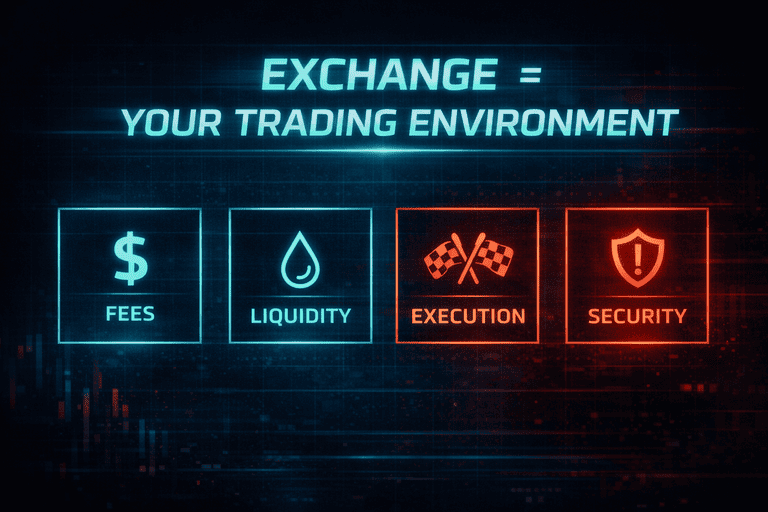
Most people think a crypto exchange is just a place to buy Bitcoin.
That’s the beginner definition.
The real definition is:
A crypto exchange is a marketplace + a custody system + an execution engine + a fee machine.
And the exchange you choose quietly decides:
-
how much you pay per trade (not just “fees”)
-
how clean your fills are
-
how often you get slippage
-
how stressful your trading feels
-
how safe your funds are
-
what you can actually trade (spot, futures, perps, options, etc.)
So yeah… it’s not a small choice.
This guide is meant to be a “base layer” page on your site — broad keyword, big traffic potential — but still written like a trader talking to a trader. Not a Wikipedia page.
What is a crypto exchange (in a useful way)?
A crypto exchange matches buyers and sellers and settles trades.
But the practical part is what matters:
A “good” exchange gives you:
-
stable order execution
-
deep liquidity (so spreads don’t blow out)
-
predictable fees
-
reliable deposits/withdrawals
-
decent risk controls
-
strong account security
A “bad” exchange gives you:
-
weird fills
-
wide spreads when it matters
-
hidden costs
-
withdrawal stress
-
support that disappears when you need it
The two worlds: CEX vs DEX (and why this matters more than people admit)
Centralized exchanges (CEX)
This is what most traders use for scalping/day trading.
Pros
-
strong liquidity on majors
-
tight spreads (usually)
-
advanced order types
-
fast execution + APIs
-
easy fiat onboarding
Cons
-
custody risk (they hold the keys)
-
KYC requirements on most
-
platform risk (freezes, outages, policy changes)
Decentralized exchanges (DEX)
DEX means on-chain trading via smart contracts.
Pros
-
self custody (you keep keys)
-
permissionless access
-
no “account freeze” in the usual sense
Cons
-
gas fees can be brutal
-
MEV / sandwich attacks exist
-
slippage can be wild on small pools
-
execution is slower (blockchain reality)
-
not ideal for fast scalping
Trader reality:
If you’re a 1-minute scalper, most of your “quality execution” comes from CEX environments.
Spot vs Futures vs Perps (what you’re actually trading)
Spot
You buy/sell the asset directly. Simpler, less explosive.
Futures / Perpetuals (Perps)
You trade a derivative contract. Perps are popular because of:
-
leverage
-
easier shorting
-
deep liquidity on major pairs
But perps add extra costs/risks:
-
funding fees
-
liquidation risk
-
fast losses if you oversize
If you touch leverage, you need rules, not vibes. Learn about risk management.
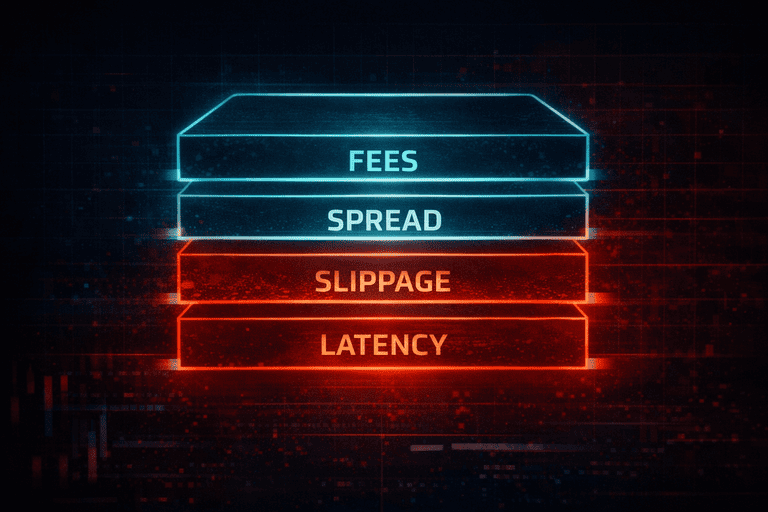
The 4 real costs of trading on exchanges (this is where people get tricked)
Most “exchange comparison” pages only talk about trading fees. That’s half the story.
Cost #1: Trading fees (maker / taker)
This is the obvious one.
Maker vs taker matters a lot more than people think.
Cost #2: Spread (the hidden tax)
Spread is what you pay for urgency. If you market buy and market sell, you pay spread twice.
Spread is the silent cost that eats scalpers.
Cost #3: Slippage (execution reality)
Slippage is when you get filled worse than expected. This hurts the most when:
-
markets move fast
-
liquidity is thin
-
your exchange is slow
If you scalp, slippage is basically a daily expense.
Cost #4: Withdrawals (the “surprise fee”)
Beginners ignore it until they try to move funds and suddenly notice:
-
withdrawal fees
-
chain fees
-
delays
-
risk checks
If an exchange is cheap to trade but painful to withdraw from, it’s not really cheap.
Execution quality: the thing you feel but can’t easily measure
Execution quality is the reason two traders can take the same setup and get different results.
A good exchange has:
-
stable matching engine
-
reliable cancels
-
consistent fills
-
low downtime during volatility
A bad exchange has:
-
laggy confirmations
-
cancel failure nightmares
-
“why did it fill there?” moments
-
random spikes in spread
Latency is the invisible killer for fast traders.
If you scalp, execution speed is part of your edge.
Security and custody: what “safe exchange” really means
“Safe” isn’t one feature. It’s a list of habits and controls.
What you can control
-
2FA (authenticator app, not SMS)
-
anti-phishing code (if supported)
-
withdrawal whitelist (if supported)
-
strong unique password
-
don’t trade on public Wi-Fi
-
don’t keep all funds on the exchange
What the exchange must control
-
operational security
-
cold storage practices
-
withdrawal risk controls
-
transparency (where possible)
Hard truth: even big exchanges can have issues. That’s why smart traders keep only what they need on-platform.
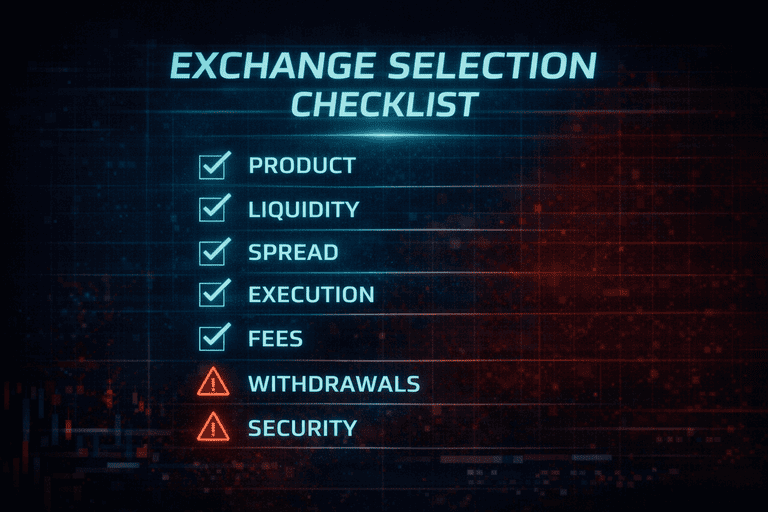
A real “how to choose a crypto exchange” checklist (not marketing)
Here’s how I’d choose, in order, as a trader:
1) What product do you need?
-
spot only?
-
perps?
-
both?
2) Does it have real liquidity on your pair?
You should care about liquidity more than number of listed coins.
3) Are spreads tight during your trading hours?
This matters if you scalp.
Here’s how to think about ‘lowest spread’ properly.
4) Is execution stable when markets move fast?
Test it. Don’t assume.
5) Fees and VIP tiers (only after the first 4)
Fees matter, but they don’t fix bad execution.
VIP tiers can reduce costs, but don’t chase volume.
6) Withdrawal reliability
Do a small test withdrawal before you scale.
The problem with “best crypto exchange” lists
Most lists are affiliate pages in disguise (some aren’t even wrong — they’re just shallow).
What matters is context:
-
your region (routing, restrictions)
-
your pair
-
your trading style (scalper vs swing)
-
your typical order types (maker vs taker)
That’s why I prefer “best exchange for scalping” over generic “best exchange.”
This is the scalper-focused comparison.”
If you’re a scalper, your exchange choice is part of your strategy
A lot of scalpers work hard on entries and ignore the environment.
But your environment decides:
-
how often you get slipped
-
how wide spread gets
-
how fast you can exit when needed
So if you scalp, use this chain:
-
execution reliability
-
spreads
-
fees (and VIP tiers)
Then optimize.
My top exchanges for scalping (fees + spreads + execution).
FAQ: Crypto Exchanges (Deep + Practical)
Are crypto exchanges safe?
Some are safer than others, but no exchange is “risk-free.” The smart approach is:
-
strong account security (2FA, anti-phishing, whitelists)
-
don’t store all funds on exchange
-
test withdrawals early
-
use reputable venues with real liquidity
What’s the difference between CEX and DEX?
CEX is a centralized company matching orders and holding custody.
DEX is on-chain trading via smart contracts where you hold keys.
CEX tends to be better for fast execution. DEX tends to be better for self-custody.
Why do I lose money even when I’m “right” on direction?
Because costs stack:
-
spread
-
fees
-
slippage
-
execution delay
This is especially common in scalping, where targets are small.
What’s the best exchange for beginners?
The best beginner exchange is one with:
-
clear fee structure
-
reliable withdrawals
-
decent liquidity on major pairs
-
strong security tools
Beginners should start spot, small size, and do test withdrawals.
Why does spread widen sometimes even on big exchanges?
Spread widens when liquidity pulls back, volatility spikes, or trading activity changes (like dead hours). It’s normal — but it’s dangerous for scalpers.
Do VIP tiers actually matter?
They matter if you already trade enough volume. But don’t trade extra just to reach a tier — that usually costs more than the discount saves.
Should I trade perps on day one?
If you’re new, no. Perps add liquidation risk and funding. Learn execution and risk control on spot first.
What should I test before trusting an exchange with serious money?
-
deposit speed
-
order execution in normal conditions
-
order execution during volatility
-
cancel/replace behavior
-
test withdrawal (small)
If any of those feel weird, you have your answer.
1 thought on “Crypto Exchanges (2026): The Real Guide to Choosing One Without Paying Hidden Costs”