
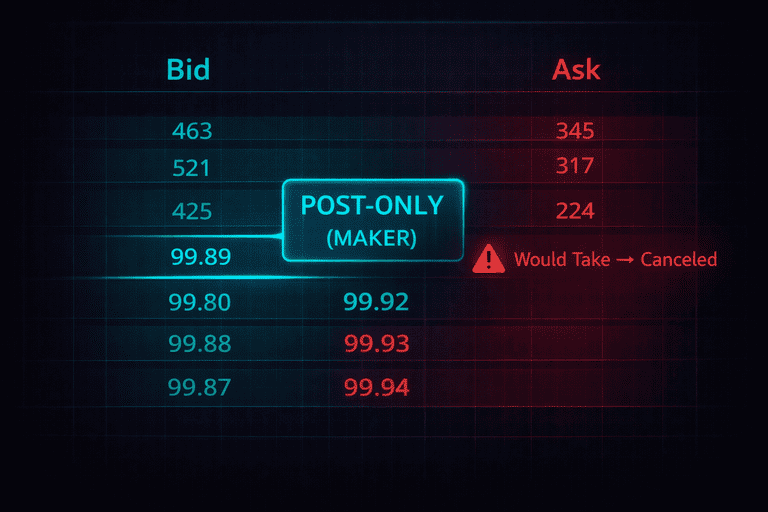
Post-only is one of the most useful order settings in crypto — and one of the most misunderstood.
Most traders discover it after they realize:
-
they’re paying taker fees too often, or
-
their “perfect” entries are getting chewed by spread + slippage, or
-
they keep accidentally crossing the book and getting filled instantly at the worst moment.
A post-only order is basically your way of telling the exchange:
“Place my limit order on the book — but do NOT let it execute immediately as a taker.”
If it would execute instantly, the exchange cancels it (or rejects it). That’s the whole point.
What does “post-only” mean in crypto?
A post-only order is a limit order that is guaranteed to add liquidity (maker), not remove it (taker).
In plain terms:
-
If your limit order would immediately match an existing order → it would be taker
-
Post-only prevents that by canceling/rejecting the order instead
So post-only = “maker or nothing.”
Post-only vs limit order (what’s the difference?)
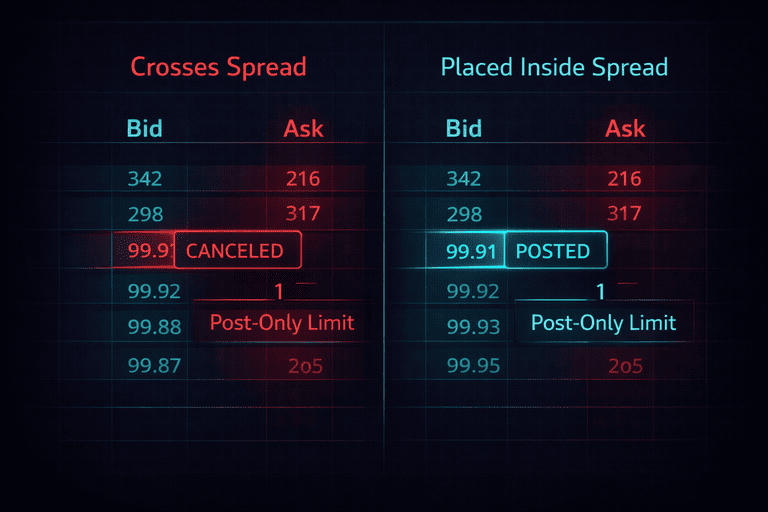
A normal limit order can still execute immediately if you place it aggressively.
Example:
-
Best ask = 100.10
-
You place a limit buy at 100.10
That will likely fill instantly → you just became a taker.
With post-only enabled:
-
That same order would be canceled/rejected, because it would take liquidity.
Normal limit order: “Fill me at this price or better.”
Post-only limit order: “Only rest on the book. Don’t fill instantly.”
Why scalpers use post-only
Post-only is popular with scalpers for 3 reasons:
1) It helps you avoid taker fees
Many exchanges charge lower maker fees than taker fees.
If you’re trading a lot, this adds up fast.
Maker vs taker fees matter a lot for high-frequency scalping.
2) It improves entry quality (less spread damage)
If you enter at the bid (as a maker), you’re not paying the full spread like a market order does.
Spread is the silent tax — post-only helps you avoid paying it unnecessarily.
3) It forces discipline
Post-only prevents you from panic-clicking a worse entry.
Your order either sits at a controlled price… or it doesn’t happen.
That’s a feature, not a bug.
When post-only orders get canceled (and why)
Post-only gets canceled or rejected when your order would execute immediately.
This happens when:
-
you place your buy too high (near/above ask)
-
you place your sell too low (near/below bid)
-
spread is tight and price moves while you’re placing the order
-
volatility spikes and the book shifts fast
Important: post-only is not “broken” when it cancels.
It’s doing its job: preventing taker execution.
How scalpers use post-only (practical setups)
Post-only works best when you’re entering in situations where you want the market to come to you.
Setup A: Pullback entry in a trend
Instead of buying the breakout candle (taker), you:
-
place post-only near the bid during the pullback
-
let price tag your limit order
-
get maker execution (often cheaper + cleaner)
Setup B: Mean reversion scalps
If you’re fading extremes, post-only makes sense because you’re intentionally trying to catch a bounce at a specific level.
Setup C: Range scalping
Range edges + post-only entries can reduce spread/fee leakage — as long as the range is real and liquidity is stable.
Best time for scalping :
Post-only works best during liquid hours with stable books.
Quiet market hours :
In dead hours, post-only can miss fills because price jumps around.
Post-only is NOT always better (the tradeoff)
Post-only sounds perfect until you meet its enemy: missed fills.
Post-only wins when:
-
market is stable
-
spreads are normal
-
you have time to wait for entry
-
your edge comes from precision
Post-only struggles when:
-
volatility is exploding
-
you need urgent entry
-
breakout is moving fast
-
order book is jumping (fast cancels)
In those moments, post-only may cancel repeatedly and you’ll get left behind.
So the real skill is knowing when to use post-only vs not.
Post-only + latency: a common scalper pain
If your connection or exchange is slow, post-only can cancel more often because:
-
by the time your order reaches the exchange, price has moved
-
what was a maker order becomes taker → exchange cancels it
Latency can cause post-only orders to fail more often.
This is why some traders think post-only is “unreliable” — but it’s often just latency + fast market conditions.
Best practice rules for using post-only
Here are clean rules you can actually apply:
-
If you’re chasing price, don’t use post-only.
-
If spread is wide relative to your target, post-only becomes more valuable.
-
If post-only cancels 2–3 times in a row, don’t fight the market.
-
Use post-only during high-liquidity hours, not random dead hours.
-
Don’t size too big — you want to get filled cleanly at the top of book.
1-Minute Scalping Strategy (Explained Clearly)
Recommended next step
If you scalp frequently, post-only is one of the simplest ways to reduce “execution leakage” — but only when conditions are right.
If you want the best overall results, you also need:
-
tight spreads
-
low fees
-
stable execution
best exchange for scalping crypto :
Not all exchanges treat makers the same — execution quality matters.
FAQ: Post-Only Orders in Crypto
What does “post-only” mean in crypto?
A post-only order is a limit order that must add liquidity to the order book. It’s designed to keep you as a maker, not a taker. If the order would execute immediately (take liquidity), the exchange cancels or rejects it.
What’s the difference between post-only and a normal limit order?
A normal limit order can still execute instantly if placed at a price that crosses the book (for example, a buy limit at the current ask).
A post-only limit order will not execute instantly. If it would fill immediately, it gets canceled/rejected so it never becomes a taker trade.
Why does my post-only order get canceled instantly?
Because it would have matched an existing order right away (meaning it would “take” liquidity). Common reasons:
-
you placed the buy too high (near/above ask)
-
you placed the sell too low (near/below bid)
-
price moved while the order was being sent
-
spread is tiny and the top-of-book shifts fast
Is a post-only order always cheaper?
Not always. It’s often cheaper on fees (maker can be lower), and it can reduce spread damage.
But the tradeoff is missed fills, which can cost you more if your strategy depends on immediate execution.
Does post-only guarantee maker fees?
It strongly pushes your order into maker behavior because it must post to the book first.
However, fee rules vary by exchange and market type, so the “maker guarantee” depends on how that exchange defines maker/taker and when fees are calculated. The intent of post-only is maker-only execution.
Can post-only still get filled quickly?
Yes. It can post to the book and then get hit immediately by another trader right after posting — that’s still usually maker behavior because your order was resting first.
Is post-only good for scalping?
Yes — in the right conditions. It’s best when:
-
you want precise entries
-
the market is stable
-
spreads are meaningful relative to your target
-
you’re trading pullbacks, range edges, or mean reversion
If you’re chasing a breakout, post-only can be painful.
When should I NOT use post-only?
Avoid post-only when:
-
the move is fast and you need urgency
-
volatility is spiking
-
liquidity is jumping around
-
you’re exiting for risk control (you need out, not “maybe fill”)
-
you’re trading news candles or liquidation cascades
Can I use post-only for take-profit (TP) orders?
Yes, and it can be a smart way to reduce fees if:
-
the market is calm
-
you’re not trying to exit instantly
But if price is dumping and you need to get out quickly, post-only is the wrong tool.
Can I use post-only for stop-loss orders?
Usually no. Stop-loss orders are designed for risk control and urgency.
Post-only is about resting on the book and avoiding taker fills. Those goals conflict during fast moves.
Why does post-only fail more often in fast markets?
Because the top of the book changes rapidly. What looked like a safe maker price can become taker by the time it reaches the exchange, so the exchange cancels it. In fast markets, post-only is more likely to “miss” because price doesn’t sit still.
Does post-only prevent slippage?
It can reduce slippage risk, but doesn’t eliminate it.
-
If you’re a maker and get filled passively, slippage is often lower.
-
But you can still get unfavorable fills if the market moves, or if you keep chasing with new orders.
Post-only mainly helps you avoid paying the spread and rushing into bad execution.
Is post-only better than market orders?
It’s not “better,” it’s a different tool:
-
Market orders: high fill rate, worse price quality (spread + slippage risk)
-
Post-only: better price quality, lower fill rate (more missed trades)
Scalpers should choose based on setup type and conditions.
What’s the simplest way to place a post-only order correctly?
For a buy:
-
place your post-only limit at or below the bid (not at the ask)
For a sell:
-
place your post-only limit at or above the ask (not at the bid)
If you place it so it would instantly match, it will cancel.
Why do I keep missing entries when using post-only?
Because you’re demanding the market come to your price. If price doesn’t retrace to your level, you won’t get filled. This is normal. Post-only is perfect for pullbacks and range edges, not for chasing momentum.
What does “Post Only (Cancel if Taker)” mean?
That’s exactly the same concept:
If your order would become a taker order, the exchange cancels it automatically instead of allowing taker execution.
What is “maker” and “taker” in simple terms?
-
Maker: you place an order that sits on the book and provides liquidity
-
Taker: you place an order that immediately matches an existing order and removes liquidity
Post-only is designed to keep you in maker behavior.
Can post-only reduce the spread cost in scalping?
Yes. If you consistently enter as a maker near the bid (or exit near the ask), you’re less likely to donate the spread every time. For small targets, this matters a lot.
Does post-only work the same on every exchange?
The concept is the same, but behavior can vary:
-
how quickly the exchange cancels
-
whether the UI shows it as “rejected” vs “canceled”
-
how fee tiers treat maker/taker
-
how stable execution is during volatility
If an exchange is unstable during spikes, post-only may cancel more often.
Can latency make my post-only orders cancel?
Yes. If your order arrives late, price may have moved so that your limit would cross the spread → the exchange cancels it. This makes post-only feel “unreliable” during volatile moments, even though it’s just doing its job.
Is post-only good for small accounts?
Often yes, because small accounts are more sensitive to fee leakage and spread tax. Post-only can help reduce costs — as long as you don’t force it in markets where fill rate matters more.
What’s a practical rule for scalpers using post-only?
Try this clean rule:
-
Use post-only for pullbacks, ranges, mean reversion
-
Avoid post-only for breakouts and emergency exits
-
If it cancels repeatedly, stop fighting it — conditions aren’t right
1 thought on “Post-Only Order Crypto Meaning: The Scalper’s Tool for Cleaner Entries”