
Fast trading attracts people for one reason: efficiency.
You don’t want to wait weeks for a setup.
You don’t want to stare at charts all day either.
You want a balance between speed, clarity, and control.
That’s exactly where 5-minute scalping sits.
Not as frantic as 1-minute charts.
Not as slow as higher-timeframe trading.
Fast enough to stay engaged — slow enough to stay rational.
This article is a complete guide to 5-minute scalping strategies for crypto traders.
Most traders searching for a profitable 5 minute scalping strategy want something simple:
a clean setup
clear entries
fast results
And yes — a 5 minute scalping strategy can work.
But here’s the part most guides don’t explain:
<strong>the strategy itself is not what decides your results.</strong>
Two traders can use the exact same 5 min scalping strategy…
and one grows steadily while the other slowly loses money.
Why?
Because of execution.
Fees.
Spreads.
Slippage.
On small timeframes, these matter more than the setup itself.
That’s why many traders struggle even with a “best 5 minute scalping strategy.”
If you ignore this, you’re trading with a hidden disadvantage.
Not hype. Not promises. Just a clear framework that actually makes sense in real market conditions.
If you’ve tried 1-minute scalping and felt it was too intense — or higher-timeframe trading felt too slow — this is the middle ground most traders are actually looking for.
What Is 5-Minute Scalping in Crypto Trading?
5-minute scalping is a short-term trading style where:
-
Trades are executed using the 5-minute chart
-
Positions are typically held from a few minutes to under an hour
-
The goal is to capture small but structured price movements, not big swings
Despite the word “scalping,” this style is not chaotic when done properly.
In fact, many traders use 5-minute scalps as:
-
A calmer alternative to 1-minute scalping
-
A faster version of intraday trading
-
A way to trade with structure without constant stress
The key difference is context.
On a 5-minute chart, price behavior is:
-
Less noisy
-
More readable
-
Easier to align with higher-timeframe bias
That alone removes many of the problems traders face on lower timeframes.
If you looking for the BTCUSDT signals you can check them here.
Why Many Traders Prefer 5-Minute Scalping Over 1-Minute Scalping
This matters — especially if you already have a strong 1-minute pillar.
1-minute scalping is powerful, but it’s not for everyone.
Here’s why many traders migrate to the 5-minute timeframe:
Less Noise, Better Structure
On 1-minute charts:
-
Fake breakouts are constant
-
Micro-volatility dominates
-
Overtrading becomes tempting
On 5-minute charts:
-
Structure forms more clearly
-
Levels are more respected
-
Setups require less guessing
Fewer Trades, Better Decisions

5-minute scalping naturally:
-
Reduces trade frequency
-
Increases selectivity
-
Improves decision quality
This is especially important for traders with small or medium accounts, where fees and execution matter more.
Easier Risk Management
Stops on 5-minute charts:
-
Are usually wider
-
Get hit less randomly
-
Reflect actual market structure
That alone makes this style more sustainable for many traders.
If 1-minute scalping feels too fast, many traders find the 5-minute chart offers a better balance between speed and clarity.
5-Minute Scalping vs 1-Minute Scalping: What’s the Real Difference?
Traders often compare 5-minute scalping and 1-minute scalping because both styles aim to capture short-term price movements. On the surface, they seem similar. In practice, they feel very different to trade.
Understanding the difference is important, especially if you are deciding which timeframe fits your personality, schedule, and risk tolerance.
Both approaches can work — but they reward different strengths.
Speed vs Structure
The biggest difference between 1-minute and 5-minute scalping is pace.
1-minute scalping is extremely fast. Price moves quickly, setups form and disappear within seconds, and decisions must be made almost instantly. This style favors traders who:
-
React quickly
-
Handle pressure well
-
Can maintain focus for short, intense sessions
5-minute scalping slows the process down.
On a 5-minute chart, price action has more time to develop. Pullbacks, consolidations, and breakouts are easier to see, and decisions are less rushed. This makes the 5-minute timeframe more forgiving for many traders.
Trade Frequency and Overtrading Risk
1-minute scalping naturally produces more trade opportunities. While this can be attractive, it also increases the risk of overtrading.
Frequent trades mean:
-
More fees
-
More execution errors
-
More emotional fatigue
5-minute scalping reduces trade frequency. Traders are forced to be more selective, which often leads to better decision-making and fewer impulsive entries.
For traders who struggle with discipline, this difference alone can be significant.
Noise and False Signals
Lower timeframes contain more noise.
On the 1-minute chart:
-
False breakouts are common
-
Small price fluctuations can trigger stops
-
Market randomness plays a bigger role
The 5-minute chart filters out much of this noise. Price levels tend to hold more consistently, and market structure is clearer. This does not eliminate losses, but it reduces the number of trades that fail purely due to random price movement.
Risk Management and Position Sizing
Because 1-minute scalping uses tighter stops, position sizing often feels more aggressive. Small mistakes can have an outsized impact on results.
In 5-minute scalping:
-
Stops are usually wider
-
Position size is smaller
-
Risk feels more controlled
This often makes risk management easier to follow, especially for traders working with small or medium-sized accounts.
Mental Load and Sustainability
Mental fatigue is an underrated factor in trading.
1-minute scalping demands constant attention. Even short sessions can feel exhausting. Over time, this pressure can lead to mistakes, emotional decisions, or burnout.
5-minute scalping is generally more sustainable. There is more time between decisions, more room to think, and less urgency. Many traders find they can trade longer and more consistently using the 5-minute timeframe.
Side-by-Side Comparison
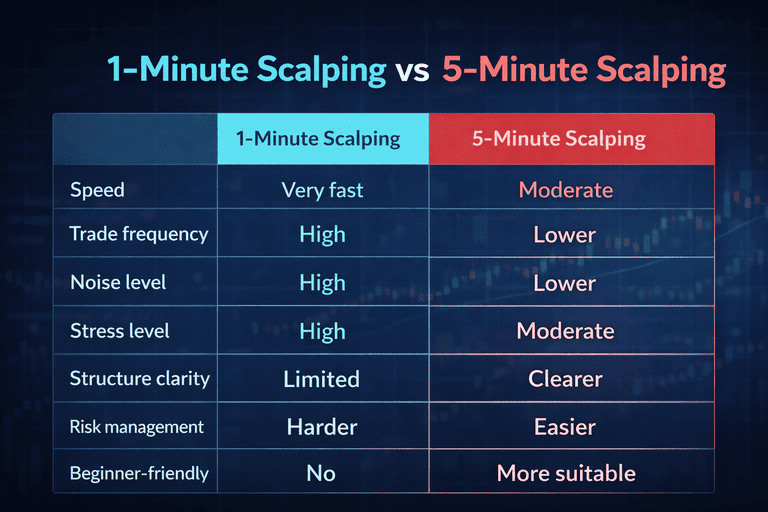
| Aspect | 1-Minute Scalping | 5-Minute Scalping |
|---|---|---|
| Speed | Very fast | Moderate |
| Trade frequency | High | Lower |
| Noise level | High | Lower |
| Stress level | High | Moderate |
| Structure clarity | Limited | Clearer |
| Risk management | Harder | Easier |
| Beginner-friendly | No | More suitable |
Which One Is Better?
There is no universal answer.
Some traders thrive on speed and intensity. Others perform better with structure and patience. Many experienced traders use both styles, depending on market conditions.
A common path is:
-
Start with 5-minute scalping to build discipline
-
Move to 1-minute scalping once execution skills improve
Who 5-Minute Scalping Is Best For
5-minute scalping is ideal if you:
-
Want active trading without constant screen pressure
-
Prefer structure over speed
-
Trade before or after work
-
Manage smaller accounts where overtrading hurts
-
Want a stepping stone between scalping and day trading
It’s also one of the best timeframes for learning execution discipline, because mistakes are easier to see and correct.
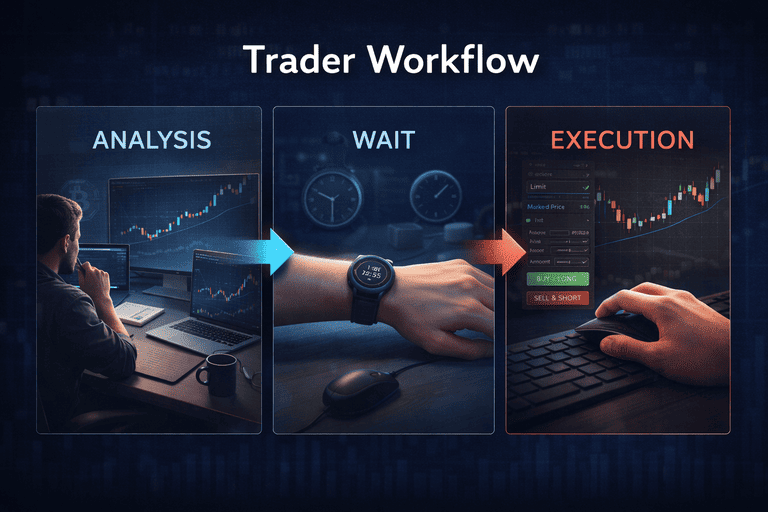
The Core Principle Behind Any 5-Minute Scalping Strategy
Before indicators, patterns, or entries, there is one rule:
You trade structure first, speed second.
If you treat the 5-minute chart like a faster 1-minute chart, you’ll fail.
If you treat it like a structured decision-making tool, it works.
Everything else in this guide builds on that idea.
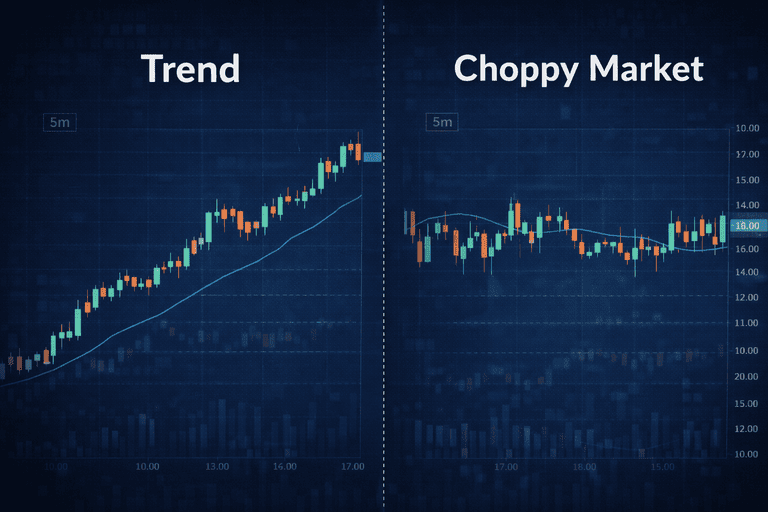
Market Conditions That Favor 5-Minute Scalps
Not all markets are equal.
The 5-minute timeframe works best when:
-
There is clear intraday direction
-
Volatility exists, but isn’t extreme
-
Liquidity is healthy
Ideal Conditions
-
London or New York session
-
Strong trend on higher timeframes
-
Clean pullbacks, not wild spikes
Conditions to Avoid
-
Extremely low volatility
-
Random chop
-
Post-news chaos without direction
Knowing when not to trade is part of the strategy.
Higher-Timeframe Context: The Hidden Edge
One of the biggest advantages of 5-minute scalping is how well it integrates with higher timeframes.
A simple approach:
-
Use 15-minute or 1-hour chart for bias
-
Use 5-minute chart for execution
You’re not predicting.
You’re aligning.
When higher timeframes agree with your 5-minute setup, probability improves — without increasing complexity.
A Practical 5-Minute Scalping Strategy (Framework, Not a Trick)
This is not a magic setup.
It’s a repeatable framework.
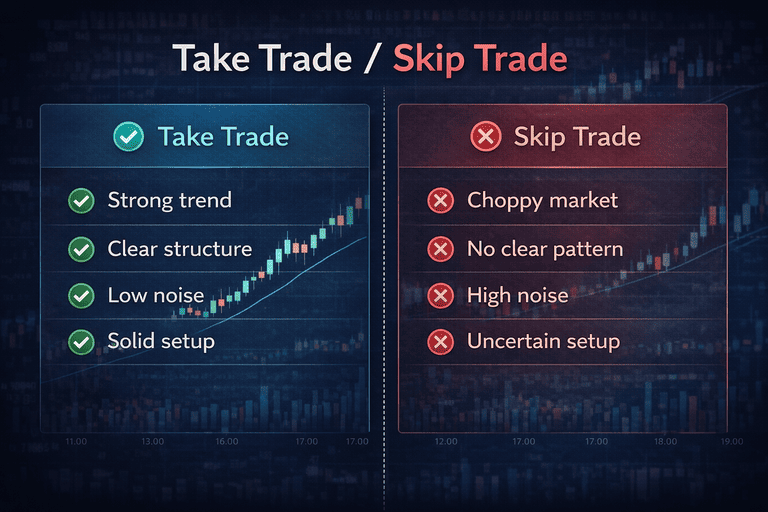
Step 1: Identify Direction
Use higher timeframe context to answer:
-
Is price trending up, down, or ranging?
If the answer isn’t clear, you don’t trade.
Step 2: Wait for 5-Minute Structure
You’re looking for:
-
Pullbacks in trends
-
Clear support or resistance reactions
-
Consolidation before continuation
No rush. Waiting is part of the strategy.
Step 3: Define Risk Before Entry
Before clicking anything:
-
Where is your invalidation?
-
Is the stop logical or forced?
-
Is the trade worth the risk after fees?
If risk doesn’t make sense, skip.
Step 4: Execute With Intent
Execution should feel:
-
Calm
-
Planned
-
Boring
If it feels emotional, you’re probably late.
Position Sizing for 5-Minute Scalping
This is where many traders quietly fail.
Because trades last longer than 1-minute scalps:
-
Stops are wider
-
Position size must be smaller
-
Risk must stay consistent
A common mistake is sizing too large because setups “look cleaner.”
They are cleaner — but losses still happen.
Risk Management Rules That Actually Work
Keep this simple:
-
Risk 0.5%–1% per trade
-
Maximum daily loss: 2%
-
Stop trading after 2–3 consecutive losses
5-minute scalping rewards discipline more than aggression.
If you wanna go more In-depth read Crypto Risk Management Strategies.
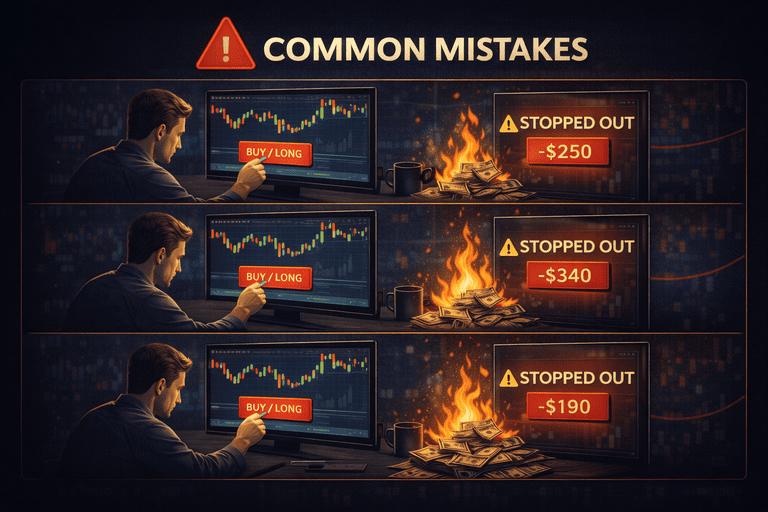
Common Mistakes in 5-Minute Scalping
Most mistakes come from impatience.
-
Trading without higher-timeframe bias
-
Entering mid-range instead of structure
-
Overtrading because setups “almost” fit
-
Ignoring fees on frequent trades
-
Treating 5-minute charts like 1-minute charts
These mistakes don’t destroy accounts instantly — they drain them slowly.
Journaling for 5-Minute Scalps
Your journal should answer:
-
Was higher-timeframe bias clear?
-
Did I wait for structure?
-
Did I respect my stop?
-
Did I trade too much?
Track process, not just results.
Execution quality matters more in short-term trading than most people realize. Spreads, fees, and order handling can quietly affect results, which is why choosing the right trading platform is part of the process.
5-Minute Scalping vs Other Trading Styles
vs 1-Minute Scalping
-
Fewer trades
-
Less stress
-
Cleaner structure
vs Day Trading
-
Faster feedback
-
Shorter exposure
-
More execution-focused
vs Swing Trading
-
No overnight risk
-
More activity
-
Requires discipline
There’s no “best” style — only what fits your personality.
Can You Build Consistency With 5-Minute Scalping?
Yes — but not by chasing perfection.
Consistency comes from:
-
Surviving bad days
-
Avoiding emotional trades
-
Repeating a simple process
-
Respecting market conditions
Most traders fail not because the strategy is bad, but because execution is inconsistent.
Final Thoughts: Why 5-Minute Scalping Deserves Its Own Pillar
This timeframe sits in a powerful position:
-
Fast enough to stay engaged
-
Slow enough to stay rational
-
Structured enough to build skill
If you master 5-minute scalping:
-
1-minute charts become easier
-
Higher-timeframe trading becomes clearer
-
Your execution improves across all styles
This is not a shortcut.
It’s a foundation.
Learn More:
Frequently Asked Questions About 5 Minute Scalping Strategy (Crypto)
What is a 5 minute scalping strategy in crypto?
A 5 minute scalping strategy crypto traders use is a short-term trading method based on the 5-minute chart. Traders look for small, repeatable price movements using structured setups such as breakouts, pullbacks, or support and resistance reactions. The goal is fast execution with controlled risk, not holding positions for long trends.
Is a profitable 5 minute scalping strategy realistic?
A profitable 5 minute scalping strategy is possible, but profitability depends more on execution and risk control than indicators. Traders who manage position size, avoid overtrading, and trade during high-liquidity sessions tend to perform better than those chasing every candle.
Is crypto 5 min scalping better than 1 minute scalping?
Crypto 5 min scalping is often more stable than 1-minute scalping because the 5-minute chart has less market noise. It provides clearer structure and fewer false breakouts. Many traders prefer it because it reduces emotional pressure and transaction costs.
Can beginners use a 5 minute scalping strategy?
Yes. Many beginners find a 5 min scalping strategy crypto approach easier than ultra-fast timeframes. The slightly slower candle formation helps traders read price action more clearly and make more structured decisions. However, strict risk management is still required.
How many trades per day do 5 minute scalpers take?
Most 5 minute scalpers take between one and five trades per session. High-quality setups matter more than trade frequency. Overtrading is one of the biggest reasons traders fail on lower timeframes.
What are good 5 minute scalping examples?
Common 5 minute scalping examples include:
-
Breakout + retest entries
-
Pullbacks in intraday trends
-
Range high/low rejections
-
EMA crossover momentum entries
The key is alignment with higher-timeframe direction.
Should I use a trading journal for 5 min scalping?
Yes. A trading journal for 5 min scalping is extremely valuable. Because trades are frequent and small, tracking win rate, execution quality, and emotional control helps identify patterns in performance. Data improves consistency.
Can 5 second scalping strategy work in crypto?
A 5 second scalping strategy is significantly more aggressive than 5-minute scalping and usually requires advanced execution speed and very low fees. For most retail traders, the 5-minute timeframe is more sustainable and realistic.
What is the best higher timeframe for 5 minute scalping?
Most traders combine the 5-minute chart with the 15-minute or 1-hour chart. The higher timeframe defines overall direction, while the 5-minute chart is used for precise entries and exits.
Is 5 minute scalping suitable for small accounts?
Yes. A 5 minute scalping strategy crypto traders use for small accounts can work well if risk per trade stays between 0.5% and 1%. Because trades are structured and not ultra-high frequency, fees are easier to manage than with 1-minute scalping.
What is the biggest mistake in 5 minute scalping?
The biggest mistake is treating the 5-minute chart like a gambling timeframe. Entering without higher-timeframe bias, forcing trades, or increasing size after losses quickly destroys consistency.
Can 5 minute scalping be profitable long term?
Yes, but only if the trader follows a repeatable process. Long-term profitability in 5-minute scalping depends on risk management, discipline, and execution quality—not on a single indicator.
12 thoughts on “5-Minute Scalping Strategy for Crypto Traders (A Practical, Balanced Approach)”