
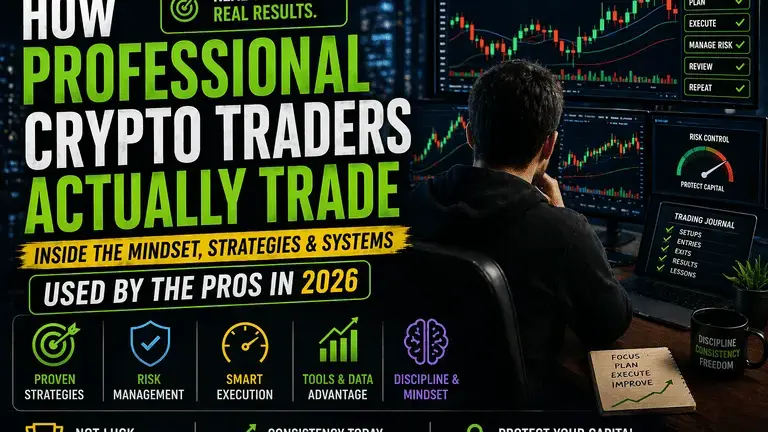
Most people imagine professional traders as geniuses who predict the market perfectly.
That’s not reality.
Professional traders don’t win because they predict everything correctly.
They win because they manage risk, control execution, and stay consistent.
The difference between beginners and professionals is not intelligence.
👉 It’s structure.
In this guide, we break down how professional crypto traders actually operate — from strategy to execution — and what you need to copy if you want to level up.
Professionals Don’t Trade Randomly
Beginner traders jump between:
- indicators
- strategies
- coins
- timeframes
Professionals do the opposite.
They focus on:
- one system
- one approach
- repeatable setups
They don’t ask:
👉 “What strategy should I use today?”
They ask:
👉 “Is my setup present or not?”
If not, they don’t trade.
That discipline alone separates winners from losers.
If you don’t have a structured system yet, this breakdown of a
👉 rule-based one-minute trading approach
is a solid starting point.
Professionals Focus on Execution, Not Prediction
This is where most people fail.
Beginners:
- try to predict direction
- chase perfect entries
- overanalyze
Professionals:
- execute defined setups
- accept imperfect entries
- focus on consistency
They know something critical:
👉 You don’t need to be right every time to make money.
You need:
- controlled losses
- repeatable wins
Execution > prediction.
Risk Management Is Everything
Ask any professional trader what matters most.
They won’t say:
- indicators
- signals
- market knowledge
They will say:
👉 Risk management
Because without it:
👉 nothing else matters
Professionals:
- risk small per trade
- use stop losses
- avoid emotional decisions
- protect capital above all
If you ignore this, you lose — no matter how good your strategy is.
Start here:
👉 practical crypto risk management framework
They Understand Costs (Most Beginners Don’t)
This is a silent killer.
Professionals deeply understand:
- trading fees
- spread
- slippage
- execution quality
Because these affect every trade.
Beginners think:
👉 “I’m profitable because my trades win”
Professionals think:
👉 “Am I profitable after costs?”
That’s a huge difference.
If you’re trading short-term, you must understand this:
👉 hidden costs of scalping explained clearly
Professionals Use the Right Tools
They don’t manually scan charts all day.
They use tools to:
- detect setups
- analyze markets
- filter opportunities
- reduce workload
Modern trading is not just manual.
It’s assisted.
For example:
👉 how to use a crypto performance scanner effectively
can help reduce decision time significantly.
They Trade Less, But Better
Beginners think:
👉 more trades = more profit
Professionals know:
👉 more trades = more mistakes
They wait for:
- high-probability setups
- strong confirmation
- optimal conditions
Then they act.
This reduces:
- emotional stress
- bad entries
- inconsistency
Trading is not about activity.
👉 It’s about precision.
They Choose Exchanges Carefully
This is massively underrated.
Professionals care about:
- execution speed
- liquidity
- spread
- reliability
Because these directly affect results.
A slow or inefficient exchange can:
- ruin entries
- increase losses
- reduce profitability
That’s why they don’t just pick random platforms.
👉 see what actually matters when choosing a trading exchange
They Control Emotions (Not Eliminate Them)
This is important.
Professionals still feel:
- fear
- greed
- hesitation
But they don’t act on them blindly.
They use:
- rules
- systems
- discipline
To control behavior.
Beginners react.
Professionals execute.
They Use Multiple Timeframes
Professional traders rarely rely on one timeframe.
They combine:
- higher timeframe → direction
- lower timeframe → entry
This gives:
- better context
- cleaner entries
- stronger confirmation
If you only trade one timeframe, you’re missing information.
They Adapt to Market Conditions
Markets change.
Professionals adjust.
For example:
- trending market → trend strategies
- ranging market → scalping or mean reversion
- high volatility → faster trades
- low volatility → fewer trades
If you don’t adapt, your strategy stops working.
To understand this better:
👉 how volatility impacts short-term trading performance
They Track Performance
Professionals don’t rely on memory.
They track:
- wins and losses
- strategy performance
- mistakes
- improvements
This allows them to:
- refine strategies
- identify weaknesses
- improve consistency
Beginners repeat mistakes.
Professionals analyze them.
They Don’t Chase the Market
This is a big one.
Beginners:
- chase pumps
- enter late
- follow hype
Professionals:
- wait for setups
- enter early or not at all
- avoid emotional trades
Missing a trade is fine.
👉 Taking a bad trade is not.
They Understand Leverage Properly
Professionals don’t abuse leverage.
They use it carefully.
They understand:
- risk exposure
- liquidation levels
- position sizing
If you misuse leverage, it destroys your account quickly.
If you haven’t read it yet:
👉 how to choose the right leverage for scalping
They Combine Strategy + Tools + Execution
This is the real edge.
Not just:
- strategy
Not just:
- tools
Not just:
- execution
👉 All three combined.
That’s what creates consistency.
What Beginners Get Wrong About Professionals
They think professionals:
- always win
- never lose
- predict markets perfectly
Wrong.
Professionals:
- lose regularly
- manage risk
- stay consistent
The difference is not perfection.
👉 It’s control.
The Real Formula of a Professional Trader
Here’s the simplified model:
👉 Strategy + Risk Management + Execution + Discipline = Profitability
Remove one part → everything breaks.
Final Thoughts
Professional traders are not magical.
They are structured.
They don’t rely on luck.
They rely on systems.
If you copy their mindset:
- trade less
- manage risk
- execute properly
- stay consistent
👉 your results will improve.
What You Should Do Next
👉 start with a structured scalping system
👉 build strong risk management habits
👉 optimize your execution with the right exchange