
If you search for the “best indicator for crypto trading,” you’ll find hundreds of answers.
RSI.
MACD.
Moving averages.
Custom indicators.
Everyone claims theirs is the best.
But here’s the truth most traders learn the hard way:
👉 No indicator works alone.
The real edge is not in finding the “best” indicator.
👉 It’s in understanding how to use them together — with structure, timing, and execution.
In this guide, we break down what actually works in 2026, how professionals use indicators, and how to build a system that doesn’t fall apart.
Why Most Traders Fail With Indicators
Beginners use indicators like magic tools.
They think:
👉 “If RSI says buy, I buy.”
That’s not trading.
That’s blind following.
Indicators don’t predict the future.
👉 They interpret past price behavior.
Used incorrectly, they:
- lag behind price
- create false signals
- confuse traders
Used correctly, they:
- confirm setups
- improve timing
- reduce mistakes
That’s the difference.
The 4 Types of Indicators That Actually Matter
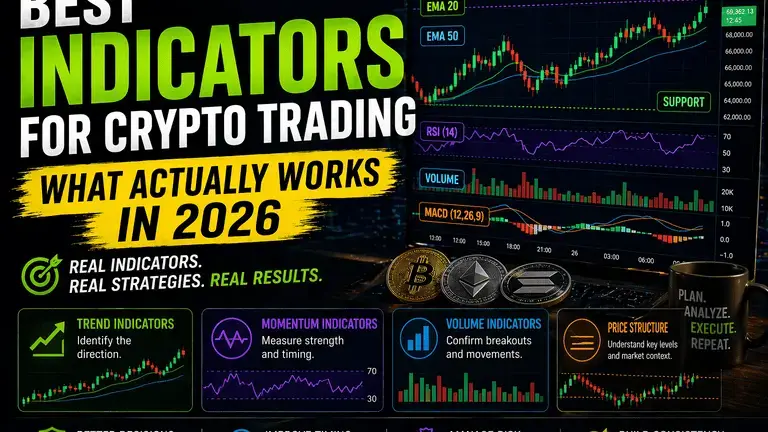
Instead of chasing random indicators, focus on these 4 categories:
- Trend indicators
- Momentum indicators
- Volume indicators
- Structure/price-based analysis
When combined, they create a complete system.
Trend Indicators (Direction Matters)
Trend indicators help you answer one question:
👉 Is the market going up or down?
The most important ones:
- EMA (Exponential Moving Average)
- SMA (Simple Moving Average)
Professionals don’t use 10 indicators.
They use simple ones effectively.
A common setup:
- EMA 20 → short-term trend
- EMA 50 → medium trend
If price is above both → bullish bias
If below → bearish bias
If you want a full breakdown, read:
👉 how moving averages actually work in crypto trading
Momentum Indicators (Timing Entries)
Momentum tells you:
👉 How strong a move is
The most popular one:
- RSI (Relative Strength Index)
Basic idea:
- RSI above 70 → overbought
- RSI below 30 → oversold
But professionals don’t use it blindly.
They use RSI to:
- confirm trend strength
- avoid weak entries
- time reversals carefully
If you’re using RSI wrong, it becomes useless.
Used correctly, it’s powerful.
Volume Indicators (The Hidden Truth)
Price moves because of volume.
Without volume:
👉 moves are weak
👉 breakouts fail
Volume helps you:
- confirm breakouts
- detect fake moves
- identify strong interest
Most beginners ignore volume.
Professionals rely on it heavily.
If you want to use it properly:
👉 how to analyze volume and performance in crypto markets
Market Structure (The Most Important “Indicator”)
This is where real traders focus.
Market structure means:
- higher highs / lower lows
- support and resistance
- trend continuation or reversal
No indicator is more powerful than price itself.
Indicators should support structure — not replace it.
The Best Indicator Combinations (Real Setups)
Now let’s get practical.
Setup 1: Trend + Momentum (Classic)
- EMA 20 + EMA 50
- RSI
Use:
- EMA for direction
- RSI for entry timing
This is simple and effective.
Setup 2: Breakout + Volume
- support/resistance levels
- volume confirmation
Use:
- breakout + strong volume → valid move
- breakout + weak volume → fake
Setup 3: Scalping Setup (Fast Execution)
- EMA trend
- RSI filter
- tight stop loss
This is similar to your
👉 fast-paced one-minute trading system
Why Indicators Alone Don’t Work
Indicators don’t account for:
- fees
- spread
- execution speed
- slippage
So even a “perfect signal” can fail.
That’s why you must understand trading costs:
👉 full breakdown of crypto trading costs
The Role of Execution (Massively Underrated)
Indicators give signals.
Execution determines results.
Bad execution:
- late entries
- poor fills
- increased losses
That’s why serious traders care about exchanges.
👉 what makes a good trading exchange for scalping
Indicators for Different Trading Styles
Scalping (1m–5m)
Best indicators:
- EMA
- RSI
- volume
Fast, simple, precise.
Day Trading
Best indicators:
- EMA
- RSI
- support/resistance
More confirmation, less speed.
Swing Trading
Best indicators:
- moving averages
- structure
- trendlines
Longer-term focus.
The Biggest Indicator Mistakes
Using too many indicators
More ≠ better.
It creates confusion.
Blindly following signals
Indicators are tools — not decisions.
Ignoring market context
Indicators without context = noise.
Over-optimizing settings
Changing settings constantly destroys consistency.
How Professionals Use Indicators
They:
- keep it simple
- combine indicators
- follow a system
- ignore noise
They don’t chase new tools every week.
They master a few.
Indicators + Risk Management = Real Edge
Even the best setup fails without risk control.
Always:
- use stop losses
- manage position size
- avoid overexposure
Start here:
👉 crypto risk management guide for traders
The Truth About “Best Indicator”
There is no single best indicator.
But there is a best approach:
👉 Combine trend + momentum + volume + structure
That’s what works.
Final Thoughts
Indicators don’t make traders profitable.
👉 Systems do.
If you:
- simplify your tools
- follow structured setups
- control risk
- execute properly
👉 you will improve.
What You Should Do Next
👉 learn a structured scalping system
👉 understand how indicators actually work together
👉 improve your execution and exchange choice