
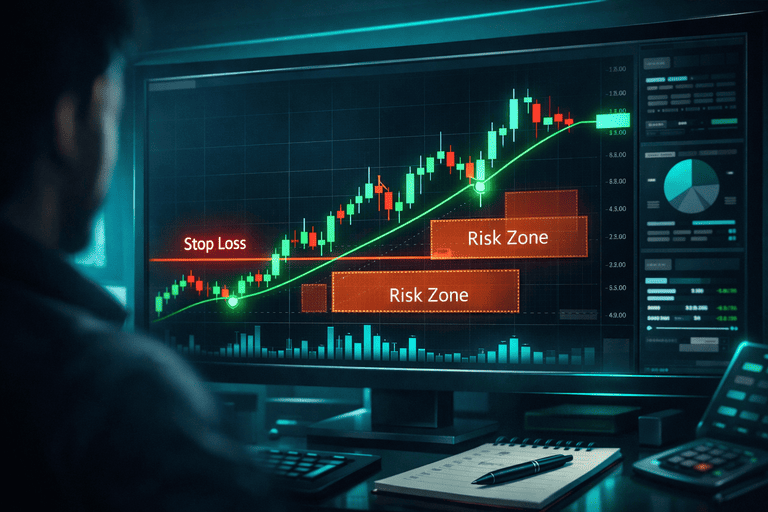
destroy accounts when it’s done without structure. Many traders believe they need more indicators or
“secret signals,” when in reality, what they truly need is a simple, disciplined
1 minute crypto scalping strategy that protects capital first.The goal of this guide is to show you a practical framework you can actually use. No hype, no guessing —
just clear rules around entries, stop losses, and risk management so you can stay in the game longer.If you’re brand new to scalping, it helps to start with a broader introduction first: scalping trading for beginners.
What Is a 1-Minute Crypto Scalping Strategy?
Scalping means taking many small trades, aiming for small profits, and closing quickly when the idea is wrong.
You’re not trying to predict the market — you’re trying to participate in short bursts of momentum with
controlled risk.
- Fast entries and fast exits
- Smaller targets instead of “home runs”
- Tight, logical stop losses
- Consistent rules instead of emotions
The 1-minute chart moves quickly, which means it rewards discipline and punishes overconfidence.
Without a plan, it feels like gambling. With structure, it becomes a skill.
In the next sections, we’ll walk step-by-step through how this
1 minute crypto scalping strategy works — starting with how to read momentum and
find smarter entries instead of chasing every candle.
The Core Idea Behind a 1-Minute Crypto Scalping Strategy
Most traders lose on the 1-minute chart because they chase candles. Price moves quickly,
emotions take over, and entries happen in the worst possible places.
A strong 1 minute crypto scalping strategy does the opposite:
- identify short-term momentum first
- wait for price to pull back
- enter only when structure is still valid
Instead of buying after a big green candle, we wait for price to retrace and show signs of continuing.
This reduces stress, tightens risk, and avoids buying the top or shorting the bottom.

Step 1: Identify Direction First
Before clicking anything, ask one simple question:
“Is the market moving up, down, or going sideways?”
Signs of upward bias:
- higher highs and higher lows
- pullbacks that bounce quickly
- candles closing near the top
Signs of downward bias:
- lower highs and lower lows
- pullbacks that fail to break previous highs
- candles closing near the bottom
If structure looks messy and direction isn’t clear, the best trade is usually:
no trade.
For a deeper explanation of how structure works inside scalping,
this guide expands the idea in more detail:
The Ultimate 1-Minute Scalping Strategy
Step 2: Wait for the Pullback
Once momentum is clear, we do not jump in immediately. We wait for price to come back toward a
logical area — previous structure, a small consolidation, or a rejection zone.
This is where patience pays. Entering on pullbacks gives:
- tighter stop losses
- better entry prices
- lower emotional stress
In the next part, we’ll take this concept and turn it into specific,
actionable entry rules — so you know exactly where
and why to enter instead of guessing.
Entries in a 1-Minute Crypto Scalping Strategy
Entries on the 1-minute chart are not random. Good scalpers are patient —
they let the market show direction first, then they enter on controlled pullbacks,
not at emotional breakouts.
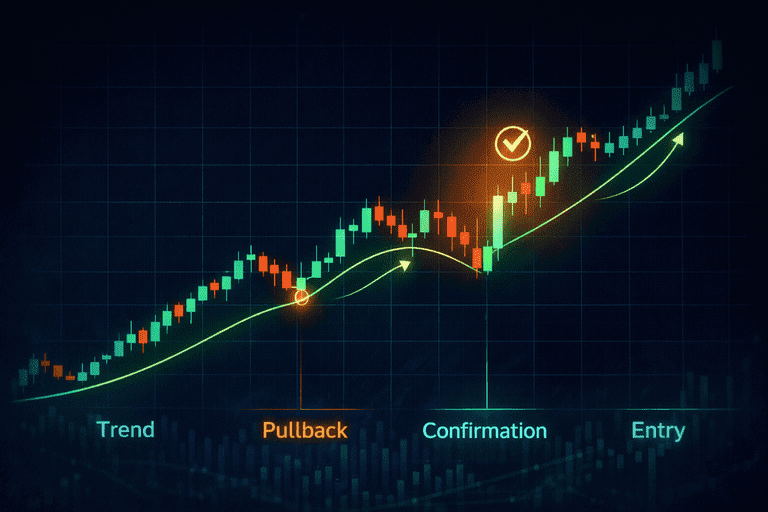
A practical way to think about entries is this:
trend → pullback → confirmation → entry
1. Confirm Trend First
The chart should clearly show either higher highs and higher lows (uptrend),
or lower highs and lower lows (downtrend). If candles are choppy with no structure,
trading becomes guesswork.
2. Wait for the Pullback
Instead of entering during strong impulse candles, wait for price to retrace.
The pullback creates a better risk-to-reward setup and keeps stops smaller.
3. Look for Confirmation
Confirmation may come from:
- wicks rejecting a level
- a small consolidation breaking in trend direction
- a candle closing strong after hesitation
We don’t need complicated indicators — the chart itself usually shows enough.
4. Avoid Chasing Breakouts
Chasing large breakout candles often leads to entering at the worst price.
By the time most traders click buy, momentum slows and the pullback begins.
A disciplined 1 minute crypto scalping strategy waits,
observes, and enters where the risk is controlled — not where fear pushes decisions.
If you want to see additional entry concepts and examples,
the main scalping pillar goes deeper here:
1-Minute Scalping Strategy Explained
Next, we’ll move into something even more important than entries:
where to place stop losses so one bad decision doesn’t wipe out your session.
Stop Losses in a 1-Minute Crypto Scalping Strategy
A stop loss is not a punishment or a sign of failure. On the 1-minute chart,
it is your main protection against sudden spikes, bad fills, and emotional decisions.
Without a stop, one move can erase an entire day of progress.
In a structured 1 minute crypto scalping strategy, the stop loss answers one simple question:
“At what price is this idea clearly wrong?”
Once price reaches that level, the trade is no longer the same trade. Staying inside becomes gambling,
not trading.
1. Structure-Based Stops
The most common approach is to place stops beyond a meaningful level on the chart:
- below a recent swing low when you are long
- above a recent swing high when you are short
- beyond a clear support or resistance zone
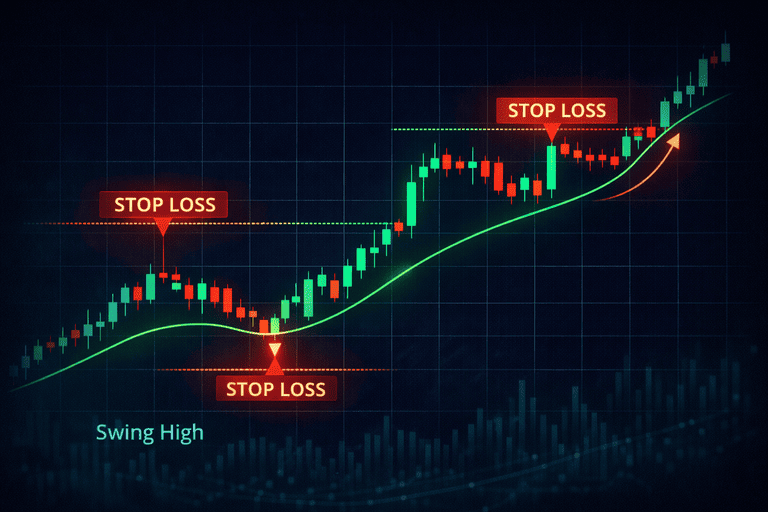
The logic is simple: if price breaks that structure and holds beyond it,
the original setup has failed and it’s time to exit.
2. Volatility-Based Stops
Markets don’t always move the same way. During high volatility,
price may swing wider before deciding direction. During quiet periods, it moves in tighter ranges.
Volatility-based stops adjust to this behavior. When conditions are more explosive,
stops are placed a bit wider. When conditions are slow and tight, stops are closer.
This helps avoid getting stopped out by normal noise while still protecting the account
when the market truly turns against you.
3. Common Stop Loss Mistakes
- placing stops “where it feels safe” instead of beyond structure
- moving stops further away when price gets close
- removing the stop completely “just this once”
- using the same fixed stop on every trade regardless of volatility
These habits slowly destroy consistency. A good stop is defined before entry, not negotiated after.
If you want to go deeper into how stop losses, position sizing, and drawdowns connect,
this risk-focused guide is worth reading:
Crypto Risk Management Strategies
In the next part, we will connect stops to something even more critical:
how much you actually risk per trade and why size matters more than most traders think.
How Much Should You Risk Per Trade When Scalping?
On the 1-minute chart, price can move quickly and unpredictably. Even good setups fail sometimes.
That is why the most important part of any
1 minute crypto scalping strategy
is deciding how much you are willing to lose if you are wrong.
Most new traders lose not because their entries are terrible — but because their position size
is far too big. One losing trade becomes three, and suddenly the account is down 20% or more.
The Simple Risk Rule
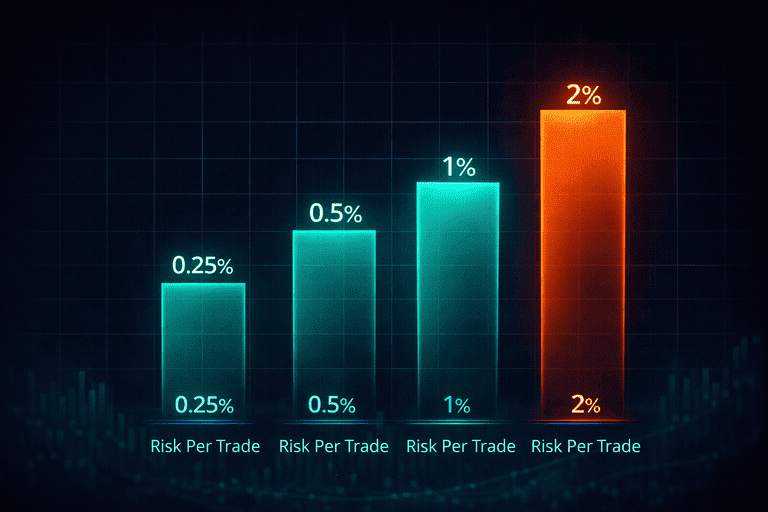
A widely used guideline in active trading is:
- 0.25% – 0.5% per trade if you’re learning or inconsistent
- 0.5% – 1% per trade if you are disciplined and experienced
- above 2% per trade is extremely aggressive
Example:
If your account is $1,000 and you risk 1%, the maximum loss per trade should be:
$10.
Not $25.
Not $50.
Just $10 — every time.
When losses are small and controlled, it becomes much easier to stay calm, evaluate the market,
and continue trading with a clear head.
Why Small Risk Creates Big Advantages
- losing streaks don’t wipe out progress
- emotion stays lower and decisions improve
- you avoid the urge to “win it back” with oversized trades
- your account grows more steadily over time
Risk management is not exciting, but it is the reason professional traders last
— while gamblers disappear after a few bad days.
If you want a deeper breakdown of how risk, drawdowns, and psychology connect,
this article explains it clearly:
Crypto Risk Management Strategies — Staying Alive in Volatile Markets
In the next part, we’ll connect risk to potential reward — and see why
not every trade is worth taking, even when it looks attractive.
Risk vs Reward in a 1-Minute Crypto Scalping Strategy
Even if your entry is good and your stop loss is logical, there is one more question every scalper
needs to ask before clicking the button:
“Is this trade actually worth the risk?”
Risk/reward (often written as R:R) compares how much you could lose
to how much you can realistically make,
based on structure — not hope.
What Risk/Reward Actually Means
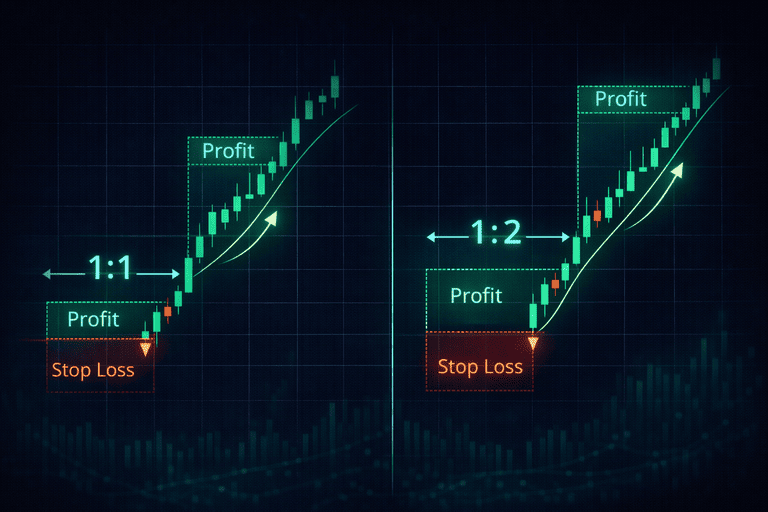
- If you risk $10 to make $10 → that is 1:1
- If you risk $10 to make $20 → that is 1:2
- If you risk $10 to make $30 → that is 1:3
In theory, higher always sounds better — but markets rarely move in perfect straight lines,
especially on the 1-minute chart.
Why 1:1 Can Still Be Dangerous
With a 1:1 trade, you usually need to win more than half of your trades just to stay break-even.
When emotions kick in, many traders struggle to maintain that consistency.
And Why 1:3 Isn’t Always Realistic
Forcing huge targets on tiny timeframes often leads to frustration, missed exits,
or turning winners into losers because price reversed before reaching the goal.
A Practical Range for Scalpers
- 1:1.5 in choppy conditions
- 1:2 when the market is trending cleanly
The goal is not perfection. The goal is consistency.
When Risk/Reward Says “Walk Away”
Sometimes the setup looks attractive, but:
- the stop has to be wide
- the target is too small
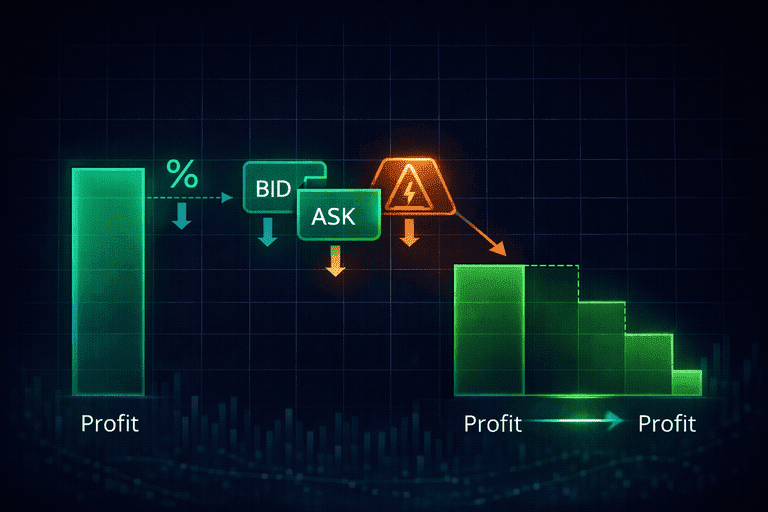
- spread or slippage eats most of the profit
In those cases, the smartest move is often:
do nothing.
Walking away protects your account — and your mindset.
And because costs matter so much for scalpers, it’s also important to understand how
fees, spreads, and execution quality impact risk/reward over hundreds of trades:
Best Exchange for Scalping Crypto — Fees, Spreads, and Execution Compared
In the next section, we’ll talk about something most traders never consider:
the hidden trading costs that quietly destroy long-term results.
Simple Checklist Before Trading the 1-Minute Crypto Scalping Strategy
Scalping on the 1-minute chart rewards structure, patience, and discipline. Before taking any trade,
walk through this quick checklist. If something feels unclear, skip the trade — there will always be more.

Pre-Trade Checklist
- Is direction clear? (uptrend, downtrend, or messy?)
- Where is my invalidation? (the price that proves me wrong)
- How much am I risking? (percent, not dollars)
- Is risk/reward reasonable? (at least 1:1.5 when possible)
- Is the entry on a pullback? (not chasing a breakout)
- Any news or spikes happening?
- Am I trading the plan — or boredom?
If two or three answers feel uncertain, step aside. Good traders protect capital first.
Where This Strategy Fits in Your Trading Journey
A strong 1 minute crypto scalping strategy is not just about entries.
It connects to a bigger system: structure, stops, risk, costs, and psychology.
If you feel like you need a broader foundation first, start here:
The Ultimate 1-Minute Scalping Strategy Explained
And if you want to make sure you protect capital while learning:
Crypto Risk Management Strategies
Remember:
Tools assist. Rules protect. Discipline wins.
Trade small. Stay patient. Focus on survival first — consistency follows.
1 thought on “1-Minute Scalping Strategy for Crypto: Entries, Stops, and Risk Management Explained”