

What Is the Long/Short Ratio?
The Long/Short Ratio is one of the most important sentiment metrics used by professional crypto traders. It measures the percentage of traders who are long (expecting price to rise) versus short (expecting price to fall). Understanding this ratio is crucial for scalpers and day traders.

In simple terms:
- Long positions = bullish sentiment
- Short positions = bearish sentiment
Example: If Bitcoin’s Long/Short Ratio is 70/30, then 70% of traders expect price to rise while 30% expect it to fall.
Why the Long/Short Ratio Matters
This metric acts as a psychological snapshot of the entire market. It helps identify whether traders are leaning heavily bullish or bearish, which is critical when timing entries on low-timeframe charts like the 1-minute.
Here’s why it’s extremely valuable:
- Market Sentiment Insight:
You instantly see whether traders are leaning long or short. - Contrarian Indicator:
When too many traders are long, the market becomes vulnerable to corrections. When too many are short, short squeezes become more likely. - Risk Management Tool:
It helps you avoid trading against strong market sentiment unless supported by clear signals. - Perfect for Scalpers:
Sudden shifts in this ratio often precede volatility spikes—ideal for 1-minute scalping strategies.
How to Use the Long/Short Ratio in Your Trading Strategy
If you scalp, read 1 min trading tips.
1. Spot Overcrowded Trades
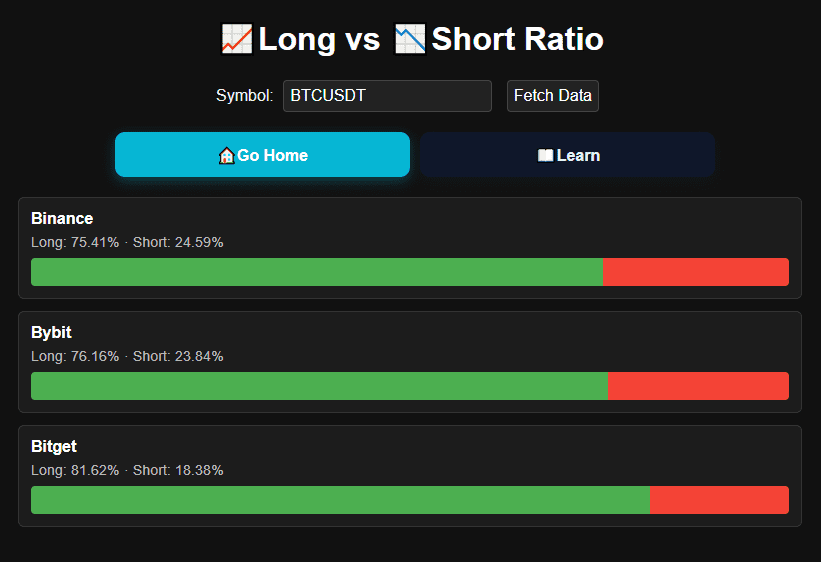
When the Long/Short Ratio rises above 75% long, the market is overcrowded with bulls. Even small drops can trigger liquidations and cascade price downward.
📉 Example:
If BTC shows an 80% long ratio while losing momentum, be ready for a potential reversal. This is where combining sentiment with price action becomes very powerful.
2. Identify Short Squeeze Opportunities
If the ratio falls below 40% long, most traders are short — which creates the perfect environment for a short squeeze. When price rises even slightly, trapped shorts are forced to buy back, accelerating the move.
📈 Example:
ETH sits at 35% long and open interest rises — price starts climbing — strong possibility of a short squeeze.
3. Combine With Other Indicators
The Long/Short Ratio becomes far more effective when combined with other tools:
- RSI divergence: Sentiment high + RSI overbought = likely correction
(Try the RSI Overbought/Oversold Detector) - EMA trend direction: A bullish long ratio + EMA downtrend = risky environment
(Check the EMA Crossover Detector) - Volume spikes: Confirm momentum behind sudden sentiment changes.
4. Track Changes, Not Just Values
A static Long/Short Ratio is not enough — the speed and direction of the change matters.
If the ratio drops from 60% long to 50% in a short time, traders are closing longs quickly — a strong signal of trend weakness or incoming volatility.
Best Practices for Using Long/Short Ratio
✔ Combine it with price action and volume
✔ Compare short-term (1h) vs long-term (24h) sentiment
✔ Use it to confirm your bias, not to predict tops/bottoms blindly
✔ Watch for extreme values — they often signal strong upcoming moves
Why Crypto Traders Love This Tool
At 1MinScalper, the Long/Short Ratio Tool gives you real-time sentiment data from multiple exchanges. This helps you catch early signals for:
- Reversals
- Short squeezes
- Trend continuations
- Volatility spikes
👉 Try the tool here:
Long vs Short Ratio Tool
Also explore more strategies to improve your trading:
2 thoughts on “How to Use the Long/Short Ratio to Predict Market Sentiment in Crypto Trading”