
How to Trade Doji Candles in Crypto (Using a Doji Candle Detector Tool)
When you trade crypto, every candle tells a story — and Doji candles are some of the most mysterious and powerful stories on your chart. They represent indecision in the market — the exact moment when neither buyers nor sellers are in full control. If you’re still getting familiar with how these moments fit into fast-paced trading, this crypto scalping beginner’s guide breaks down the fundamentals in a way that actually clicks.
The Doji Candle Detector automatically scans all crypto pairs and highlights where a Doji is forming or completing — helping you catch early reversal setups before most traders even notice. When combined with a proven execution framework like this 1 minute scalping strategy, Doji signals stop being “interesting candles” and start becoming actionable decision points.
What Is a Doji Candle?
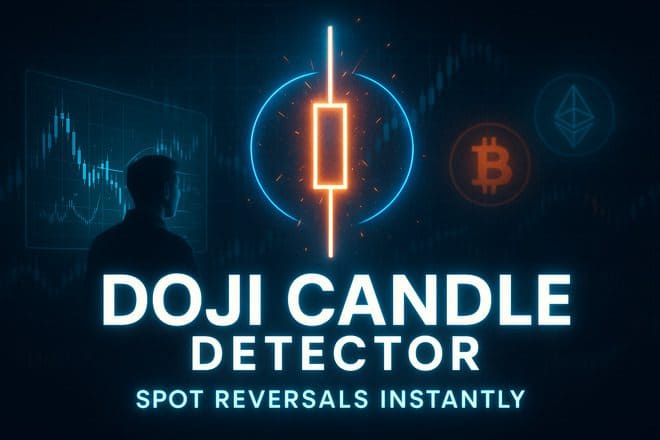
A Doji candle forms when the open and close price are nearly identical. The market moves up and down, but ends very close to where it started — a classic moment of balance between bulls and bears.
Here’s what a Doji typically tells you:
- Buyers pushed the price up, but couldn’t hold control.
- Sellers pushed it down, but failed to sustain momentum.
- Result: indecision — setting the stage for a reversal or breakout.
Types of Doji Candles
Different Doji shapes tell slightly different stories:
- Standard Doji – Balanced shadows; pure indecision.
- Dragonfly Doji – Long lower wick; bullish reversal pressure.
- Gravestone Doji – Long upper wick; bearish reversal pressure.
- Long-Legged Doji – Huge wicks both sides; volatility incoming.
How to Trade Doji Candles on Crypto
Doji candles don’t predict direction alone. They need context.
1. Wait for Confirmation
Never trade the Doji itself. Wait for the next candle.
- If price breaks above the Doji’s high → bullish reversal possible.
- If price breaks below its low → bearish continuation or reversal.
This is your entry trigger.
2. Use Support & Resistance
If a Doji forms at a major level — support, resistance, trendline — its signal becomes much stronger. Combine this with volume for better confirmation.
3. Combine With Indicators
Boost accuracy by layering confirmation indicators:
- RSI for overbought/oversold zones → RSI Overbought/Oversold Detector
- EMA crossovers for trend direction → EMA Crossover Detector
- MACD / Supertrend for momentum confirmation
Example:
A Doji at support + RSI below 30 + bullish follow-up candle = 🔥 high-probability long setup.
4. Set Clear Stop-Loss & Targets
- Stop-loss: Below the Doji wick for buys, above for sells.
- Take-profit: Aim for 2× risk or key support/resistance levels.
Using the Doji Candle Detector Tool
If you trade 30+ crypto pairs, manual scanning is impossible. Our Doji Candle Detector handles everything automatically:
- Shows pairs where a Doji is forming
- Alerts when a Doji just completed
- Updates in real time
Use it to catch reversals and breakouts as they form — not after they happen.
👉 Try the Doji Detector (Free)
Pro Tip: Combine Doji + RSI for Elite Accuracy
When the Doji Detector shows a Doji at a key level, check your RSI Detector :
- Doji at support + RSI oversold = strong bullish reversal zone
- Doji at resistance + RSI overbought = clean bearish reversal signal
This combo filters fake signals and gives you cleaner trades.
Final Thoughts
Doji candles are the market’s pause button — a moment of pure equilibrium before the next big move. With the right strategy, confirmation, and the Doji Candle Detector, you can turn these “pause moments” into powerful, high-probability trading opportunities.
Stop guessing.
Start detecting.
Trade with precision.
4 thoughts on “How to Trade Doji Candles in Crypto (Using a Doji Candle Detector Tool)”