
Let’s be honest: watching charts all day is not “dedication.”
It’s often just stress with a candlestick skin.
Most people don’t quit because crypto is hard. They quit because the lifestyle is brutal: constant checking, constant emotions, constant “one more look.” And the worst part? The more you stare, the more you trade… and the more you trade, the more you pay in fees, spreads, and bad decisions.
So if your goal is:
“I want to trade crypto without living inside the chart.”
This article gives you real systems to do exactly that—without pretending it’s risk-free.
We’re going to build a no-screen-time trading stack: rules, automation, alerts, and a simple schedule that keeps you active in the market without being chained to it.
The Big Shift: You Don’t Need More Screen Time — You Need More Systems
Chart-watching feels productive because it’s busy. But “busy” doesn’t equal “effective.”
If you want to trade without watching charts all day, you need:
-
A plan that makes decisions before emotions happen
-
Automation where it makes sense
-
Alerts instead of eyeballs
-
Risk controls that protect you when you’re not watching
Think of this like a company:
If the whole business collapses when the CEO stops staring at the dashboard… the business is trash.
We’re building something that runs even when you go eat, sleep, work, or exist like a human.
Pick Your No-Chart Style: 4 Paths (Choose One)
There are multiple ways to trade without watching charts all day. But mixing everything at once is how people end up doing… nothing.
Pick one “operating model”:
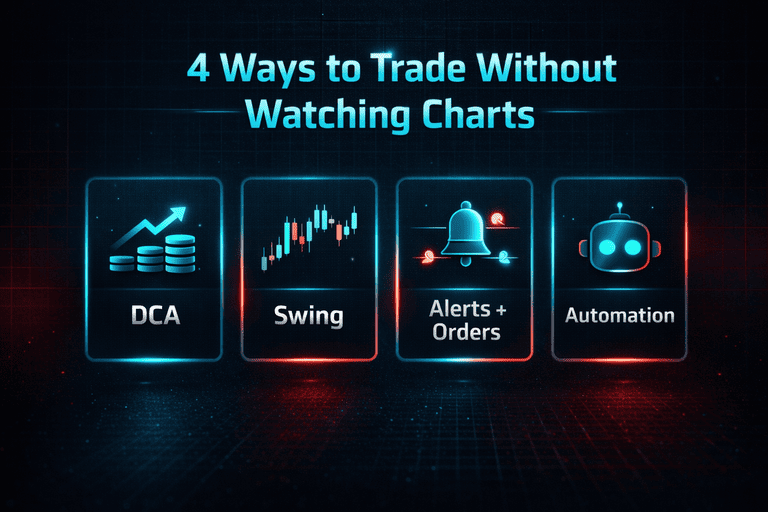
1) The Investor System (Lowest Time, Lower Stress)
-
Recurring buys (DCA)
-
Monthly or weekly check-in
-
Focus on long-term trend, not noise
2) The Swing System (Medium Time, Medium Control)
-
Trades last days/weeks
-
You check once or twice per day
-
Entry/exit planned, not reactive
3) The Alert + Orders System (Low Screen Time, Higher Precision)
-
You don’t watch the chart
-
You let alerts tell you when price hits your zones
-
Orders + SL/TP handle execution
4) The Automation System (Bots / Grid / DCA bots)
-
Your rules run automatically
-
You monitor performance + risk, not candles
-
Very efficient… if you set it up correctly (and don’t get greedy)
The Core Rule: You’re Not Allowed to “Just Watch”
If you open charts without a clear purpose, your brain starts searching for entertainment.
And your finger starts searching for the “Buy” button.
So here’s your rule:
Every chart check must be one of these:
-
Place a planned order
-
Update a stop-loss / take-profit
-
Verify a condition
-
Close a trade (by rule)
-
Walk away
If it’s not one of those… it’s not trading. It’s doomscrolling with candles.
Method 1: The Set-and-Forget DCA System (Best for Most People)
DCA is boring. That’s why it works.
You’re not trying to win every day. You’re trying to:
-
avoid emotional timing mistakes
-
reduce decision fatigue
-
stay consistent
How to do it properly
Step 1: Choose what you’re accumulating
Keep it simple: BTC, ETH, or a small basket.
The bigger the basket, the more you’re “managing.”
Step 2: Choose frequency
-
Weekly is a sweet spot for many people
-
Daily is okay but can become too “hands-on”
-
Monthly is very hands-off but rough psychologically
Step 3: Add a risk guardrail
Example guardrail:
-
“If the market is insanely euphoric, I keep my DCA amount but do not increase it.”
-
“No doubling because I feel excited.”
DCA + Rules = the “grown-up” version
If you want to level up DCA without watching charts:
-
DCA normally
-
Add a simple rule: increase slightly during big drawdowns, return to normal later
The goal is consistency, not perfect bottom-catching.
Read more about Crypto Risk Management Strategies.
Method 2: Trade With Alerts + Pre-Set Orders (My Favorite “No-Chart” Setup)
This one is powerful because it replaces screen time with notifications.
You decide your plan once, then you let price come to you.
The simple workflow
-
Identify your “zones” (support/resistance levels or key prices)
-
Set alerts at those zones
-
Prepare your orders:
-
entry (limit)
-
stop-loss
-
take-profit
-
Now you’re trading like a professional: plan first, execute later.
A clean example (no magic, just structure)
Let’s say BTC is ranging and you have a level you like.
-
Buy zone: 100
-
Stop-loss: 97
-
Take-profit: 106
You set alerts at 101/100.5 area so you don’t miss it.
When alert hits, you either place your limit order… or you skip if your checklist fails.
Why this works
Because you are not reacting to every wiggle.
You only react when price reaches a level that matters.
Best Exchange for Scalping Crypto — Fees, Spreads, Execution
And if you want this to also monetize cleanly:
Here are the exchanges I’d actually start with if I wanted low friction + fast execution
Method 3: Swing Trading With Scheduled Check-Ins (No More Random Checking)
Swing trading is basically:
“I trade the bigger moves, not the tiny noise.”
It’s the best “middle ground” for people who still want trades, but not chart addiction.
The schedule that actually works
-
Morning check: 5–10 minutes
-
Evening check: 5–10 minutes
That’s it.
No lunchtime checking. No “one last look.”
Because that’s how you get sucked into nonsense.
Your swing-trade rules (simple version)
-
Trades last days/weeks
-
Risk per trade: small and fixed
-
Stop-loss always exists
-
Take-profit always exists
-
No moving stop-loss “to give it room” unless it’s part of your plan
If you follow a schedule, you automatically remove the “random behavior” that kills most traders.
Method 4: Automation (Bots) — The Right Way to Avoid Screen Time
Automation can be amazing.
It can also be a money shredder if you use it like a casino.
The correct mindset:
-
Bots are not “free money machines”
-
Bots are rule executors
-
You still manage risk like a human adult
What you should automate
-
Grid trading in a range (only when market is actually ranging)
-
DCA bots with limits
-
Risk-managed entries/exits with predefined rules
-
Rebalancing
What you should not automate (unless you’re very experienced)
-
Full leverage YOLO bots
-
Bots that “martingale” or double down endlessly
-
Anything where you don’t understand how it behaves in a crash
If you want automation, the best plan is:
-
start small
-
run it with strict limits
-
monitor performance weekly
-
never increase size just because it worked for two weeks
The No-Chart Trading Stack (Checklist)
Here’s your “minimum viable setup”:
Setup checklist
-
Pick one strategy style (DCA / Swing / Alerts+Orders / Automation)
-
Decide your risk cap (daily/weekly loss limit)
-
Set alerts (price zones, not random)
-
Use stop-loss + take-profit by default
-
Choose a monitoring schedule (daily 10 min or weekly 30 min)
-
Track outcomes (simple notes: entry, exit, reason)
This gives you structure. Structure gives you peace. Peace gives you better decisions.
Risk Controls (Non-Negotiable If You’re Not Watching Charts)
If you’re not watching charts all day, you need protection that works even when you’re away.
1) Always use a stop-loss (or you are gambling)
If you refuse stop-loss because “it might wick me out,” that’s not a strategy.
That’s denial with confidence.
2) Use position sizing like a professional
Don’t size positions based on feelings.
Size based on risk.
A simple rule that doesn’t require math pain:
-
Risk a small fixed percentage per trade
-
If your stop-loss is far, your position size is smaller
3) Have a weekly maximum loss limit
Example:
-
“If I lose X this week, I stop trading and review.”
That one rule alone saves people from spirals.
still no strategies? check out the 5 min trading strategies.
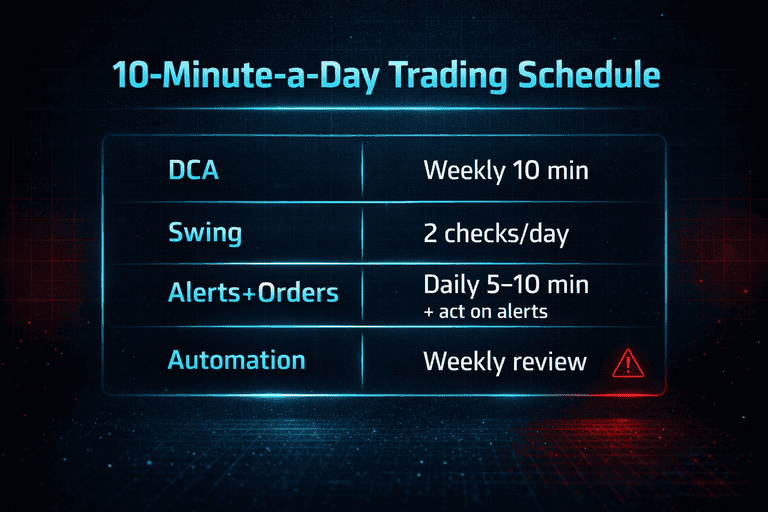
A Practical Monitoring Schedule (This Is the “No-Chart” Secret)
Here’s what “trading without watching charts all day” really means:
If you’re doing DCA
-
Weekly: 10 minutes
-
Monthly: 20 minutes review
That’s it.
If you’re doing swing trading
-
Daily: 2 check-ins × 5–10 minutes
-
Weekly: 20 minutes review
If you’re doing alerts + orders
-
Daily: 5–10 minutes to check alerts + order status
-
When alert triggers: 2–3 minutes decision time (yes/no)
If you’re doing automation
-
Weekly: performance review + risk review
-
Monthly: strategy review + parameter tuning (small changes only)
Your objective is not “more trading.”
Your objective is more consistency with less chaos.
The Biggest Mistake People Make: Replacing Charts With Constant Notifications
Alerts are good.
But if you set 50 alerts everywhere, you didn’t reduce screen time… you just moved the addiction into your phone.
So use alerts like a sniper:
-
a few meaningful levels only
-
not every price tick
AQ: Trading Crypto Without Watching Charts All Day
Can you really trade crypto without watching charts all day?
Yes — but you trade differently.
Instead of “reacting,” you use systems: alerts, pre-set orders, scheduled check-ins, or automation. You’ll miss some micro moves, but you’ll also avoid the constant overtrading loop that kills most accounts.
What’s the best strategy if I only have 10 minutes per day?
For most people:
-
DCA (if you want maximum simplicity)
-
Alerts + pre-set orders (if you want more precision)
If you’re still learning, start with DCA + rules. If you’re more experienced, alerts + orders gives you control without screen addiction.
How often should I check my trades if I don’t want chart addiction?
Use a schedule, not feelings:
-
Swing trading: 2 times/day (morning + evening)
-
Alerts + orders: 1 quick daily check, plus action when an alert hits
-
Automation/bots: weekly review (and emergency alerts)
The key is: no random checking. Random checking is how you fall back into the chart trap.
What’s the biggest mistake people make when trying to stop watching charts?
They stop watching charts… but start watching:
-
price widgets
-
Twitter
-
Telegram calls
-
notifications every 2 minutes
That’s the same addiction with a different outfit.
Use fewer alerts, only at meaningful levels.
Are crypto trading bots actually safe?
Bots can be safe if the risk is safe.
A bot is just a tool that executes your rules faster than you can.
Bots become dangerous when:
-
you don’t understand the strategy (grid, DCA, trend, etc.)
-
you use too much leverage
-
you increase size because of a short winning streak
-
you run a bot in the wrong market condition (like using a range bot in a trend)
Start small, limit exposure, and review weekly.
Can I do this without leverage?
Yes — and for most people, that’s the smarter way.
Leverage increases:
-
liquidation risk
-
emotional pressure
-
need for constant monitoring
If your whole goal is “less screen time,” leverage usually fights that goal.
What orders help the most if I don’t want to watch charts?
These are your “set-it-and-go-live-your-life” tools:
-
Limit orders (don’t chase)
-
Stop-loss (protect when you’re away)
-
Take-profit (lock wins without staring)
-
OCO orders (if your exchange supports it: TP and SL as a pair)
This is basically the professional workflow: plan first, execution second.
Do I need technical analysis if I’m not watching charts?
Not necessarily — depends on your style.
-
DCA: minimal TA needed
-
Swing trading: basic structure helps (support/resistance, trend direction)
-
Alerts + orders: you need levels (zones) more than indicators
-
Bots: you need rules + market condition awareness
The goal is to reduce complexity, not increase it.
Is swing trading better than scalping if I don’t want to watch charts?
Almost always, yes.
Scalping usually demands:
-
tight execution
-
fast decisions
-
more screen time
-
higher fee/spread sensitivity
Swing trading is more compatible with scheduled check-ins and planned risk.
How do I set alerts without turning my phone into a casino machine?
Use the “sniper alert rule”:
-
set only alerts at key zones (support/resistance)
-
avoid alerts that trigger constantly
-
keep the number small (like 3–8 alerts max for your main pairs)
Alerts are meant to reduce screen time — not replace it with buzzing.
What’s a good “no-chart” crypto portfolio setup?
A simple structure could look like:
-
Core: BTC/ETH (long-term)
-
Smaller allocation: 1–3 higher-risk assets (optional)
-
Cash/stable buffer for opportunities (optional)
Keep it small enough that you can manage it with your schedule.
Should I trade spot or futures if I want less screen time?
Spot is easier for low screen time.
Futures can work, but it adds:
-
liquidations
-
funding costs
-
higher emotional pressure
-
tighter stop requirements
If you do futures, keep leverage low and risk even lower.
Best Crypto Exchanges for Scalping (Fees, Spreads & Execution Compared)
What’s the safest way to start if I’m a complete beginner?
Start with:
-
DCA on BTC/ETH
-
Learn basic risk management
-
Add alerts later
-
Only then consider swing trades or automation
Crypto Risk Management Strategies: How to Protect Your Capital Before You Trade
How do I avoid “revenge trading” if I’m not watching charts?
Use one rule: maximum loss limit.
Example:
-
“If I lose X this week, I stop trading and review.”
Revenge trading thrives on constant screen time. Scheduled systems kill it.
How do I know if I’m overtrading even if I’m not watching charts?
Look for these signals:
-
you enter trades without a written reason
-
you break your schedule (“just checking quickly”)
-
you increase position size after wins
-
you move stop-loss further away when price goes against you
If any of those happen, your system isn’t strict enough yet.
What’s the best way to track performance without becoming obsessed?
Keep it simple:
-
entry price
-
exit price
-
reason for trade (one sentence)
-
whether you followed the plan (yes/no)
You don’t need a 200-column spreadsheet.
You need consistency and a review routine.
Is it possible to automate the “signal part” but keep manual control?
Yes — that’s actually one of the best setups.
You can automate:
-
scanning (RSI, patterns, EMA cross)
-
alerts
-
watchlists
But keep execution manual so you maintain control and avoid blind bot risk.
What if I still feel anxious when I’m not watching charts?
That’s normal at first. Your brain is used to constant checking.
A practical fix:
-
define your next check-in time (e.g., “8pm”)
-
make sure your SL/TP is set
-
close the chart
The anxiety fades when your system proves it can run without you.
Can I do this while working a full-time job?
Yes — that’s the whole point.
If you work a job, your best fits are:
-
DCA
-
swing trading with 2 check-ins/day
-
alerts + orders
Scalping all day doesn’t mix with a normal life unless you’re intentionally choosing that lifestyle.
What tools do I need for this?
Minimum:
-
a charting/alert tool (or exchange alerts)
-
an exchange that supports proper orders (SL/TP, preferably OCO)
-
a risk plan
Optional:
-
scanners and confirmation tools (to save time)
Final Words: Your Goal Is Freedom, Not 24/7 Market Babysitting
If you want a strategy that works without watching charts all day, you’re aiming for:
-
fewer decisions
-
better rules
-
controlled risk
-
scheduled check-ins
-
automation that doesn’t turn into roulette
That’s the real “pro” approach.
If you want to go one step deeper, use tools that help you confirm trades quickly instead of staring at charts.
Open up the full tool dashboard