
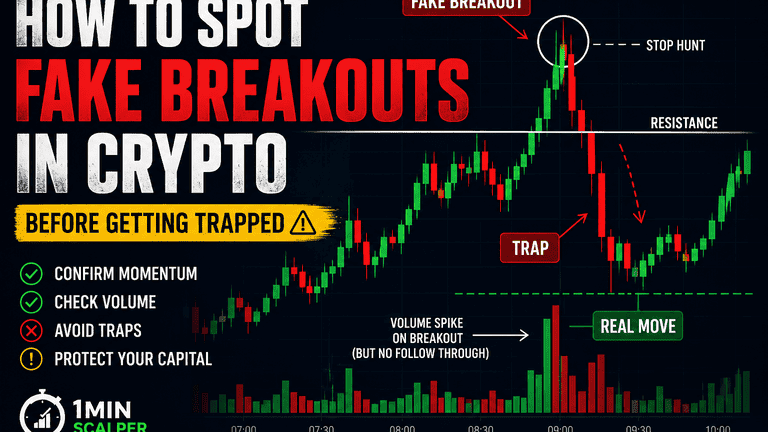
Fake breakouts are one of the most expensive traps in crypto trading.
If you have traded long enough, you probably know this feeling.
Price breaks above resistance. Volume rises. Candles look strong. Everything screams breakout.
You enter long.
Three candles later, price dumps back below resistance, wipes your stop loss, and continues falling.
That was not a real breakout.
That was a trap.
And if you trade the 1-minute chart, fake breakouts happen constantly.
In fact, many beginner scalpers lose money not because their market bias is wrong, but because they cannot distinguish between real momentum and liquidity grabs.
This is one reason many traders struggle with profitability. If you haven’t read it yet, our article on why traders lose money explains the bigger picture:
→ Why Crypto Traders Lose Money
In this guide, I’ll show how I personally filter breakouts to avoid low-quality entries.
What Is a Fake Breakout?
A fake breakout happens when price moves beyond a key level:
- resistance
- support
- trendline
- range boundary
- previous high or low
… but fails to continue.
Instead of trending, price reverses.
Why does this happen?
Because markets need liquidity.
Many breakout traders place stop orders around obvious levels.
Large participants know this.
Price moves into those zones, triggers breakout entries, collects liquidity, and then reverses.
That reversal creates the trap.
Why Fake Breakouts Hurt Scalpers More
Swing traders can survive some noise.
Scalpers usually cannot.
On the 1-minute chart:
- spreads matter
- latency matters
- slippage matters
- timing matters
Even small false moves can ruin risk-reward.
This becomes worse on poor exchanges.
Execution speed matters a lot in fast trading:
→ Fast Execution Crypto Exchange
And if you trade on high-spread platforms, fake breakouts become even more expensive:
→ Crypto Exchange With Lowest Spread
7 Ways to Spot Fake Breakouts
1. The Breakout Candle Is Too Big
This is one of the simplest filters.
Beginners love giant breakout candles.
Professionals get suspicious.
Why?
Because explosive candles often mean late momentum.
Example:
BTC sits below resistance for 30 minutes.
Suddenly one huge candle pumps 1.2%.
Retail traders chase.
Smart traders ask:
Who is buying now?
Who is selling into that buying?
Large candles near major resistance often mean exhaustion.
Rule:
If breakout candle is abnormally large compared to previous candles, wait.
Do not chase.
2. Volume Does Not Confirm
Real breakouts usually have strong participation.
Weak volume means weak conviction.
Ask:
Did volume increase meaningfully during breakout?
If no, caution.
A breakout without volume often fails.
Volume analysis is critical in fast markets.
Useful related guide:
→ How to Check a Crypto Pair Before Trading
I personally avoid breakouts when volume stays flat.
3. Price Breaks Level but Closes Back Inside
This is a classic fake breakout signal.
Example:
Resistance = 108,500
Price moves to:
108,560
But candle closes at:
108,470
That tells you buyers failed.
The breakout did not hold.
That failed close matters more than the wick.
Many fake breakouts reveal themselves immediately.
Watch candle closes, not just intrabar movement.
4. There Is No Retest
Good breakouts often retest.
Price breaks level → pulls back → confirms support → continues.
That retest shows buyers are defending.
No retest doesn’t always mean failure.
But no retest + weak continuation = danger.
This is one reason patience improves win rate.
I’d rather miss one trade than enter five bad ones.
5. Funding or Sentiment Is Too One-Sided
This matters more than many traders realize.
If everyone is already long, upside can become fragile.
Too much crowd bias creates squeeze conditions.
Useful sentiment tools include:
- long/short ratio
- funding rate
- fear & greed
Related guides:
→ Long Short Ratio Guide
→ Fear and Greed Index
When everyone expects breakout, fake breakout risk rises.
6. Breakout Happens During Dead Hours
Timing matters.
Not all sessions are equal.
Low-liquidity hours produce messy price action.
That means more fake moves.
Session matters a lot.
Strong guides for timing:
→ Best Time for Scalping
→ London Session Scalping
Some of the cleanest BTC moves happen around:
- London open
- NY open
- major news events
Dead hours often create traps.
7. Order Book Shows Absorption
Advanced traders watch this.
Price pushes upward.
But sell walls keep absorbing market buys.
That means someone large is selling.
This hidden supply often kills breakouts.
Watch for:
- repeated rejection
- large resting orders
- weak follow-through
Order book behavior reveals things indicators cannot.
My Personal Fake Breakout Checklist
Before I trade a breakout, I ask:
Is volume expanding?
Is volatility healthy?
Is session active?
Did candle close strong?
Is liquidity nearby?
Is market overcrowded?
If 2–3 answers look bad, I skip.
Simple.
No trade is also a position.
The Biggest Breakout Mistake
The biggest mistake?
Entering because of excitement.
Not because of edge.
Many traders confuse movement with opportunity.
Fast candles create urgency.
Urgency creates emotional entries.
Emotional entries destroy consistency.
If this sounds familiar, read our beginner mistakes guide:
→ Crypto Trading Mistakes Beginners Make
Risk Management for Breakout Trading
Even with good filters, fake breakouts still happen.
That is normal.
Your goal is not perfection.
Your goal is controlled loss.
This is why stop placement matters.
Use structure-based stops instead of random percentages.
(Perfect follow-up from previous article.)
Also read:
→ Best Stop Loss Strategy for 1 Minute Scalping
A bad breakout entry with smart risk management is survivable.
A bad breakout with oversized leverage is dangerous.
Leverage guide:
→ Best Leverage for Crypto Scalping
Final Thoughts
One lesson changed how I trade breakouts.
I stopped asking:
“Is this breakout real?”
Instead I ask:
“Who is trapped if this fails?”
That question reveals much more.
Markets move where liquidity exists.
The more you understand where traders are positioned, the easier fake breakouts become to spot.
Real breakouts feel strong.
Fake breakouts feel emotional.
Learning the difference can dramatically improve your scalping performance.
FAQ
What is a fake breakout in crypto?
A fake breakout happens when price moves beyond support or resistance but quickly reverses instead of continuing.
Are fake breakouts common in Bitcoin?
Yes. Bitcoin frequently performs liquidity sweeps around obvious levels.
Should beginners trade breakouts?
Yes, but only with confirmation and strict risk management.
Is volume important for breakout trading?
Very. Strong volume increases breakout reliability.
Can indicators detect fake breakouts?
Indicators help, but price action and volume are usually better.
Which timeframe is best for breakout confirmation?
Many scalpers use 1-minute entries with 5-minute or 15-minute confirmation.
Do bots cause fake breakouts?
Sometimes. Algorithmic trading can amplify short-term liquidity grabs.
How do professionals avoid fake breakouts?
They combine volume, liquidity, timing, sentiment, and risk management.
Should I wait for retest?
Often yes. Retests reduce false entries.
Can fake breakouts be profitable?
Yes. Some traders specifically trade breakout failures.