
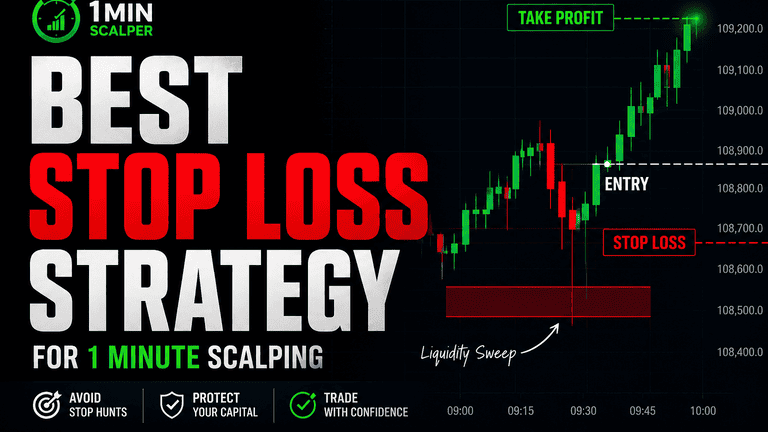
If you trade the 1-minute chart long enough, you learn one painful truth:
Getting the direction right is not enough.
You can predict the move correctly, enter at the right time, and still lose money because your stop loss gets hit by a tiny wick before price moves exactly where you expected.
I’ve seen this happen thousands of times.
That is actually one of the biggest reasons why beginner scalpers fail. They focus too much on entries and not enough on stop placement.
If you are trading fast markets like Bitcoin, Ethereum, or volatile altcoins, your stop loss strategy can matter more than your entry.
If you are new to fast trading, I strongly recommend reading our complete guide on the 1-minute scalping system first:
→ 1 Minute Scalping Strategy
In this guide, I will explain how professional scalpers place stops, avoid fake stop-outs, and reduce unnecessary losses.
Why Most Scalpers Get Stopped Out
Most traders place stop losses in obvious locations:
- directly below support
- directly above resistance
- below previous candle low
- above previous candle high
The problem?
Everyone sees those levels.
Large liquidity players know where retail traders hide their stops.
This creates what traders call liquidity sweeps or stop hunts.
Price briefly moves into those areas, triggers stops, grabs liquidity, and then reverses.
That is why you often feel:
“My stop got hit and then price instantly moved to target.”
It is not bad luck.
It is usually bad stop placement.
The 4 Best Stop Loss Methods for 1-Minute Scalping
After years of watching fast charts, I found four stop methods that consistently outperform random fixed stops.
1. Structure-Based Stop Loss (Best Overall)
This is my favorite method.
Instead of using arbitrary numbers, use market structure.
For long trades:
Place stop below the latest meaningful swing low.
For short trades:
Place stop above the latest swing high.
Example:
You enter BTC long after breakout at 108,200.
Recent swing low sits at 108,050.
Bad stop:
- 108,045
Good stop:
- 108,020 or 108,000
Why?
Because you leave room for normal volatility.
This reduces wick stop-outs.
2. ATR Stop Loss (Best for Volatile Markets)
ATR means Average True Range.
It measures volatility.
When volatility rises, fixed stops become dangerous.
Example:
During calm hours, BTC may move only $20 per candle.
During high volatility, BTC may move $120+.
Using the same stop in both conditions makes no sense.
Formula:
Stop distance = 0.8x to 1.5x ATR
This works especially well during volatile sessions.
Read more about volatility here:
→ Crypto Volatility Guide
3. Spread + Slippage Stop Loss
Many traders ignore execution costs.
Huge mistake.
In scalping, fees, spread, and slippage matter a lot.
Example:
You set a stop 0.20% away.
But exchange spread + slippage eats 0.08%.
Your real stop becomes much tighter than expected.
This is why exchange quality matters.
Read:
If your exchange has poor execution, even perfect stop placement can fail.
4. Time-Based Stop Loss (Underrated)
This is one advanced traders use a lot.
Instead of stopping based only on price, stop based on time.
Ask:
How long should this setup need to work?
Example:
You take breakout trade.
Expected move should happen within 3–5 candles.
But after 6 candles price is still stuck.
Exit.
Even if stop is not hit.
Why?
Because momentum disappeared.
For scalpers, dead trades are expensive.
Capital trapped in slow trades means missed opportunities elsewhere.
The Biggest Stop Loss Mistake
The worst habit?
Moving your stop further away after entering.
Example:
Initial stop:
-0.3%
Price moves against you.
You widen stop to:
-0.6%
-1.2%
-2%
Now one losing trade destroys five winners.
Professional scalpers accept small losses fast.
Beginners negotiate with the market.
The market does not negotiate.
How Tight Should Your Stop Be?
There is no universal answer.
But here is a practical range for crypto scalping:
Low volatility
0.15%–0.30%
Medium volatility
0.30%–0.60%
High volatility
0.60%–1.20%
This depends heavily on:
- pair liquidity
- spread
- session
- leverage
For leverage considerations, read:
→ Best Leverage for Crypto Scalping
Risk Management Matters More Than Win Rate
This surprises many traders.
You do NOT need a 90% win rate.
You need controlled losses.
Example:
Win rate = 45%
Average winner = 2R
Average loser = 1R
This is profitable.
That is why proper risk management matters.
Read our full guide:
→ Crypto Risk Management Strategies
My Personal Rule for 1-Minute Scalping
If I had to simplify everything into one rule:
I never place stops where everyone else places them.
That single rule improved my trading more than any indicator.
The market punishes obvious behavior.
The better you understand liquidity and stop placement, the less you get shaken out.
A good entry helps.
A smart stop keeps you alive.
And in scalping, survival is everything.
FAQ
Should I use percentage stop loss in scalping?
Percent stops can work, but structure-based stops are usually better because they adapt to price action.
Is mental stop loss okay?
Usually no. Fast markets move too quickly. Hard stops are safer.
Can I scalp without stop loss?
Technically yes, but it is extremely risky and not recommended.
What stop loss do professional scalpers use?
Most professionals combine structure, volatility, and liquidity analysis.