
This is a great follow-up because it links naturally to:
- fake breakouts
- stop loss strategy
- volatility
- order book / liquidity (future article)
And it’s a juicy keyword because “SMC / smart money” traders search this a lot.
Crypto Liquidity Sweep Explained: How Smart Money Hunts Stop Losses
If you have traded crypto long enough, you have probably experienced this.
Price comes close to your stop loss.
It barely touches it.
Your position closes.
Then price immediately reverses and moves exactly where you originally expected.
Annoying?
Very.
Random?
Usually not.
In many cases, what you just experienced was a liquidity sweep.
Understanding liquidity changed how I trade more than almost any indicator.
I used to focus heavily on entries.
Now I pay much more attention to where other traders are trapped.
Because markets do not move randomly.
They move toward liquidity.
If you are new to fast trading, start with our main scalping framework first:
→ The Best 1 Minute Scalping Strategy
Once you understand liquidity, you stop seeing charts as candles.
You start seeing them as zones filled with orders.
That changes everything.
What Is Liquidity in Crypto Trading?
Liquidity refers to areas where many orders are sitting.
These include:
- stop losses
- breakout entries
- limit orders
- liquidation levels
- clustered retail positions
Think of liquidity as fuel.
Large participants need that fuel to execute large orders efficiently.
If a whale wants to buy a huge amount of Bitcoin, they need sellers.
Where do sellers appear?
Often around stop-loss zones.
That is why liquidity attracts price.
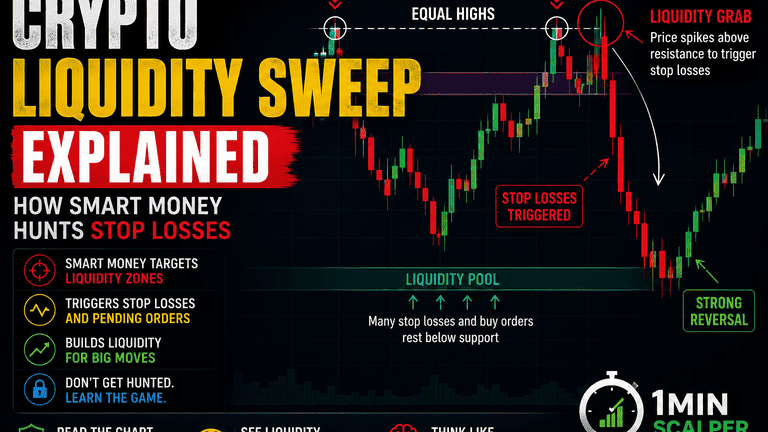
What Is a Liquidity Sweep?
A liquidity sweep happens when price intentionally pushes into a liquidity zone to trigger orders.
Examples:
Above recent highs
Many short traders place stops here.
Below recent lows
Many long traders place stops here.
Above resistance
Breakout traders enter here.
Below support
Breakdown traders enter here.
Once those orders trigger, large players gain liquidity.
Then price often reverses.
That sweep becomes the trap.
This is strongly connected to fake breakouts.
Related guide:
→ How to Spot Fake Breakouts in Crypto
Most fake breakouts begin with a liquidity sweep.
Why Smart Money Hunts Liquidity
Let’s clear something up.
“Smart money” doesn’t mean some evil trader hunting your personal stop.
Markets simply seek liquidity because large orders need counterparties.
Imagine someone wants to buy $50 million of BTC.
Buying aggressively into thin liquidity creates slippage.
Read more about slippage here:
→ Crypto Scalping Slippage Explained
Instead, large players often prefer to buy where panic selling appears.
Where does panic selling happen?
At stop losses.
That creates liquidity.
The 3 Most Common Liquidity Sweeps
1. Sweep Above Equal Highs
This is extremely common.
Chart shows:
- high
- pullback
- second high near same level
Retail traders see breakout potential.
Stops from short sellers also accumulate above.
Price spikes upward.
Stops trigger.
Breakout traders enter.
Then price reverses.
Classic sweep.
2. Sweep Below Equal Lows
Opposite setup.
Price forms support.
Long traders feel safe.
Stops gather below support.
Price dips slightly lower.
Stops trigger.
Panic selling begins.
Then reversal.
Classic stop hunt.
3. Range Sweep
Markets often trade inside ranges.
Range top collects breakout buyers.
Range bottom collects breakdown sellers.
Price frequently sweeps one side before moving toward the other.
Scalpers love these setups.
How to Spot a Liquidity Sweep
Here are my favorite confirmations.
Sudden wick into obvious level
Long wick = first clue.
Especially when level is obvious.
Ask:
Would many traders place stops here?
If yes, attention.
Volume spike
Sweeps often trigger large order flow.
That creates sudden volume.
Volume spike alone is not enough.
But combined with rejection, it becomes powerful.
Fast rejection
This matters most.
A real breakout usually continues.
A sweep often rejects fast.
Example:
BTC breaks above resistance.
Within 2 candles it falls back below.
Big warning.
Session timing
Liquidity sweeps happen often near:
- London open
- New York open
- major economic news
Session timing matters more than many beginners realize.
Useful reading:
→ Best Time for Scalping
→ London Session Guide
High-liquidity sessions create cleaner sweeps.
How I Trade Liquidity Sweeps
My process is simple.
I do NOT blindly trade every sweep.
I wait for confirmation.
Checklist:
✅ obvious liquidity zone
✅ sweep occurs
✅ strong rejection candle
✅ volume confirmation
✅ reclaim of key level
Then I consider entry.
The key is patience.
Beginners enter during sweep.
Professionals often enter after rejection.
Huge difference.
Liquidity Sweeps and Stop Loss Placement
This is where many traders improve dramatically.
Never place stops at obvious levels.
Example:
Bad stop:
Exactly below support.
Better stop:
Beyond likely sweep zone.
If you missed our previous guide, read it here:
→ Best Stop Loss Strategy for 1 Minute Scalping
Once you understand liquidity, stop placement becomes much smarter.
Biggest Beginner Mistake
The biggest mistake is emotional interpretation.
Traders say:
“Market manipulated me.”
That mindset is not useful.
Instead ask:
Where is liquidity?
Who is trapped?
Where must price go to fill orders?
This mindset turns frustration into analysis.
That shift matters.
A lot.
Final Thoughts
One question improved my trading more than almost anything:
Where would I place stops if I were a beginner?
That simple question reveals liquidity.
And liquidity often reveals direction.
The more obvious a level looks, the more careful I become.
Price loves obvious levels.
Not because lines matter.
Because orders matter.
And where orders cluster, opportunity appears.
FAQ
What is a liquidity sweep?
A liquidity sweep happens when price moves into a zone containing many stop losses or orders, triggering them before reversing or continuing.
Is liquidity sweep manipulation?
Not always. Often it is normal market mechanics caused by order flow.
Are liquidity sweeps bullish or bearish?
Both. Sweeps can happen above highs or below lows.
Do whales cause liquidity sweeps?
Large traders can contribute, but sweeps often happen naturally in liquid markets.
Can beginners trade liquidity sweeps?
Yes, but confirmation is important.
Are liquidity sweeps common in Bitcoin?
Very common, especially around major support and resistance.
Are fake breakouts always liquidity sweeps?
Not always, but many fake breakouts include a liquidity grab.
Which timeframe works best?
Liquidity concepts work on all timeframes, but scalpers often use 1m–15m.
How do I avoid being swept?
Avoid obvious stop placement and use structure-based risk management.
Do indicators detect sweeps?
Not directly. Price action and volume are more reliable.